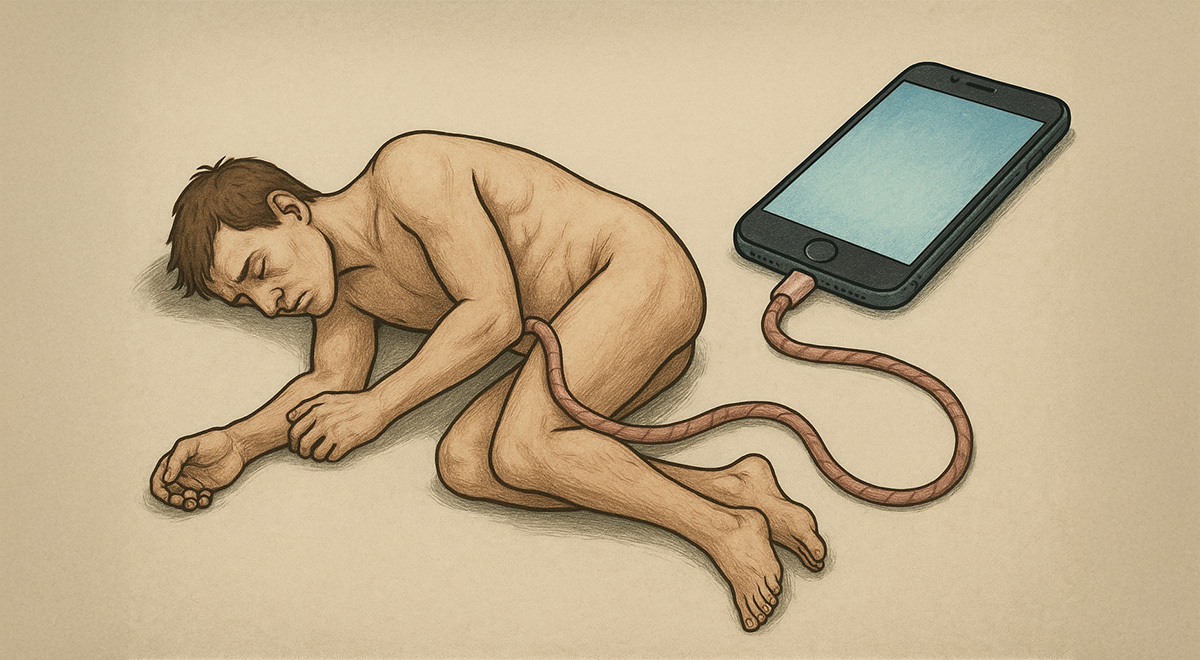
The rotten umbilical cord connecting us to tech: Are you ready to cut it?
The worst has come true. Your phone battery died on a three-hour bus ride to see your parents. Your headphones turned off at the beginning of a long weekend run. Your government sent your country into a social media blackout.
By Cybernews

 Follow us
The worst has come true. Your phone battery died on a three-hour bus ride to see your parents. Your headphones turned off at the beginning of a long weekend run. Your government sent your country into a social media blackout.
For better or worse, technology has become the lifeblood of modern society, and any malfunction may send individuals, companies, or whole markets into distress.
When used sensibly, tech can be a facilitator of scientific research, wellbeing, and individual development, among other things. But, as with food, we are often drawn to less healthy options and end up drowning in endless feeds of brain-rotting content, clutching our phones as if they were magical lifebuoys.
This week, I picked five thought-provoking stories by Cybernews journalists that dissect some of today’s trends and pressing issues.










Seven tech terms to understand the modern discourse
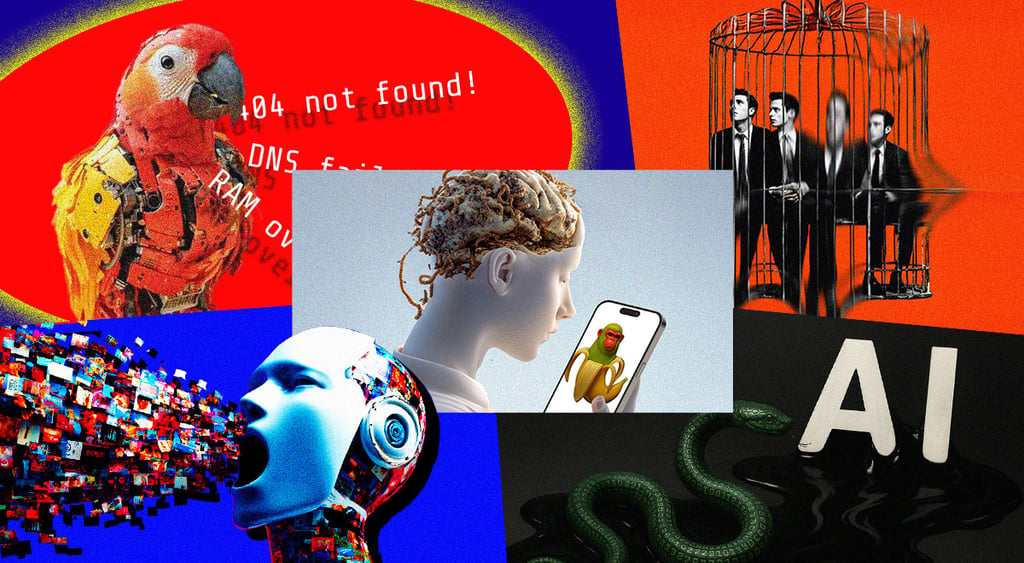
The internet is infested with new-age vocabulary, be it new technical terms to describe innovation or creative slang that people use to hate on tech. Having immersed ourselves deeply in the discourse around tech, we noticed certain terms repeating themselves more often than others and decided to give a brief explanation.
Interestingly, they all have negative connotations, and that might actually be a good thing. Why? Well, if we keep comparing the AI boom to the dot-com bubble, it’s reassuring to know there’s less enthusiasm around AI than there was around the launch of random web businesses. Or, at the very least, there is a more in-depth and weighted discussion that might help cool markets off, even just a little.
Here are the terms we discussed in the article: AI slop, brainrot, snake oil, enshittification, staocastic parrot, clanker, and canaries in the coal mine.
Living the high life

I was about to text some work trivia to one of my colleagues in corporate when I found out that her Slack channel had been deactivated. Apparently, she quit quietly. That’s not how most of us imagine doing it. Don’t we all deserve a good quitting story, in the same way we all deserve a nice proposal story?
Wrong.
I find marriage proposals lame and outdated, at least when one of the parties is unsuspecting. It’s the same with quitting your job. As much as you’d like to shout your truths to your boss’s face and slam the door, what would it achieve? Why burn bridges and shit on someone else’s [hard] work and soul if you’ve already gotten out of the hellhole you think your company is?
It’s also okay to want to do those things. However, take the time to process things and look under the hood. Are you just chasing a story for social media that your followers would go crazy about?
At the same time, if your employer really is exploiting people and you feel injustice, do speak out.
Welcome to first world-problems

Guilty as charged. I wanted to buy something nice for myself after I ran my first marathon a year ago. But I had a really hard time choosing a gift. I could already afford the things I wanted, like earrings or niche perfume, so none of that felt special. I ended up piercing my belly button.
Apparently, I’m not alone with this “problem.” Some people want to do the same – cheer themselves up with a new purchase. But what do you buy when you already have everything you need, and can afford what you don’t need but really want?
Marketers have come up with a solution to this first-world problem. People can now buy a blind box, and the Labubu trend has contributed tremendously to the popularity of these mystery boxes.
Even when I’m scouting for vintage clothing on second-hand online marketplaces, I notice people selling their old stuff in mystery bags. Wouldn’t buying a lottery ticket be at least a little better for the environment?
Social media is a human right

It’s time to move on to the more serious and terrifying events of the past couple of days.
Last Friday, the Nepali government imposed a ban on social media to tamp down political protests. Unfortunately, this only made matters worse, and Gen Z flooded the streets. The protest against the ban turned deadly after police opened fire on mass demonstrations against the social media ban and government corruption.
Yes, social media harms us in many ways and is, to a large extent, a slurry pit of human hatred, marketing tricks, and propaganda feeds. But buried somewhere in there is also our freedom of expression and speech, and you can’t take that away from people. It has become a basic human right.
The bigger question

Scientists still have a long way to go to figure out how the human brain works. If we don’t really understand how we ourselves think, can we even attempt to understand how AI “thinks?”
The uncertainty about how AI models arrive at their decisions has triggered a new wave of debate. Maybe we should stop building complex AI systems until we are able to understand how they “think.”
Questions like this are scary and have no immediate answer. But I know just one thing: it’s not the time to bury our heads in the sand and wait for the AI wave to pass. It won’t. We are only afraid of what we don’t know. So keep learning, and keep reading.
In other news:
- As per recent leaked data, software engineers at Microsoft can earn as much as $340,000 annually, plus various benefits. At Meta, they seem to be getting even bigger bucks. But even if you get half a million dollars, does it make you rich? Especially, given the fact that most of the high-paying jobs are in California, where rent for a decent apartment is as high as $6,000.
- You might not like it, but your WiFi devices are already mapped and used in vast, public location tracking systems without giving you anything in return. This means that attackers can accurately pinpoint where you are from a couch on another continent.
- A Cybernews reader was worried that their private conversations with ChatGPT and Grok models could end up on Google search. Each week, our team selects a pressing and common reader issue and deconstructs it to help readers stay safe online.
- AI isn’t the first thing users look for in a new smartphone, a survey has revealed.
- Cybercriminals are taking sextortion to the next level by employing automated malware to take webcam images of users watching pornography.
