How to use WhatsApp in China using a VPN in 2026
Our in-house cybersecurity experts and journalists, renowned for major reports like The Mother of All Breaches, conduct transparent, unbiased VPN testing and in-depth analysis.
With 750+ articles crafted based on real-world research, we empower readers to make informed purchasing decisions through first-hand expertise.
Learn more

International travel already comes with its fair share of challenges. It gets even more frustrating when essential apps suddenly stop working, which is a common experience in China. Due to the country’s strict internet controls, often called the Great Firewall, several services are restricted, including WhatsApp.
Since 2017, WhatsApp has been inaccessible in China, making it difficult for travelers to stay in touch with friends and family. The good news is that there are reliable ways to regain access, such as using a VPN, GPS override, or an eSIM. In this guide, I walk you through how to access WhatsApp in China.
One of the more unexpected hurdles when traveling abroad is losing access to the apps you rely on daily. In China, this usually happens because tightly regulated internet policies limit platforms that use strong encryption, which can disrupt your usual communication tools.
What a VPN can and cannot do
A VPN may help route your internet traffic through a server outside China, which can allow access to services that are otherwise unavailable on local networks. However, a VPN does not guarantee that WhatsApp will work at all times. Internet restrictions in China change regularly, and VPN connections may be blocked or interrupted without notice.
Whether a VPN works depends on several factors, including the network you're using, the VPN service itself, and current internet controls in China.
Can you access WhatsApp in China without a VPN?
In some cases, yes. If you're using international roaming through your home mobile carrier, your traffic may be routed through your carrier's network instead of the local Chinese internet, allowing WhatsApp to work without a VPN.
Some international eSIM providers may also route mobile data outside mainland China, meaning WhatsApp and other blocked services can sometimes be accessed without a VPN. However, this varies by provider, destination, and network configuration, so it's not guaranteed. Before you travel, check your carrier's or eSIM provider's documentation to see whether services like WhatsApp are expected to work in China.
If neither international roaming nor your mobile data provider offers this type of routing, a VPN may be one option to try.
VPN use is regulated in China, and restrictions can change over time. Before using a VPN, make sure you understand and comply with all applicable local laws and regulations. Even if a VPN has worked previously, there is no guarantee it will connect or continue working during your visit.
How to choose a VPN for WhatsApp in China
Finding a VPN that reliably works in China is difficult because the service needs to meet several criteria. Besides, it’s always a hit or miss situation. Users report that VPNs that used to work before suddenly stop working completely. Here’s a glimpse at some of the areas you should pay attention to when considering VPNs for China:
- Features for bypassing online censorship. A suitable VPN for China must have multiple tools for tackling the Great Firewall. Effective features include obfuscation, double VPN, Tor over VPN, IP rotation, GPS override, and numerous tunneling protocols.
- Trustworthy security fundamentals. Besides specialized features for curbing network restrictions, a worthwhile VPN should cover the basics, too. So, it should have a kill switch, strong encryption, and DNS leak protection.
- Vast server fleet. You’ll have better connection speeds and content unblocking results if the VPN has numerous servers worldwide. Crucially, the provider should have plenty of options around China if you want excellent connection performance while traveling there.
- Swift connection speeds. The fastest VPNs offer a combination of modern tunneling protocols and many servers to ensure customers can have optimal connections in various circumstances. Even so, it’s worth checking recent speed testing data to see if a particular VPN provider is fast enough for you.
- Good device compatibility. It’s vital to pick a VPN that offers intuitive and easy-to-use apps for the devices you use frequently. Most VPNs have software for popular desktop and mobile operating systems, but double-checking the specifics is always a good idea.
- Reasonable price. The best VPNs for WhatsApp come in various price points, meaning you will likely find a practical option for China within your budget. Even better, you can usually use a free trial or money-back guarantee to test the VPN before subscribing.
- Availability. Most of the VPNs that are accessible all over the world are not accessible in China. If you are traveling there, make sure to download the app before your trip.

How to use WhatsApp in China with a VPN
Getting started with a VPN and WhatsApp in China is a straightforward 5-step process. Below, I describe each step in detail so you know how to stay connected using WhatsApp while traveling in China.
Step 1. Choose a VPN service
First, you must choose an effective VPN that can easily circumvent the Great Firewall of China. I recommend NordVPN since it performed well in our tests and is pretty affordable. You should subscribe to a long-term plan to get the best prices, although the 3-day NordVPN free trial is also an option if your trip to China is short.
Step 2. Download the VPN app
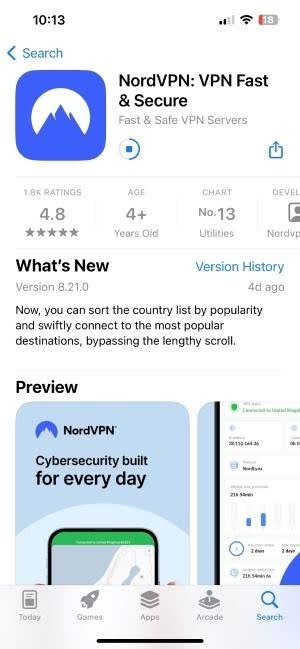
Once you've picked a suitable VPN service, you must download the VPN app on your device. I suggest doing this before heading to your destination because most VPN websites are unavailable in China. Laptop users can download the VPN app directly from the provider’s website, while smartphone users should utilize their app store.
Step 3. Enable the VPN’s security features
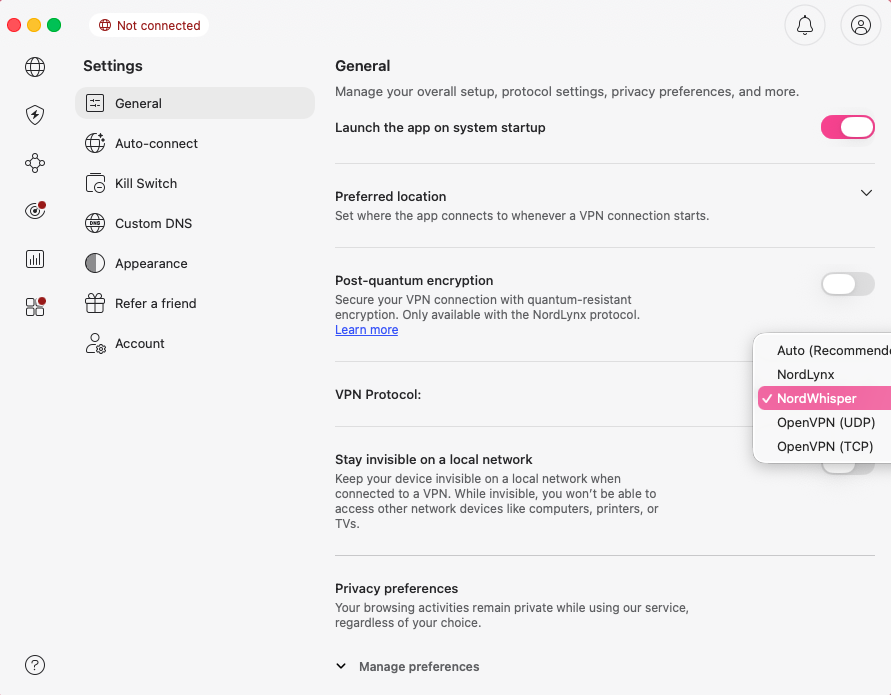
The Great Firewall is a significant obstacle for many VPNs, meaning you’ll have to enable your provider’s various security features to have a fighting chance. With NordVPN, your options include connecting to a special server category like obfuscated, double VPN, or Onion over VPN. Alternatively, you can use the NordWhisper tunneling protocol, which is made specifically for bypassing network restrictions. Many VPNs have similar tools, albeit with different names.
Step 4. Connect to a VPN server
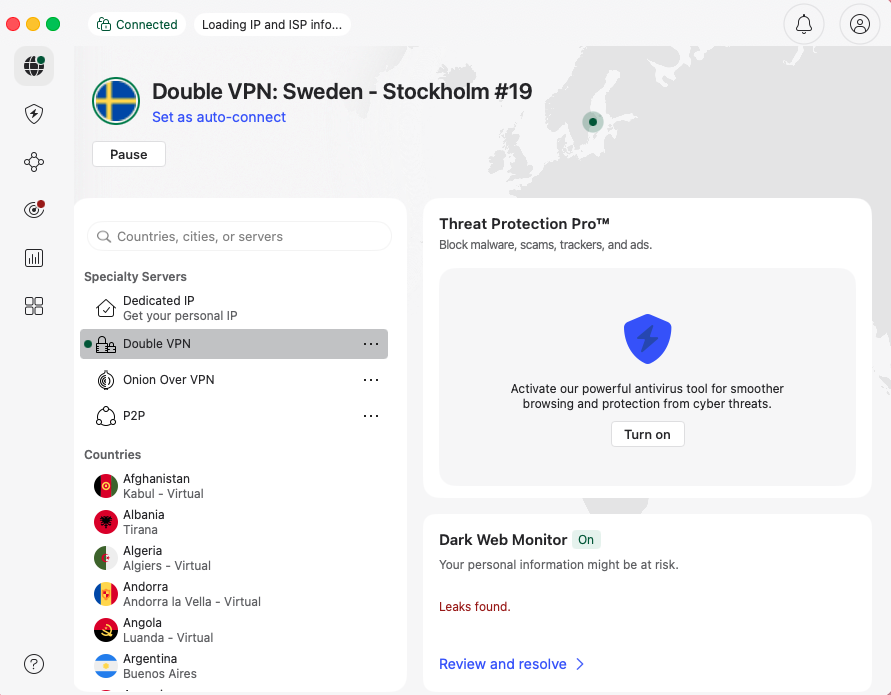
Once the app is configured, all that remains is to connect to a suitable VPN server. You should connect to servers near China to get the best possible connection speeds while using WhatsApp. Alternatively, you can also choose any country you like if you want to unblock another service that is geographically restricted to a specific region. However, note that regular servers might not be as effective at bypassing the Great Firewall.
Step 5. Open WhatsApp and start messaging
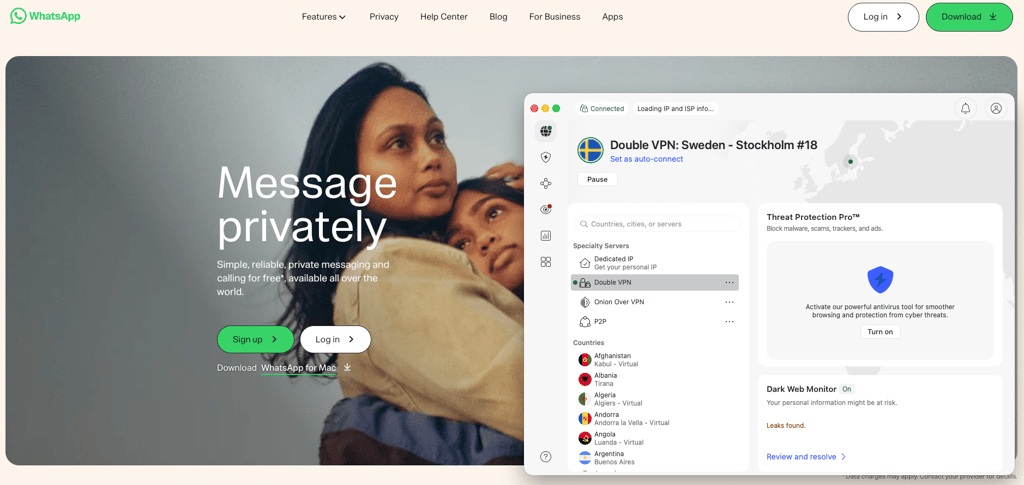
Finally, you can download and install WhatsApp on your device once China’s restrictions no longer hold you back. If you were savvy enough to do that before entering China, then all you really have to do now is open the app and use it to your heart’s content.
WhatsApp not working in China with VPN: 5 easy fixes
As mentioned before, the Great Firewall of China is a difficult challenge that most VPNs might struggle with. This could lead to WhatsApp not working even when you’re connected to a VPN. Luckily, you can try a few easy fixes if something isn’t working. Here’s what I suggest:
- Switch servers. Sometimes the simplest solution is all that’s necessary. The first server you connected to might not work because it’s overcrowded, or its IP address is flagged. Try a different server in the same country or a different region.
- Enable a different tunneling protocol. Some VPN protocols are better suited for bypassing online restrictions, such as NordVPN’s NordWhisper. Switching between protocols to see what works in your specific scenario is a good idea.
- Check for updates. Ensure your VPN and WhatsApp apps are up to date to bypass the latest online censorship. Also, check for updates for your device’s operating system.
- Contact customer support. You should reach out to your VPN provider’s customer support representatives if you’re tired of troubleshooting these issues yourself. They’ll may be able to suggest what works and what doesn’t. Top-quality providers like NordVPN offer 24/7 live chat for easy problem resolution, while others only have email communication.
- Try another VPN service. If nothing works, your only recourse is to try another VPN for China. Many services offer free trials and money-back guarantees for testing them without commitment. Additionally, it’s good practice to have two VPNs available when traveling to China to have options to cycle between them. However, I understand that this might be excessive for some users.
Why is WhatsApp blocked in China?
WhatsApp is blocked in China due to the government’s strict control over internet communications. Authorities enforce heavy censorship through the so-called Great Firewall, which restricts access to foreign platforms that cannot be monitored or regulated locally.
One of the main reasons for the ban is WhatsApp’s end-to-end encryption. While that’s great for privacy, it also means messages can’t be monitored by authorities. The same applies to other platforms like Facebook, Instagram, Twitter, and YouTube, which are also restricted.
Instead, the government promotes domestic apps like WeChat that comply with local laws and allow content monitoring. As a result, WhatsApp has been largely inaccessible in China since 2017, especially for sending messages, media, and making calls without workarounds like VPNs.
Alternatives to using a VPN to access WhatsApp in China
Although VPNs are the best way to bypass China’s restrictions on WhatsApp, it’s a good idea to be familiar with alternative methods of unblocking the messaging service. After all, not everyone is willing to subscribe to a premium VPN for the best results. Plus, having multiple tools at your disposal means you’ll have something to fall back on if your VPN doesn’t work. So, let’s look at what those alternatives are:
- Tor Browser. The Tor Browser is one of the most popular ways to bypass online censorship worldwide for free. It’s a special web browser that routes your traffic through multiple encrypted nodes to protect your online security and anonymity. It’s open-source and free to use, although its connection speeds can be slow compared to VPNs.
- International eSIM. Using an international eSIM is a reliable but costly way to bypass the Great Firewall. A foreign eSIM will connect to networks outside of China, which aren’t subject to the country’s restrictions. An international eSIM service like Saily worked the best when we tested it in restricted regions.
- Proxy servers. Proxy servers are similar to VPNs since they reroute your traffic through an intermediary. However, they don’t encrypt your traffic, thus making them less effective at bypassing the Great Firewall and less secure in general. There are some exceptions, such as Shadowsocks proxies, but those are sometimes included with VPN subscriptions.
- Shadowsocks. This is a fairly effective encrypted proxy that is sometimes used to bypass online censorship. It’s open-source and customizable, but requires technical knowledge to set up.
Is it safe to use a VPN in China?
Whether VPN use is safe in China depends on a few key factors.
Firstly, VPNs aren’t outright banned in China. Instead, they are heavily regulated, and only state-approved services can legally operate in the country. Unsurprisingly, a VPN that’s approved by China’s government most likely doesn’t have your privacy in mind. Instead, its sole purpose is to enable companies to create secure networks for their work needs. This means that many consumer VPNs like NordVPN and ExpressVPN are technically illegal and restricted in China.
For example, border control could decide to check your phone for VPN apps and ask you to delete them. The situation in China changes constantly, so be sure to do your own research based on your travel plans and typical online activities.
In conclusion, foreigners using VPNs in China have to worry about their VPN not working. Meanwhile, Chinese citizens could face severe repercussions if the government deems their VPN use illegal.
Improve your privacy
VPNs aren’t the perfect solution to online privacy, meaning you must take a few extra steps to protect your privacy when browsing the web. It isn’t strictly necessary to do these things, but they can make a huge difference in keeping your identity secure. Here’s what I suggest:
- Make anonymous accounts. The best way to prevent tracking is to ensure all your online accounts have as little PII (personally identifiable information) as possible. This means you shouldn’t input your real name into WhatsApp. Alternatively, have a separate account that doesn’t use your real name.
- Use incognito mode. Most browsers have incognito mode, in which all your browsing cookies and data are deleted after each session. This approach will ensure that others won’t know what sites you visit frequently. However, keep in mind that incognito only limits local browser history and does not hide activity from websites, networks, or ISPs.
- Choose privacy-friendly alternatives. Products from major companies like Google, Microsoft, and Facebook collect vast amounts of data about their users, undermining their privacy. When possible, pick privacy-friendly alternatives to popular browsers, search engines, apps, and other services.
Why do you need a VPN to access WhatsApp in China?
China restricts access to WhatsApp through the Great Firewall. Because of that, the app can't connect to WhatsApp when you're using a local internet network in mainland China.
When this happens, WhatsApp may remain on "Connecting…", messages may fail to send, or voice and video calls may not go through. Unlike many streaming services, WhatsApp doesn't usually display a dedicated geo-restriction message; instead, it just doesn’t connect.
A VPN can help with one part of this issue. It can encrypt your internet traffic and route it through a server outside mainland China. This may allow WhatsApp to reach its servers if your VPN connection works reliably.
For example, NordVPN offers a new protocol called NordWhisper. If you're using NordVPN in China, it's worth trying this protocol if other ones fail to connect. Unlike traditional VPN protocols, NordWhisper uses web tunnel technology that makes VPN traffic resemble ordinary web traffic, which may make it more difficult for some network filters to identify and block.
However, it's important to understand what a VPN doesn't do or simply can’t do. It doesn't guarantee access or ensure that every VPN will work in China. Internet restrictions change frequently, and some VPN connections may be detected or blocked.
| VPN for WhatsApp in China | What it requires | Can a VPN help? |
| Reach WhatsApp's servers | IP address that isn't blocked | ✅ Yes |
| Keep a stable connection | A VPN that continues working despite changes to internet censorship | Sometimes, no VPN can guarantee reliable access at all times. |
| Bypass internet censorship | VPN traffic that isn't detected or blocked by local filtering systems | Success depends on the VPN and the current restrictions in China. |
| Avoid ISP or local network monitoring | Encryption between your device and the VPN server | ✅ Yes |
| Access WhatsApp if your VPN connection is blocked | Alternative connection methods, such as international roaming or an eSIM that routes traffic outside mainland China | ❌ No |
| Change the GPS location | Complicated technology like GPS override | Sometimes, if the VPN has the required technology |
When you don't need a VPN
You don’t need a VPN in every situation. Depending on how you're connected, WhatsApp may already work without one.
You may not need a VPN if:
- you're using international roaming from your home mobile carrier and your traffic isn't routed through China's restricted internet infrastructure
- you're using an international travel eSIM whose provider routes traffic outside mainland China
- you're outside mainland China, such as in regions where WhatsApp isn't restricted
If you're using a local Chinese Wi-Fi network or SIM card and WhatsApp isn't connecting, a VPN may help establish access, but it isn't guaranteed to work.
Final thoughts
WhatsApp is restricted in mainland China due to the country's internet censorship. Because of that, people may find that messages, calls, and media sharing don't work when connected to local networks.
A VPN may help restore access by routing your internet traffic through a server outside mainland China, but it isn't a guaranteed solution. China's internet restrictions change frequently, and VPN connections that work today may stop working without notice.
If you plan to rely on WhatsApp during your trip, it's a good idea to install and configure your VPN before arriving in China and have an alternative connection method, such as international roaming or a travel eSIM, as a backup.
Based on our latest testing, NordVPN was one of the more reliable options we evaluated for use in China. However, no VPN can guarantee uninterrupted access, so it's worth considering multiple providers if staying connected is essential during your trip.
FAQ
Can you use WhatsApp in China?
WhatsApp was blocked in China in September 2017, but a VPN may help you access it by changing your IP address.
Does WhatsApp work in Hong Kong?
Yes, WhatsApp works in Hong Kong because there are no formal restrictions on the service.
What are the alternatives to WhatsApp in China?
If you can’t get WhatsApp working in China, you might be interested in local options instead. However, Chinese apps like WeChat do not offer you as much privacy.
Why is WhatsApp illegal in China?
WhatsApp is owned by Facebook, which is also blocked in China. Since Facebook is unwilling to give the Chinese government permission to moderate and censor messages on WhatsApp, it blocked it. In general, the Chinese government seeks to control the information intake of its citizens. However, you may be able to unblock WhatsApp with a VPN, like NordVPN.
How can I get WhatsApp to work in China?
If you are traveling to China, it’s best to download a VPN and set it up before arriving. Then, use a reliable VPN to connect to a different country outside China. Without the VPN, messages and calls may not work because the app is blocked nationwide.
Is it illegal for a foreigner to use a VPN in China?
Before traveling to China or using a VPN in China, make sure to familiarize yourself with local laws and regulations. It is not illegal to use a VPN in China, but most of the VPNs available there are government-approved and issued.
How to use VPN with WhatsApp?
To use a VPN with WhatsApp, you need to first install a VPN, then connect to a server in another country, and open WhatsApp as usual. The VPN reroutes your traffic, allowing messages and calls to function normally even in restricted regions.
Where else is WhatsApp banned?
WhatsApp is also banned in some other countries, such as North Korea, Syria, Iran, the UAE, and Cuba. Depending on political issues in each country, these countries might eventually allow it, and others might block it.