European Google alternatives urge governments to back €50m search index
A Franco-German search initiative claims it could build European search indexes within a year at a cost of about €50 million, as part of a push to reduce Europe’s reliance on US-dominated big tech infrastructure.
Image by Cybernews

 Follow us
A Franco-German search initiative claims it could build European search indexes within a year at a cost of about €50 million, as part of a push to reduce Europe’s reliance on US-dominated big tech infrastructure.
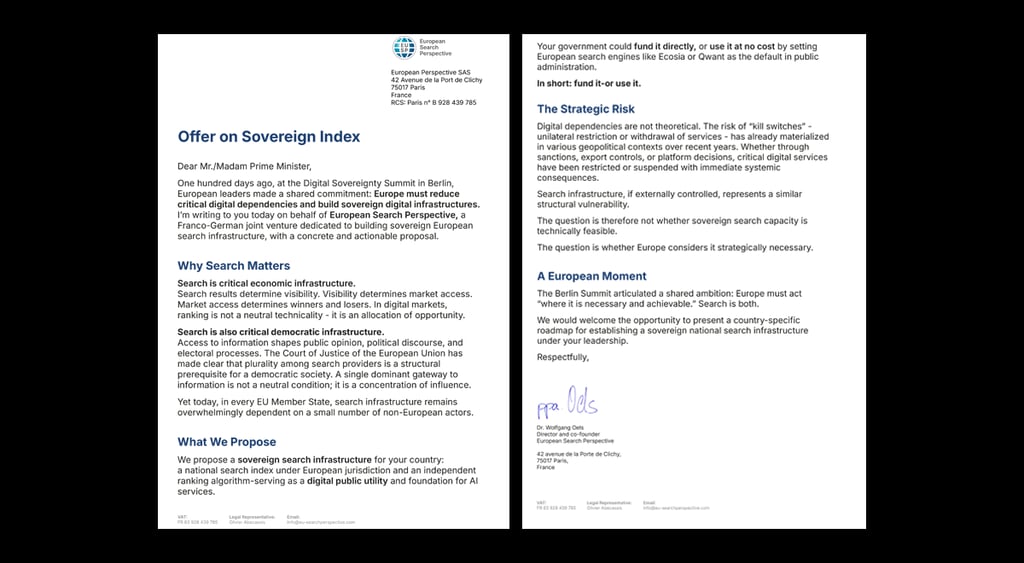
In an open letter sent to heads of all 27 EU member states, the European Search Perspective (EUSP) said that European countries should build web indexes hosted entirely within the EU to reduce reliance on US and Russian search infrastructure.
The EUSP is a joint venture between two European search engines: Germany’s Ecosia (which famously uses ad revenue to fund tree planting projects) and France’s Qwant – the default engine for the French administration.
European cloud giant OVH, Qwant’s owner, is also listed as an infrastructure partner on the new project.











The group says the project could build national or language-specific search indexes within “about a year” and estimates that the cost of a full web index covering all languages is “around €50 million.”
A search index – the constantly updated database of web pages that search engines and many AI systems rely on – has, according to the initiative’s director, become “critical digital infrastructure” for both economies and AI systems.
Digital sovereign concerns
The initiative’s director, Wolfgang Oels – also Ecosia’s COO– set out the case for a sovereign European search index to a small cohort of journalists via the German-native conference platform OpenTalk on Tuesday.
Oels argued that 99.5% of search queries in Europe are answered using search technology from just three companies: two based in the US (Google, Bing) and one in Russia (Yandex).
According to Oels, without access to those search systems, in the event of a geopolitical event, for instance, European governments could lose critical capabilities and the digital economy would be disrupted.
Oels pointed to Denmark “investing heavily in their digital sovereignty,” to prevent such a “kill switch” scenario following US claims over Greenland.
The threat, he added, was not the stuff of fiction as the Trump administration uses big tech “as a lever to enforce its own goals.”
Oels also referenced recent reports about US embassies in Europe that were ordered to fight against European data sovereignty initiatives, as well as reports that “Ukraine was pressured to give away its minerals in order to keep Starlink access.”
Building a European web index
The European Search Perspective (EUSP), which launched last year, aims to build an independent web index for Europe.
An open letter, published on Thursday, marks the first time the initiative has publicly called on national governments across the EU to support the development of sovereign search infrastructure.
The EUSP’s aim is to create a privacy-focused search index hosted entirely in Europe to reduce reliance on US big tech infrastructure.
The index would power search results for both Ecosia and Qwant, while also providing APIs that could be used by other European technology companies.

Those services would include a search API (a document index that allows web pages to be retrieved swiftly) and AI-based systems capable of generating summaries of information found on the web.
“We’ve already indexed the French web, and we are launching the German answers this spring,” Oels informed journalists.
The initiative argues that search indexes are becoming increasingly important for AI systems.
Many AI tools rely on web search and document retrieval systems to provide context and ground their answers in up-to-date information.
“Web indexes are not only the basis for search engines but also for many AI services. Wherever you need web browsing, you need a search API and a document API to ground that on,” Oels said.
“We are ready to offer this for free”
Unlike many digital infrastructure proposals, the initiative is not asking governments for money.
Instead, Ecosia and Qwant say the infrastructure would be financed through advertising revenue if governments across Europe switched to European search engines as their default search providers.
Oels claimed that this would generate enough traffic to make the system financially sustainable.
“We are ready to offer this for free if public administrations set us as the default search engine."European Search Perspective director and Ecosia COO Wolfgang Oels
That additional market share would generate advertising revenue that could pay for building and operating the search infrastructure, he added.
“Switching search engines takes less than 30 minutes and doesn’t cost anything,” he claimed, adding that organizations that have already adopted Ecosia as their default provider include Deutsche Telekom, DHL, HSBC, and SAP.
Oels declined to say whether the initiative had faced direct backlash from US companies or officials, describing the issue as “sensitive.”
However, he pointed to a publicly reported 1,200% increase in Microsoft’s search API pricing several years ago as an example of the vulnerabilities European search providers face when relying on external infrastructure.
Technical challenges
While Oels said a comprehensive index for an individual country or language could be built within a year, building and maintaining large-scale search indexes is no mean feat.
Search systems must constantly crawl and update vast numbers of websites while filtering spam, search engine manipulation, fake content, and malware that could degrade the results.
How will index deal with the problem of rankings, ensuring that poor results do not end up at the top, whether through manipulation or simply error?

“We use a wide range of semantic and user feedback-based methods, and at the moment this is working quite well,” he told Cybernews.
“Also, unlike Google or MSFT, we will allow our B2B customers to change the results. This enables even greater diversity of providers.”
Despite the technical complexity, Oels believes the technology is manageable.
Strong password generator

For a full Europe-wide web index, the project estimates costs of around €50 million, although indexes covering specific languages or countries would vary in cost, depending, among other factors, on how many people speak the language.
However, Oels adds that a comprehensive country or language-specific index could be built out “within a year.”
To reduce costs, the project has developed its own hardware and focuses on indexing the most relevant parts of the web rather than attempting to store every page.
“If you look at the web, most of it is a graveyard,” said Oels.
“By taking those documents out and not recording them, we reduce cost and latency.”
Behemoth in the room
Oels argues the biggest obstacle to building a European search ecosystem is not technology but market access. Search markets are dominated by Google, making it difficult for alternatives to gain users.
Even large competitors have struggled – Oels says Microsoft’s search engine Bing holds 12% of the desktop search market in Europe but only 0.4% on mobile, which is less than Ecosia’s.
The search leader gave the example of privacy-focused, ad-free search engine Neeva, built by former Google engineers with $70m in venture capital, which ultimately shut down after not attracting enough users.
“They had a fantastic product, but they were not able to have enough people switch their defaults,” he said.
That’s why EUSP is urging governments to address the problem by adopting European search engines as their default options, he concluded.
“States need to become anchor customers for the solutions they want to see existing in Europe,” he urged, adding that the sovereign web index would be “ a piece of freedom that cannot be taken away and cannot be manipulated.”
The move comes as users across Europe look to ditch their US providers and swap lists of European alternatives. Europe is also set to launch its own social media platform,W, as an alternative to X, formally known as Twitter.
Unlock more exclusive Cybernews content on YouTube.