Here’s what might be getting in the way of the AI revolution
We might be travelling in a perpetually moving train, with a selected few destined to prosper while the masses suffer, sparking revolutions that are bound to happen.

Snowpiercer. By Cybernews

 Follow us
We might be travelling in a perpetually moving train, with a selected few destined to prosper while the masses suffer, sparking revolutions that are bound to happen.
Just like aboard the Snowpiercer, it’s all a mess. Artificial intelligence has somehow become a magic lifebuoy. Without it, it seems, businesses can’t survive, workers can’t land a job, and you are left to rot in the Middle Ages.
Agentic AI, an autonomous system capable of making decisions and executing tasks without human intervention, is bringing real, measurable changes.
The AI Snowpiercer could be sped up even more, if not for one huge obstacle.






“Significant skills gaps are emerging, requiring IT professionals to upskill in areas such as AI development, machine learning, data science, and prompt engineering,” a report by a staffing firm, ManpowerGroup, reads.
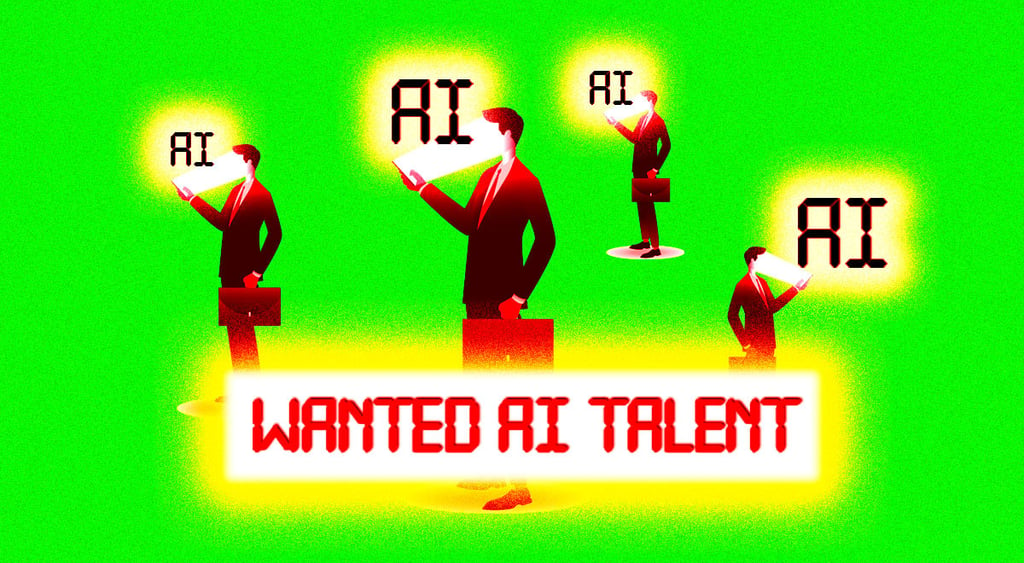
Competition for AI talent is heating up both in the US and Europe. Anthropic is seeking senior AI talent, with annual salaries ranging from £225,000 to £340,000 ($303,000 to $458,000).
According to Sifted, a number of US-based companies are seeking talent in Europe, where people can be hired for “a fraction of the cost” of what they would pay in Silicon Valley.
We need to figure out how to train people to work and understand AI quickly, and keep the current talent happy. Developers often vibe coding against their will, and these are not the times when “Arbeit Macht Frei.”

These are the times when people have a choice to walk away. Companies across the US are forcing workers to use AI tools, and frustrated professionals aren’t putting up with it.
“I expect that within 2-5 years, I'll be delivering pizzas for a living, not because I can’t hack it anymore, just because reviewing and fixing AI-generated code does not appeal to me as a career,” one coder said.
As we pointed out, it’s a story of the many. IT workers suddenly dream of alpaca farms and would rather deliver pizzas than keep fixing AI’s shoddy output just to please management. IT pros often feel like bystanders to their own jobs.
This is also where the next big cybersecurity crisis is emerging. From hackers using AI to accelerate cyberattacks, LLMs spitting out garbage code, and employees entrusting sensitive corporate data to random chatbots, we are already feeling the tremors of an earthquake that is almost certain to trigger a tsunami, leaving many struggling to survive on their own.

News in brief:
- Cybernews researchers discovered critical vulnerabilities affecting Lenovo’s implementation of its AI chatbot, Lena, powered by OpenAI’s GPT-4. The flaws could potentially lead to data theft and customer support system compromise and serve as a jumpboard for lateral movement within the company’s network.
- A 60-year-old US man was hospitalised with rare bromide toxicity after following ChatGPT’s dietary advice, in a case doctors say highlights the dangers of relying on AI for health guidance.
- Hundreds of online games vanish every year, leaving players powerless as purchases disappear overnight. Ross Scott’s Stop Killing Games campaign is fighting for digital ownership before it’s too late.
- Starbucks has told South Korean remote workers to stop turning the coffee chain into an office space after people began bringing bulky tech items into the stores.
- Moscow's digital communications watchdog said it has restricted WhatsApp and Telegram users in Russia from making voice and video calls using the messaging platforms.