Flexberry AI Assistant
Last updated: 18 December 2025
What is Flexberry AI Assistant?
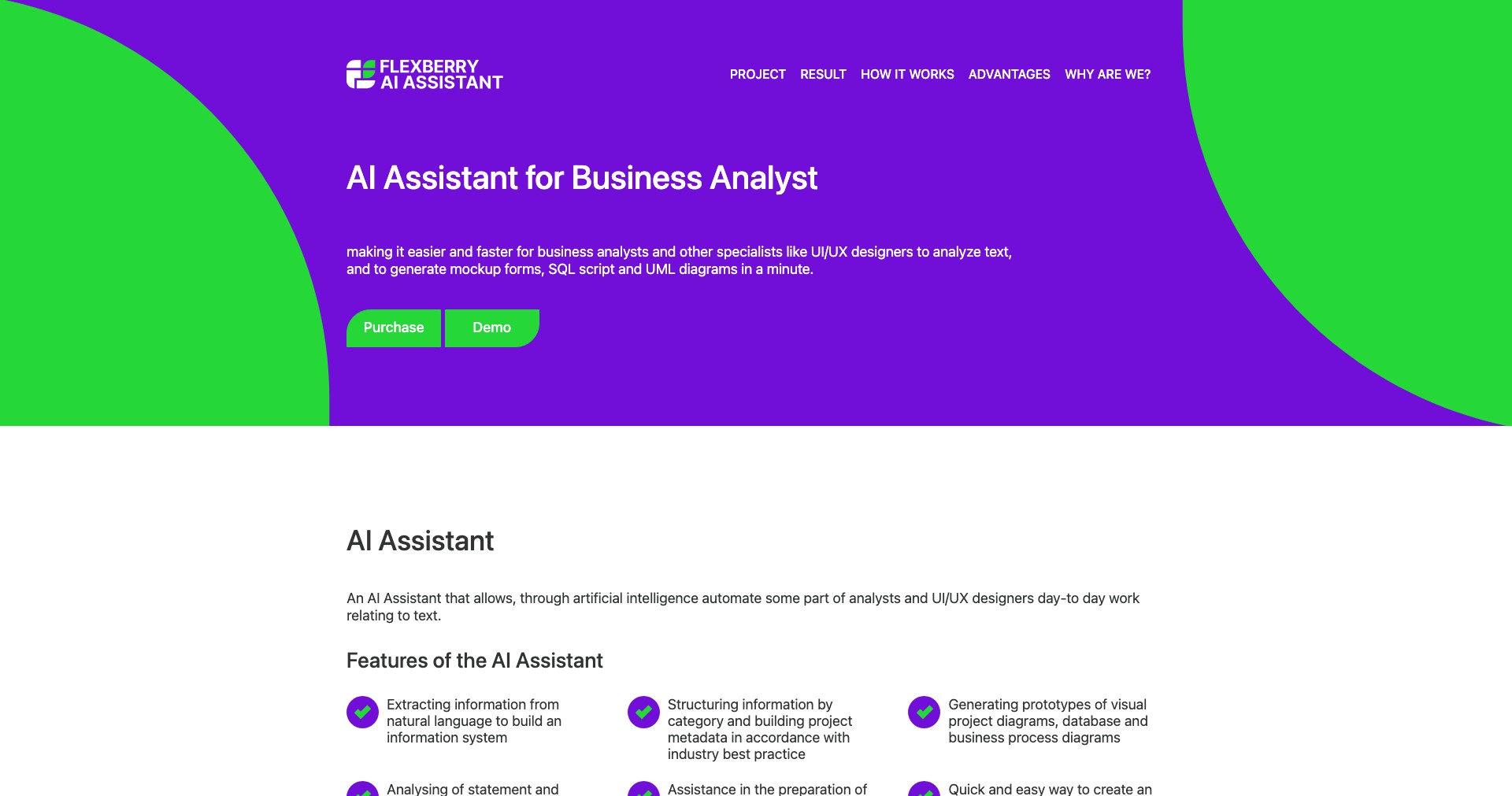
Flexberry AI Assistant is an intelligent solution created by Flexberry, a leading platform in low-code development and requirements engineering. The AI Assistant works as a productivity booster for professionals engaged in software development projects, addressing critical stages like requirements gathering, analysis, documentation, and design.
Operating as an add-on to the Flexberry ecosystem, this assistant leverages AI-driven models to interpret user prompts and business requirements, automatically generating text artifacts, user stories, and modeling diagrams. This streamlining proves highly valuable to business analysts, developers, and project managers aiming for faster and more accurate project kickoffs.
Key Features:
-
Requirements Text Generation:
Automatically creates detailed software requirements based on user prompts, dramatically reducing manual effort and ensuring completeness. -
User Stories & Use Case Automation:
Generates structured user stories and use case descriptions from plain language inputs, facilitating agile project documentation. -
Visual Model Diagrams:
Produces UML, BPMN, or ER-diagrams from requirements or user commands, supporting model-driven development and improving understanding among stakeholders. -
Natural Language Interface:
Offers a chat-like interface where users can provide complex project details in plain English, and the assistant translates them into formal documents or models. -
Integration with Flexberry Platform:
Seamlessly integrates within the Flexberry development environment, enabling automated requirements-to-code workflows and project traceability.
What makes Flexberry AI Assistant unique?
What sets Flexberry AI Assistant apart is its deep integration into the model-driven development lifecycle through the Flexberry platform. Unlike standalone AI chatbots, it’s tailored for enterprise-grade requirements engineering and automates not just document creation, but also the transformation of business logic into executable models.
Additionally, the assistant’s ability to convert plain language into technical artifacts—like diagrams and structured requirements—bridges the gap between non-technical stakeholders and developers. This reduces miscommunication, accelerates project onboarding, and minimizes errors at the design stage.
Pros and Cons
Who is using Flexberry AI Assistant?
Business Analysts: Business analysts benefit from automated generation of requirement specifications, user stories, and diagrams—streamlining their workflow and reducing manual writing.
Developers & Technical Architects: Developers and architects use the assistant to translate high-level requirements into actionable technical models, expediting project setup and reducing errors.
Project Managers: Project managers leverage the assistant to quickly produce documentation, estimates, and traceability reports, thus aligning teams and stakeholders faster.
Evolution and Improvements
Since launch, Flexberry AI Assistant has added support for more modeling standards, expanded its language processing capabilities, and improved integration with external tools and repositories.
The assistant now supports multi-language prompts, wider diagram types (such as BPMN and ER-diagrams), and provides better contextual awareness when generating requirements and documentation.
Continuous feedback from Flexberry’s user community has led to richer feature sets, such as smart error detection in input prompts and customizable artifact templates.
Pricing
| Plan | Price | About |
| Freemium | Free | Basic feature set with limited outputs, ideal for exploring capabilities. |
| Professional Subscription | Contact sales | Includes advanced features, integrations, and priority support, designed for teams and enterprises. |
Verdict
Flexberry AI Assistant stands out as a specialized AI-powered support tool for agile and model-driven software development processes, especially within the Flexberry ecosystem. Its main strength lies in automating documentation and modeling, effectively bridging non-technical and technical team communications.
While its tight coupling with Flexberry limits broader industry adoption, for organizations leveraging this platform, the assistant offers measurable productivity gains. Early adopters in business analysis and development roles will find it a valuable asset, though those outside the ecosystem may look to more general purpose AI tools.


