Notion AI review: is it worth your money?
Being behind major reports like The Mother of All Breaches and RockYou2024, our in-house cybersecurity experts and journalists provide unbiased, real-world testing and in-depth analysis.
We maintain complete transparency by openly sharing our testing methodologies with our audience.
Learn more

Often, modern workplaces require us to be everything at once: managers, copywriters, designers, and assistants. While it’s possible to master all these skills, having a helping hand can save hours of valuable time. Notion AI is a built-in assistant that lives inside Notion’s powerful workspace, helping you brainstorm ideas, write documents, summarize notes, and manage tasks without ever leaving the app.
In this Notion AI review, I set out to see just how capable this assistant really is. I tested and compared its features, performance, ease of use, and learning curve for new users. Let’s take a closer look at what Notion AI can actually do – and whether it’s truly a game-changer for your day-to-day work.
Quick overview: who Notion AI is for
- Best for: teams who already use Notion and want faster document creation, wikis, and answers
- Great for: knowledge bases, project documentation, and organized workflows
- Not ideal for: users who only need a simple AI writer for standalone content
Pros and cons of Notion AI
Suggested score: 4.3/5
What is Notion AI?
Notion AI is your built-in AI partner, ready to step in and help with productivity and writing tasks right inside the Notion workspace. Its main goal is to help you work faster and smarter by generating content, summarizing notes, and automating routine tasks. In short, the time-consuming stuff.
Because Notion AI works directly within the Notion app, there’s no need to switch between multiple platforms to get things done. It’s designed for individuals and teams who already use Notion to manage projects, write documentation, or organize workflows. Here are the key areas where Notion AI can do the heavy lifting and make your workday smoother:
- Summarize long texts or meeting notes
- Generate blog posts, reports, or emails
- Brainstorm ideas or outlines for projects
- Translate documents into different languages
- Fix grammar, spelling, and tone
- Rewrite or simplify existing text
- Extract key takeaways from databases or pages
To put it simply, Notion AI is a smart assistant that helps with writing, organization, and project management in your workspace.
Notion AI features reviewed
Notion AI isn’t just a writing solution. It can help you with creating, organizing, and managing your content where you already do your work, rather than pulling from the open web. You can even connect it to tools like Google Drive and Slack if you want to expand its reach. Now, let’s look at the main Notion AI features and how they can help you make your day-to-day work easier.
Q&A across your workspace (Ask Notion)
Ask Notion lets you query your entire workspace and get answers from pages, wikis, databases, and supported integrations like Google Drive or Slack. Every response includes links back to the original source, making it easy to trace information. I found it very convenient for “Where is X?” or “Summarize Y” type questions.
For my first test, I prompted Ask Notion to find the rating for Interstellar in my Movie & TV Show database. As I expected, Notion AI pulled the rating directly from my workspace database and provided it along with a link to the database entry. This is actually very helpful to quickly verify the given information and explore more details.
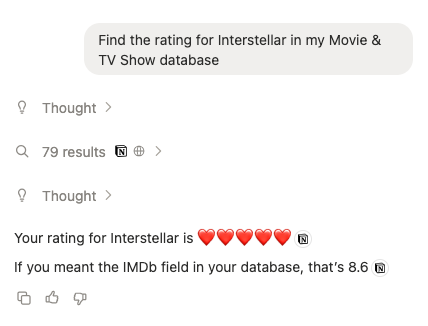
Additionally, Notion AI becomes even more powerful when you connect it to the tools you already use, like Slack, Google Drive, or GitHub. These integrations let the Q&A feature pull answers from a wider range of sources, helping you find exactly what you need without switching between apps. Privacy controls are built in, so you can choose which pages, databases, or spaces are included – or keep sensitive ones excluded from AI search.
Note: Ask Notion retrieves information from your content in the Notion workspace. It doesn’t perform open web searches.
AI writing and editing inside docs
Searching for answers in your workspace is only the starting point of Notion AI’s capabilities. It can also come in handy while creating, improving, and organizing your workspace content. And that’s all without switching multiple platforms – and even leaving your docs.
To be precise, you can generate new text, rewrite or simplify existing content, summarize long notes, translate documents, change tone, create outlines, and even extract action items from meeting notes. With inline citations and links to relevant workspace pages, you can trace sources and keep everything organized.
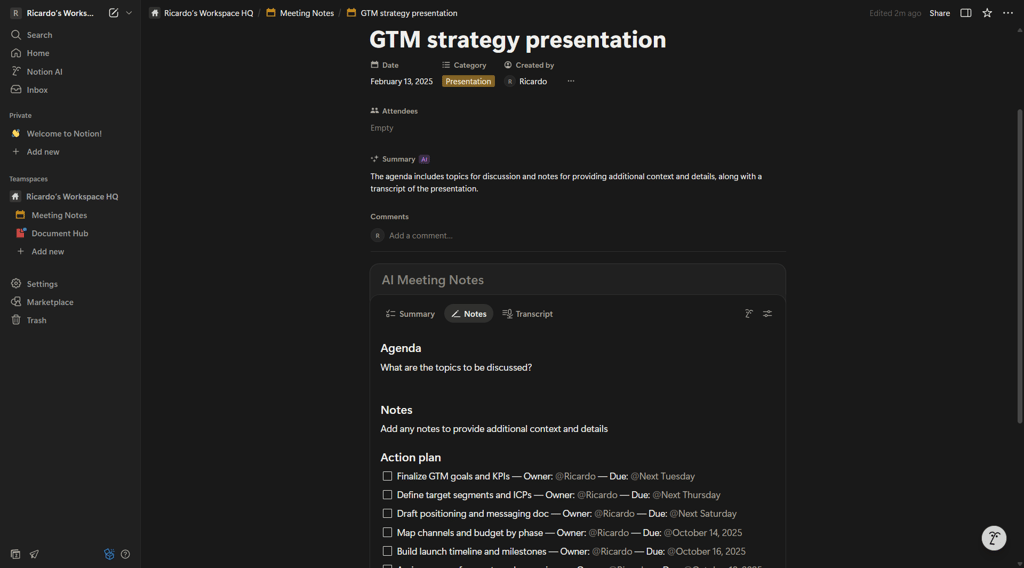
In one of my tests, I provided the tool with my test meeting notes, which included a basic summary of the topics covered during the meetings. I then asked to create a checklist of tasks from one of the meetings listed in notes – the GTM strategy presentation.
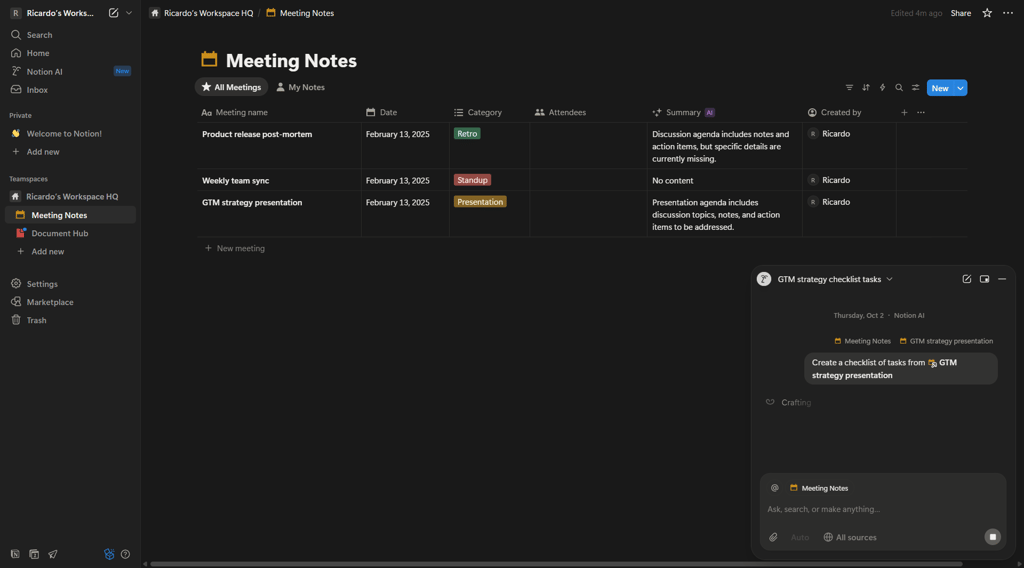
After a few seconds of processing, the tool generated a detailed checklist of tasks based on my test meeting. I found the suggested tasks surprisingly relevant, and with a bit of fine-tuning, they could easily serve as a real follow-up plan. Overall, I was genuinely impressed by how effectively Notion AI handles task extraction and turns meeting notes into something immediately usable.
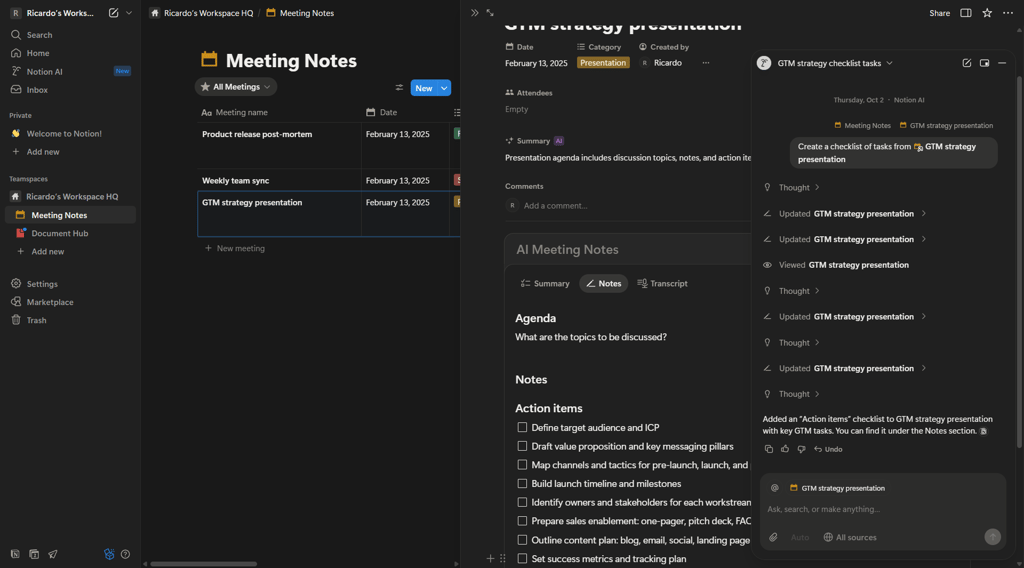
In my next test, I gave Notion AI a more advanced, multi-layered task with three specific steps to complete. I asked it to transform the same GTM strategy presentation notes into a structured action plan, assigning task owners, setting due dates, and organizing everything in a clear, followable format.
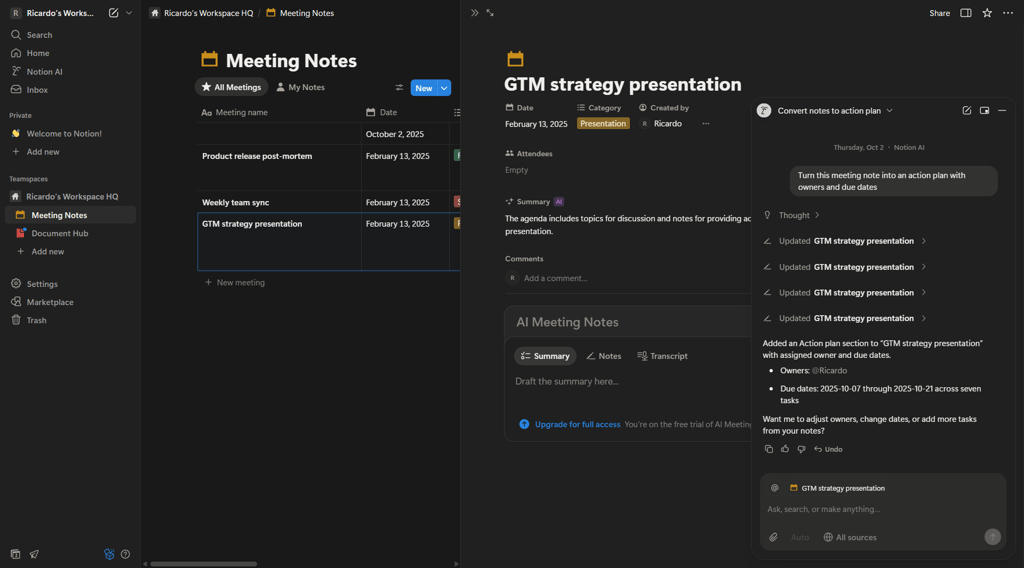
Since this was only a test task, Notion AI didn’t have a lot of information to work with. Still, I was satisfied with how well it handled the job – creating a detailed action plan, assigning an owner named Richardo to all the tasks, and even adding due dates.
Just like with the previous task, I had to review everything it produced to make sure it matched what I had in mind. Some tweaks were necessary, but I found that the more context and details I provided, the better and more accurate the results became. My takeaway is that you shouldn’t hold back – feed Notion AI as much information as possible, and it can really make your planning easier.
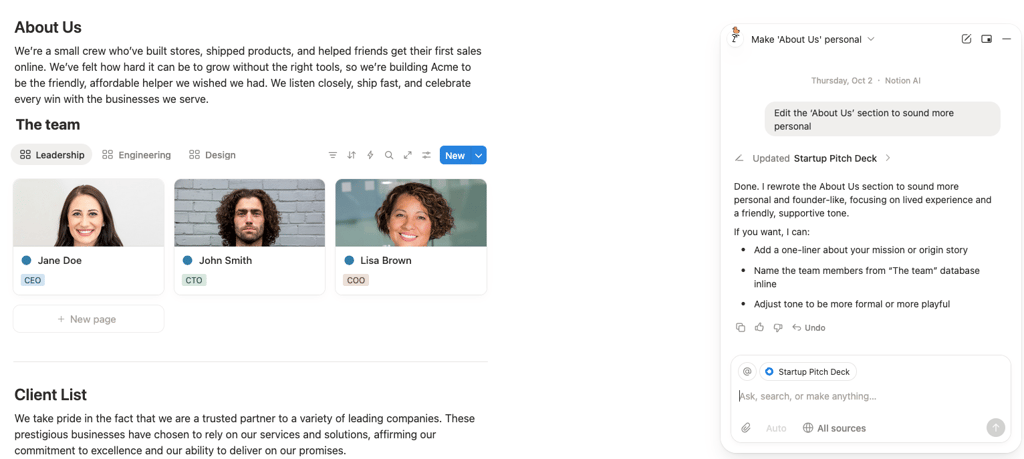
Lastly, I requested Notion AI to edit the existing About Us section to make it sound more personal. The tool immediately recognized the tone I was aiming for – focusing on lived experience, warmth, and a friendly, supportive voice – and rewrote the section in the right direction.
What I really appreciated was that it didn’t just stop there. Notion AI offered practical suggestions for further improvement, like adding a one-liner about my mission or origin story, or pulling team members’ names directly from the Team database inline. These aren’t groundbreaking marketing strategies, of course, just small tips, but I found that they can really make a difference in making the text feel more authentic and engaging.
Overall, it felt like having a thoughtful assistant helping me refine my content without taking over the creative process.
AI Autofill for databases
Another feature that I appreciated is smart automation for databases. It can help you save time on repetitive tasks while keeping your workspace organized. Autofill can automatically classify entries, summarize content, extract tags, generate descriptions, suggest priorities, and even draft follow-ups. This is particularly useful for triaging support tickets, organizing user feedback, or keeping sales notes up to date.
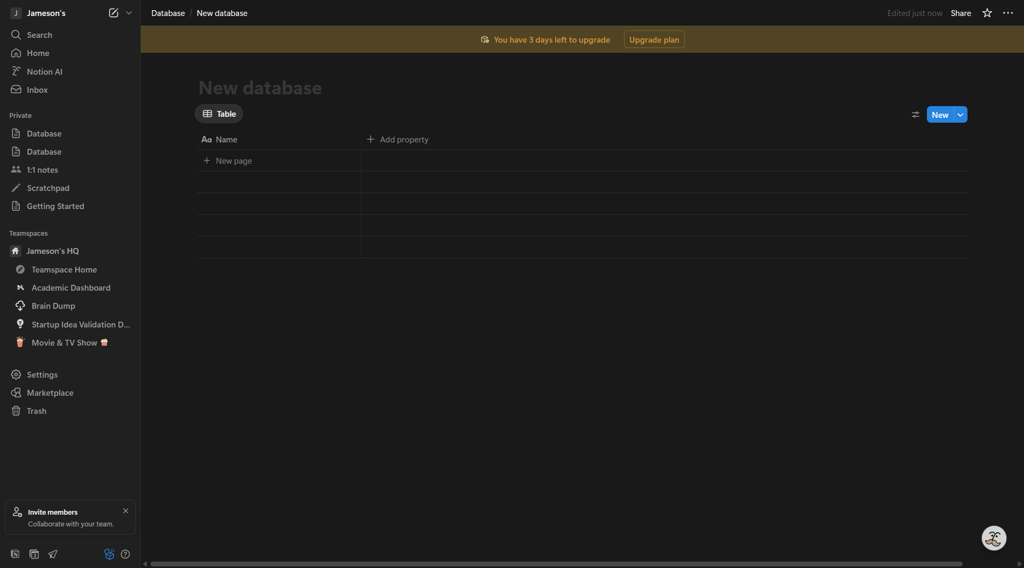
To test this feature’s capabilities, I asked Notion AI to sort through all the user feedback available in my Notion workspace. To give you a clearer picture of how this AI assistant handled the task, I set up a new, empty database and let Notion AI populate it.
Notion AI handled the setup pretty well. The tool created a clean, well-structured database with all the essentials – priority, status, assignee, customer name, date, and category – already in place. It not only listed entries, but also automatically tagged and prioritized them in a way that actually made sense.
For instance, a pricing-related suggestion was marked Low priority, while a bug report was correctly flagged as High and set In Progress. Even the feature request got its own UI/UX tag and a Medium priority label. It felt like a solid starting point for a real feedback system, needing only a few personal touches to fit my workflow perfectly.

Complex problem solving and project planning
Notion AI can also be a practical ally for teams tackling complex projects. Its combination of AI-assisted writing and database capabilities can help you brainstorm, plan, and iterate without getting bogged down in endless spreadsheets. From my own experience, having AI suggest ideas or draft outlines feels like having a teammate who’s always ready to tackle the messy first draft.
In my testing, I asked Notion AI a complex problem-solving task – analyze the AI-powered reporting launch plan and identify any major logical inconsistencies and ambiguities. The results were impressively thorough. Notion AI quickly identified critical issues with timeline constraints, undefined success metrics, vague quality standards, and accountability gaps.
What's particularly valuable is how it didn't just flag problems but offered specific improvements – like clarifying what reporting enabled actually means and how generation error rates should be measured. This level of analytical capability goes far beyond simple writing assistance, demonstrating how Notion AI can function as a project management consultant that helps teams identify blind spots before they become roadblocks.
The AI doesn't just react to what you've written. It actively identifies structural weaknesses and ambiguities that might otherwise go unnoticed until they cause problems downstream.

Notion Calendar and Sites with AI
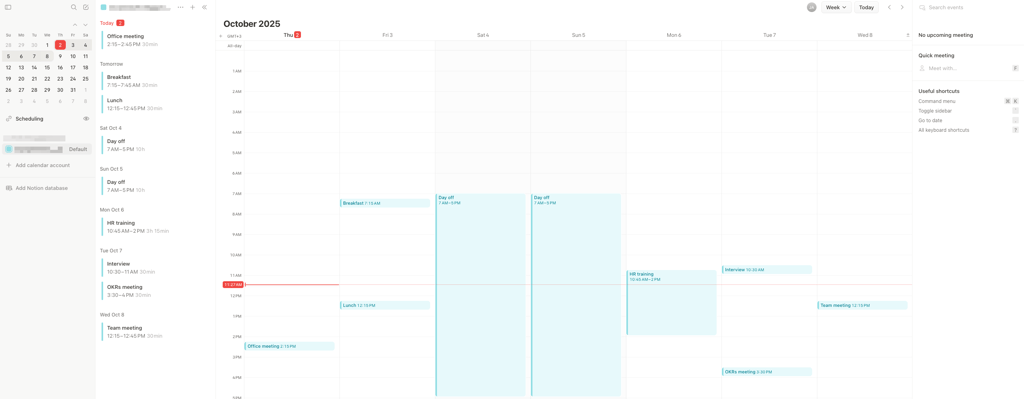
Notion AI also makes scheduling and sharing easier. With Notion Calendar, I got quick summaries of my upcoming events, pulled in meeting notes, and generated full agendas. Notion Sites takes it a step further, letting you publish pages as simple, shareable websites, while AI helps polish the copy before it goes live.
When I tested it, prepping a project kickoff took me just a few minutes. I asked Notion AI to create a project kickoff agenda with roles, objectives, and key risks, and it generated a clear, ready-to-use outline. A few quick edits later, I had something I could confidently share with my team.
Notion AI pricing and plans
Notion AI is available as an add-on to Notion’s productivity platform, and its pricing structure depends on the type of plan you’re subscribed to. Below, I break down how Notion AI is priced across different tiers and what features you get with each option:
| Plan | Price (per user, billed annually) | Notion features | Notion AI features |
| Free | $0.00/month | Basic forms and sites, calendar, email, and databases, including subtasks, dependencies, and custom properties | A trial of Notion AI, including document generation and database autofill |
| Plus | $10.00/month | Unlimited collaborative blocks, file uploads, and charts, custom forms and sites, and basic integrations | A trial of Notion AI, including document generation and database autofill |
| Business | $20.00/month | SAML SSO, granular database permissions, page verification, private teamspaces, conditional form logic, domain verification, and premium integrations | Notion AI Agent, enterprise search, AI meeting notes, and research mode |
| Enterprise | Custom pricing | User provisioning (SCIM), advanced security and controls, audit logs, a customer success manager, security and compliance integrations (DLP, SIEM), domain management, and advanced integrations | Notion AI Agent, enterprise search, AI meeting notes, research mode, and zero data retention with LLM providers |
Is Notion AI good value?
Notion AI offers great value for users who already rely on Notion’s workspace for writing, planning, and collaboration. Its AI tools can help you save tons of time right where you work. However, if you only need a simple chatbot or prefer writing outside Notion, it’s probably not worth the extra cost.
FAQ
Is Notion AI free?
No, Notion AI isn’t free. While Notion offers a free tier for its core productivity tools, it only includes a trial of AI features, such as document generation and database autofill. Full access to Notion AI is available only with a paid subscription or add-on plan.
What are the benefits of Notion AI?
Notion AI helps you work faster by creating content, summarizing notes, and handling repetitive tasks automatically. It also keeps your projects organized with smart databases, research help, and helpful suggestions inside your Notion workspace.
Is Notion AI better than ChatGPT?
No, Notion AI isn’t better than ChatGPT, as they serve different purposes. ChatGPT is best as a basic AI writer, while Notion AI works better for teams, helping create documents, draft notes, and manage projects all in one workspace.