Clever woman exposes Wise scam - scammer loses it
Phishing attacks are becoming more sophisticated by the day, and one recent case that reached the Cybernews newsroom raised serious eyebrows.


 Follow us
Phishing attacks are becoming more sophisticated by the day, and one recent case that reached the Cybernews newsroom raised serious eyebrows.
It all started when the woman, who decided to stay anonymous, received a legitimate-sounding call from a man presenting himself as a Wise support manager. Wise is a well-known fintech company that provides international money transfers and reportedly assists over 15 million active customers globally.
The man’s voice sounded confident and caring. He informed the victim about suspicious scheduled charges and asked whether to authorize them.
“I was suspicious and alert, assessing if I’m not giving any personal data or if they are not asking something personal. It really sounded legit,” the woman said.
And it really did sound real at the beginning, as they had the target's full name, email address, and phone number. To increase their credibility even more, they also shared the first six numbers of the woman’s physical debit card.












This might sound very alarming, like “How did they get my card details?” However, in reality, those digits aren’t that secret.
The first number identifies the card brand, like Visa or Mastercard, and the next few reveal the issuing bank or financial institution. Scammers can easily use this information to target users of a specific bank, making their pitch seem far more convincing.
Since the woman didn’t know what kind of transfers the supposed representative was referring to, he told the victim that her card details might have been stolen. He patiently walked her through the supposed steps to secure her account, suggesting she block or at least freeze her card.
The scammers even offered “free insurance” and additional security features on behalf of Wise.
No one calls from WhatsApp
However, there was a serious catch to the call. The supposed Wise representatives had called via WhatsApp. There’s a simple golden rule – no legitimate financial institution contacts its customers via WhatsApp.
During the talk, another person, supposedly from Wise’s fraud department, took over the call. While it was obvious to her by that time that it was a scam, she became curious about their next move and continued the talk.
It soon became clear that the second fraudster lacked the polish of the first. He sounded nervous as he asked the women to check their Wise accounts for any recipients they didn’t recognize and to report or delete them.“Why does ChatGPT say Wise doesn’t call on WhatsApp?” the woman provoked the fraudster, who lost his temper immediately.
“Why did you go to ChatGPT when I asked you to check your App, why are you not doing what you are asked?!”he raged.
“Ok, this is not nice, and now I think it’s a scam,” the woman responded.
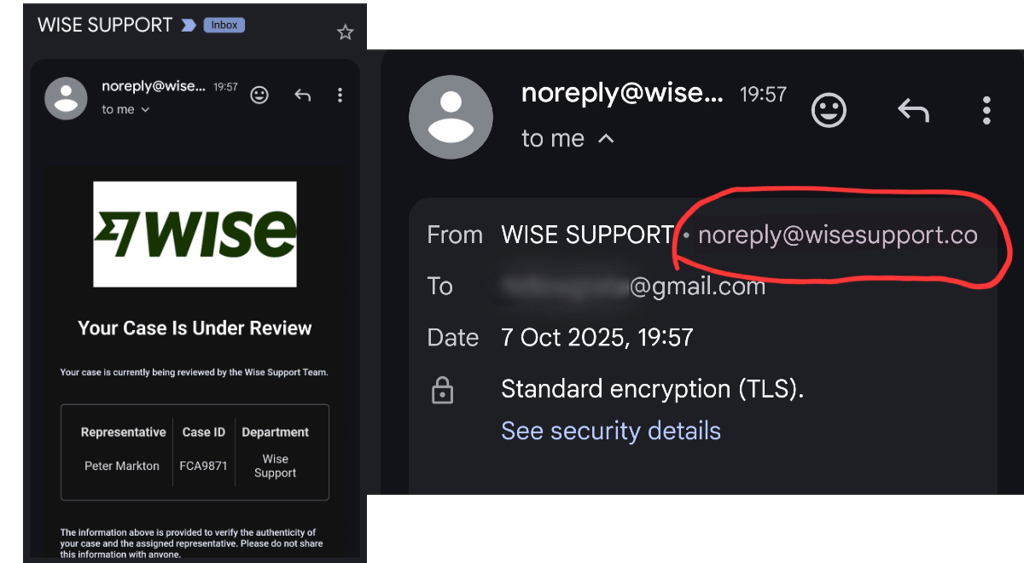
The fraudster promised to send a reference to prove his point. Shortly after, the women received an email appearing to come from Wise’s support team. It claimed that the victim’s case was under review and had been assigned to a representative named Peter Markton.
For all who have Wise accounts, receiving emails with transaction status updates and other important information is very familiar. The phishing email shared with Cybernews looked just like one of those.
However, the main hook was the sender: [email protected]. Real emails from Wise come from the domain @wise.com.
“Nice effort, but I’m not up for scamming today. Your email is obvious,” said the woman to the fraudsters on the call, telling them to “brush up their skills and use them in more meaningful ways to create beauty in this world instead of destruction.”
The scammers got really desperate and started cursing and calling her names.
“Fuck you, [name],” sent the last highly targeted insult to the scammers.
Companies should grasp the importance of data protection
This phishing attempt shared with Cybernews is a stark reminder of why protecting user data is crucial.
Phishers can pull phone numbers from everywhere. Breaches at telecoms, retailers, and other companies can spill millions of numbers onto hacker forums and dump sites, while legitimate data-broker firms openly collect and sell contact lists compiled from public records, web forms, app permissions and purchase histories.
“Scammers commonly use leaked data as a starting point for mass social engineering campaigns,” explained the Cybernews research team.
“It often lets attackers craft a more personalized scam that can look relatively legitimate, because it can include the right info and the right context to create a credible story.“
Our researchers explain that typical signs of most social engineering attacks are any type of urgency cues, like deadlines or threats of losing money, because they make people act quickly and overlook red flags more often.
“From the breached company’s perspective, transparency about leaked data is crucial, because if people are aware that their data may have been exposed, they will be more skeptical if unexpected messages occur, even if they look legitimate on the surface level,” they said.
How to stay safe from phishing attacks
- Avoid posting your number publicly: Don't share it on forums, job boards, or social media
- Use secondary numbers wherever possible: Second phone number apps can help you reduce your phone number exposure.
- Add a carrier PIN code: This protects against unauthorized SIM swaps
- Audit your digital footprint: Regularly check which services have your number and remove it where possible
- Always double-check the email addresses: Some applications help to check email addresses to know if an email is associated with known scams or data breaches.
- Block suspicious numbers: If you get a suspicious call or text, block the number. Both Android and iOS make it easy to block recent callers or texts in just a few taps.
- Watch for phishing texts or suspicious links: Messages can seem like they’re from your bank, delivery services, or government agencies and usually contain urgent language and a shortened link. Never click on unexpected links or respond to messages from unfamiliar numbers. When unsure, go directly to the company’s official site or app. Being aware and cautious will help protect you.
Unlock more exclusive Cybernews content on YouTube.