AI/ML API
Last updated: 16 June 2026
What is AI/ML API?
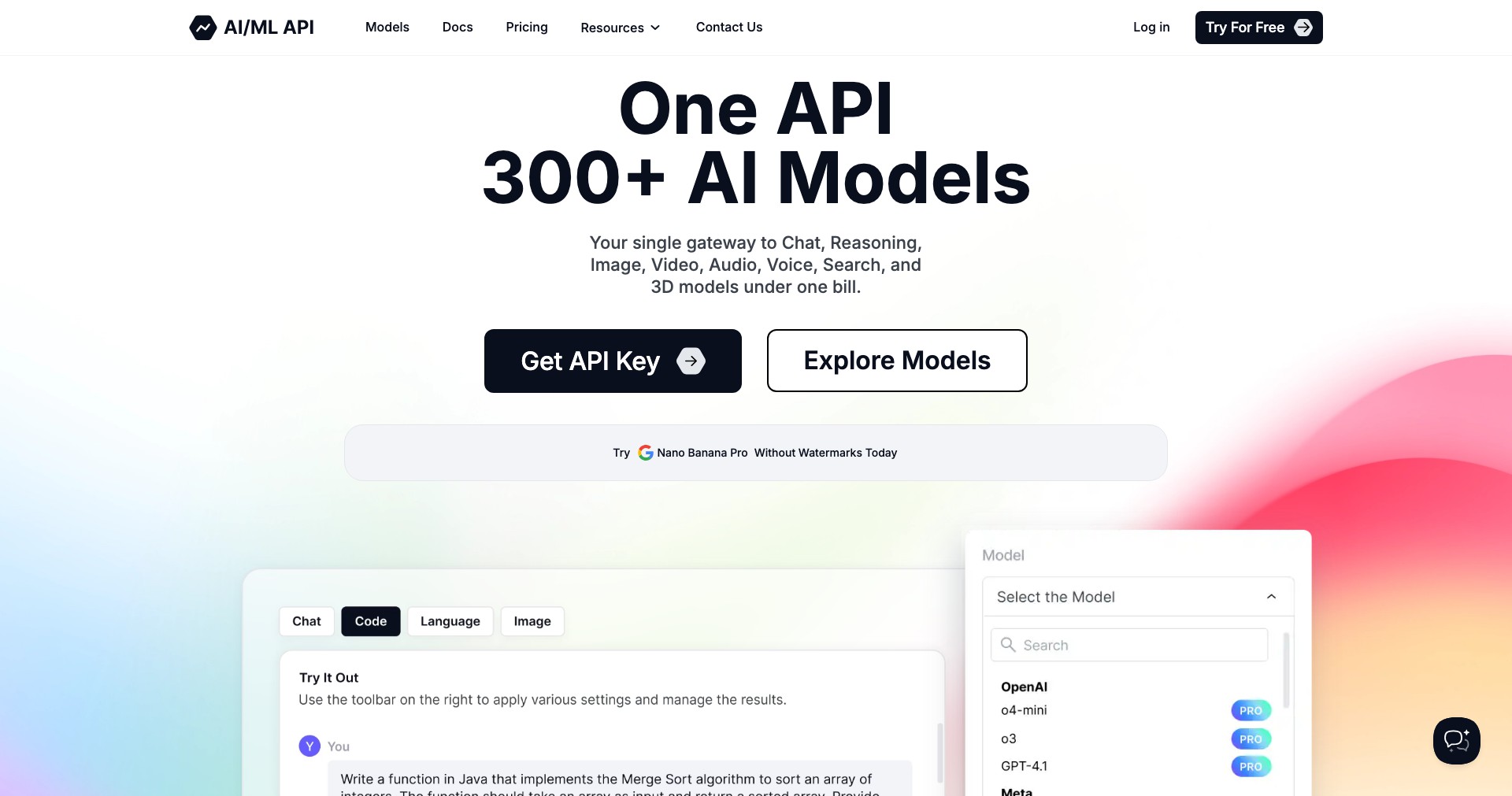
The AI/ML API is a robust tool that bridges the gap between advanced artificial intelligence and real-world business applications. It is delivered as a cloud-based interface, enabling developers to easily incorporate AI functionalities such as natural language processing, image recognition, predictive analytics, and more into their products—without needing in-depth expertise in machine learning algorithms.
By exposing state-of-the-art ML models via simple RESTful endpoints, the API services empower organizations of all sizes to accelerate innovation, reduce R&D costs, and quickly launch scalable AI-powered features. Whether you’re building a chatbot, automating data analysis, or personalizing user experiences, an AI/ML API delivers the capabilities you need with high reliability and efficiency.
Key Features:
-
Pre-trained Model Access:
Provides instant access to advanced, pre-trained ML models for tasks like text analysis, image classification, and speech recognition—enabling rapid deployment of AI features. -
Scalable Cloud Infrastructure:
Runs on secure, elastic cloud servers that auto-scale based on your application's needs, supporting anything from development prototypes to high-traffic production systems. -
Easy API Integration:
Offers clear, well-documented endpoints and SDKs for popular programming languages, streamlining the integration process and reducing development time. -
Custom Model Support:
Allows users to train, upload, or fine-tune their own machine learning models for unique use cases, giving total flexibility for custom AI solutions. -
Robust Security & Compliance:
Implements data protection, encryption, and privacy features to meet industry compliance standards, building trust for enterprise use cases.
What makes AI/ML API unique?
AI/ML API platforms distinguish themselves by combining access to both ready-to-use ML models and the ability to easily deploy custom models. This dual approach enables businesses to start quickly with out-of-the-box solutions, while retaining the flexibility to address niche or proprietary requirements.
Compared with traditional machine learning solutions, these APIs significantly decrease the need for infrastructure management, and handle everything from model hosting to scaling securely. Additionally, leading APIs frequently release updated models, staying at the forefront of AI advancements.
Pros and Cons
Who is using AI/ML API?
Software Developers: Engineers seeking to embed AI-powered capabilities into web, mobile, or enterprise applications benefit from the simple API-driven interface and pre-trained models.
Data Scientists & Analysts: Professionals who want to quickly prototype and deploy predictive analytics without handling the complexity of model hosting or scalability.
Product Managers & Startups: Teams aiming to validate AI-driven features rapidly in their MVPs or products, without the overhead of building a full ML pipeline in-house.
Steady Evolution & Updates
AI/ML APIs have evolved from basic, limited-scope tools to comprehensive platforms supporting a vast array of ML tasks—including text, vision, audio, and tabular data.
Recent updates focus on improved latency, increased throughput, and expanded customization options, empowering users to deploy AI capabilities in production-grade scenarios.
Continuous improvement in model accuracy and regular addition of new pre-trained models ensure that users always have access to the latest in AI innovation.
Pricing
| Plan | Price | About |
| Pay-as-you-go | Varies (e.g., $0.001 to $0.01 per API call) | Charges based on actual usage, suitable for startups and scalable for enterprises. |
| Subscription | $20–$1000+ per month | Offers fixed-rate access for predictable budgeting, often includes higher quotas or premium support. |
| Freemium | Free tier with usage limits | Provides free access with basic quotas to allow testing and experimentation, with paid upgrades available. |
Verdict
AI/ML API platforms excel at democratizing artificial intelligence by making advanced ML capabilities easily accessible and scalable for diverse industries and skill levels. They notably reduce barrier-to-entry for developers, data scientists, and product teams, ensuring speed and efficiency in embedding cutting-edge AI into digital products.
While recurring costs and occasional black-box limitations can be concerns, the advantages—speed, scalability, security, and flexibility—make AI/ML APIs a top choice for organizations wanting to stay innovative without heavy infrastructure investment. Users seeking deep model customization or privacy for highly sensitive data may want to explore hybrid or on-prem solutions.


