Lang.ai
Last updated: 18 December 2025
What is Lang.ai?
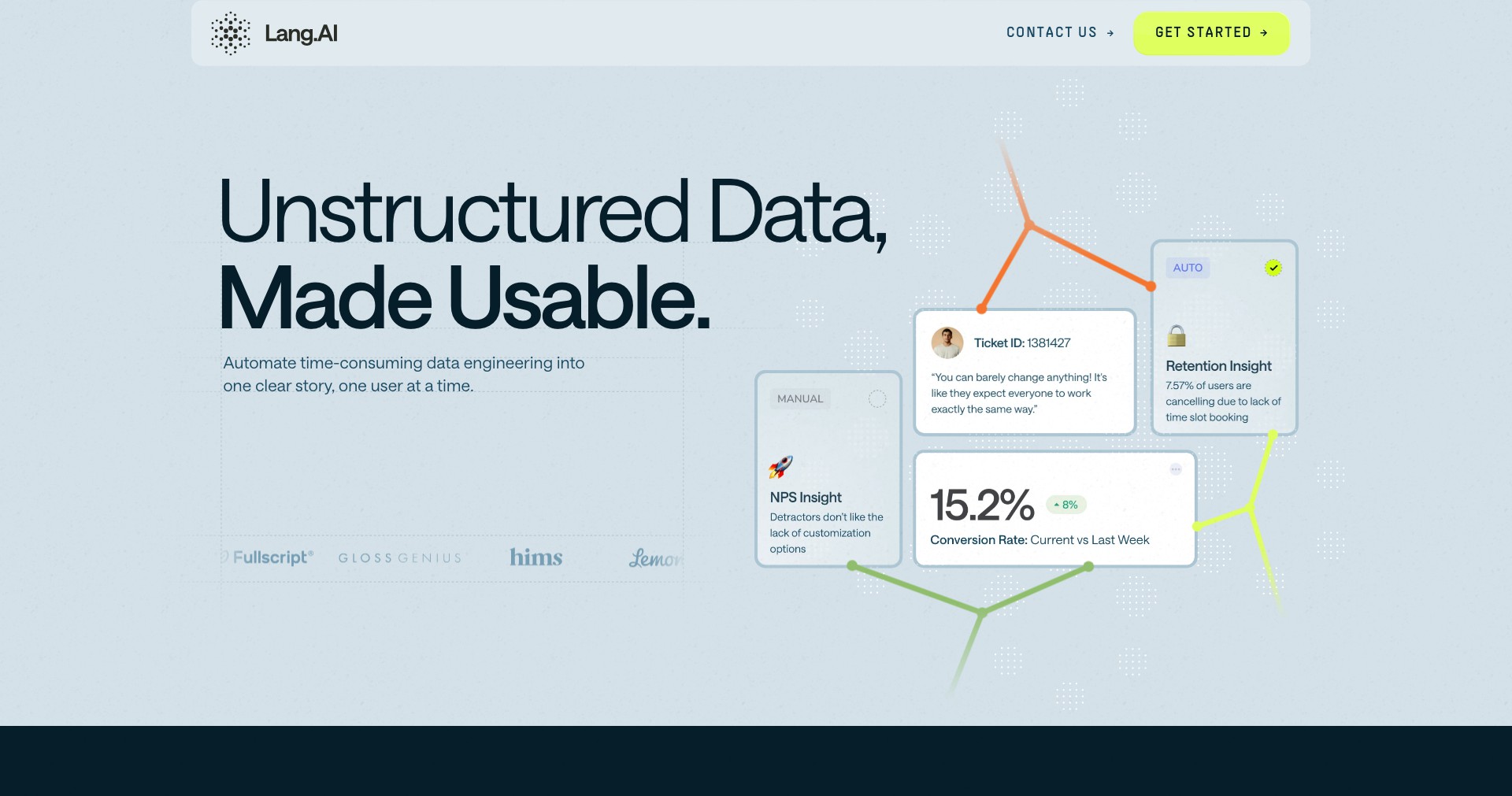
Lang.ai is an AI-powered platform designed to help businesses make sense of vast amounts of unstructured customer feedback, such as support tickets, survey responses, and social media interactions. By using natural language processing, it transforms raw text data into actionable insights without requiring manual tagging or extensive data science expertise.
The no-code approach of Lang.ai enables customer operations, support, and product teams to create custom categories and automate data workflows with ease. This empowers organizations to quickly identify trends, root causes, and customer pain points, thus enhancing decision-making and overall customer experience.
Key Features:
-
No-Code Workflow Builder:
Lang.ai provides an intuitive interface for users to build workflows that automatically categorize and analyze textual data. This eliminates the need for programming skills, enabling anyone on the team to create complex automations. -
Customizable AI Taxonomies:
Users can create and modify semantic categories to fit their business needs. This system learns from your data, creating tailored taxonomies that evolve as more information is processed. -
Real-Time Data Analysis:
The platform analyzes customer feedback in real time, allowing organizations to respond quickly to new trends, issues, or customer sentiments as they emerge. -
Seamless Integrations:
Lang.ai integrates with popular CRMs, ticketing systems, and data warehouses (such as Zendesk, Salesforce, Intercom, and more), streamlining workflows and ensuring data consistency across your tech stack. -
Robust Reporting and Insights:
The platform offers comprehensive dashboards and reporting tools for tracking performance, common themes, and key drivers of customer satisfaction or dissatisfaction, equipping teams with the data needed for informed action.
What makes Lang.ai unique?
Lang.ai stands out due to its genuinely no-code setup, which democratizes AI-powered text analysis for non-technical business users—a rarity in the natural language analytics space. Unlike traditional solutions that require heavy IT or data science involvement, Lang.ai empowers support and operations teams themselves to manage and iterate on models and taxonomies.
Its approach to customizable semantic taxonomies and continuous learning from domain-specific data ensures greater relevance and accuracy than out-of-the-box text analytics solutions. The seamless integration with leading customer service and CRM tools further sets it apart, creating a fluid pipeline from raw feedback to actionable business insights.
Pros and Cons
Who is using Lang.ai?
Customer Experience Teams: Teams focused on improving customer satisfaction can swiftly identify pain points and root causes, thanks to automated feedback categorization and actionable insights.
Support Operations Managers: Those overseeing support operations benefit from real-time analysis and reporting, allowing them to allocate resources efficiently and monitor emerging support issues.
Product Managers and Analysts: Product teams leverage Lang.ai’s data-driven workflows to discover feature requests and bugs hidden within qualitative feedback, helping prioritize roadmap decisions.
Evolution and Improvements
Since its initial launch, Lang.ai has continually enhanced its core AI models to improve the accuracy and relevance of automatic categorization, especially with domain-specific language.
The platform has expanded its integration capabilities, connecting with a broader range of customer experience and data platforms to fit seamlessly into enterprise workflows.
User experience has been a focus area, with updates centered around simplifying the no-code builder and making dashboard visualizations more user-friendly to non-technical stakeholders.
Pricing
| Plan | Price | About |
| Enterprise Custom Pricing | Contact for quote | Custom plans and pricing based on business size and needs; tailored onboarding and support are included. |
Verdict
Lang.ai delivers exceptional value for enterprises looking to automate and extract deep insights from customer feedback at scale—without relying on IT or data science teams. Its powerful, no-code interface and flexible taxonomy settings are particularly beneficial for customer-centric organizations.
While smaller firms may find entry costs high and require a certain data volume to realize the full benefit, larger businesses and teams dealing with high feedback volumes will see a strong ROI via enhanced efficiency, faster decision-making, and improved customer experiences.


