Antivirus market report 2026: changes in user behavior and new trends


In 2026, antivirus software remains widely used across the US, but its role is changing as security habits evolve. Now, more users rely on the operating system's built-in protection and combine it with security tools like VPNs and password managers. This opens the question: how is antivirus usage actually changing, and what is replacing it?
To understand this, Cybernews conducted its second annual antivirus usage study among over 1,000 American internet users, comparing the findings with those from 2025. Our research discusses key trends in antivirus adoption, including shifts toward built-in security tools and the growing use of other security tools like VPNs and password managers. What's more, it examines how users perceive cyber risks and how their attitudes evolve year over year.
- Mobile security remains a weak spot as fewer American users invest in protecting their mobiles (18%) than in computer protection (41%).
- Compared with the 2025 survey data, in 2026 the number of US residents who experienced cybercrime grew by 14%.
- For the second year in a row, Norton and McAfee remain top choices as third-party antivirus solutions. However, AVG, which was mentioned in the 2025 report, didn’t make it to the 2026 report.
- More people who, in addition to the built-in security tools, choose to use third-party antivirus software, invest in paid over free alternatives for better protection of their mobile and desktop devices.
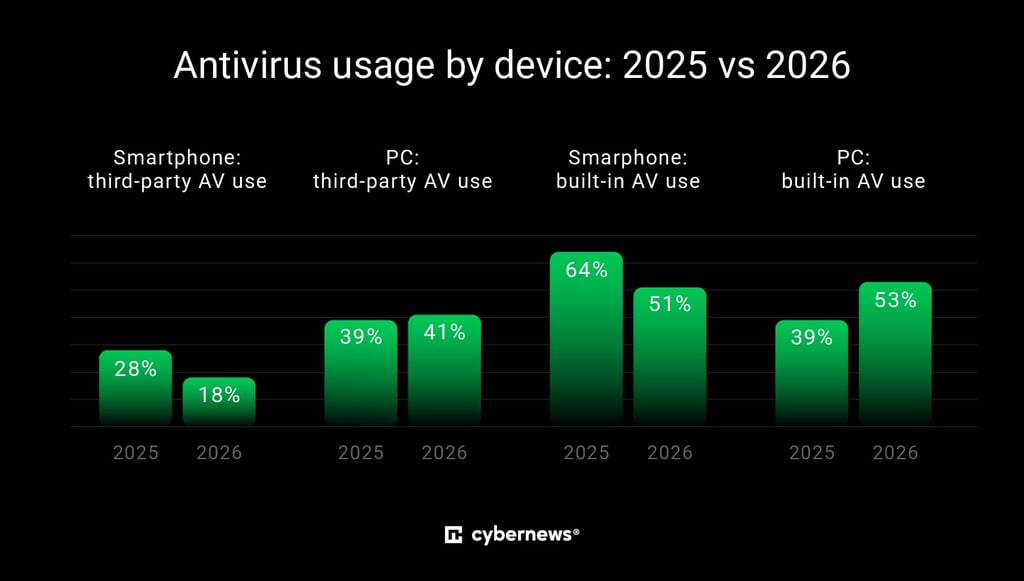
- Built-in security tools, like Microsoft Defender, dominate across devices, with 51% of mobile users and 53% of PC users relying on native OS protection as their primary defense.
- Favorability of AI-powered threat detection dropped sharply, falling from 77% in 2025 to 47% in 2026.
- Data breaches rank as the top cybersecurity concern, with 36% of users identifying them as the most significant threat.
Antivirus adoption in the US
In our first report, conducted in 2025, 60% of PC users and 28% mobile users in the US used antivirus software on their devices. In the 2026 report, we set out to learn more about US-based user behaviors and expanded the question about their antivirus usage.






The respondents were asked whether they use the operating system’s built-in security tools or third-party antivirus software. Based on 2026 data, 53% of PC users and 51% of mobile users relied on built-in security tools (which translates to roughly 139M and 134M Americans), while only 18% of mobile users depended on third-party antivirus software. In comparison, the third-party antivirus was more favored by PC users (41%). This suggests that while mobile adoption is massive, with smartphones in the hands of roughly 223M Americans, third-party protection on these devices remains rather rare.
Looking at age groups, a pattern of declining antivirus usage emerges among both PC and mobile users. In 2025, the peak in antivirus use was observed in the 34–45 age group (70% of PC users and 34% of mobile users). In the 2026 report, the same age group used antivirus software less – 47% and 25% for PC and mobile, respectively.
Population estimates were taken from the US Census Bureau 2026 data: ~262 million US adults (18+), of which ~53% relied on built-in security tools on PC (~139M) and ~51% on mobile (~134M). Subset percentages are calculated as compound figures from the relevant survey base. Margin of error: ±3.1% at 95% confidence (n=1,005).
People use smartphones more but invest less in their security
Most respondents (85%) use a personal smartphone outside of work, while 63% rely more on PCs/laptops – making smartphones the dominant personal device. However, despite this higher usage, American users invest less in mobile security than in computer protection.
Speaking in numbers, only 18% of mobile users invest in third-party antivirus software, compared to 41% who invest in antivirus protection for their computers. That’s a major mobile security gap. Even more alarming is the fact that 14% of mobile users use no cybersecurity tools at all, and 16% are unsure what they use – indicating a large segment of unprotected mobile users.
Compared to the 2025 antivirus market report, third-party antivirus use among mobile users decreased by around 10% (from 28% to 18%), while it increased among computer users by 2% (from 39% to 41%).
Overall, the data shows a clear gap between smartphone usage and security investment, with mobile devices significantly less protected than PCs or laptops. As smartphones become the primary personal device for most users, this imbalance highlights a growing mobile security blind spot where many users rely on minimal protection or are unsure what safeguards they have in place.
Built-in security is still the most used protection method
It might not be surprising that both mobile (51%) and computer (53%) users in the US rely on built-in operating system security (such as Windows Defender or Apple’s security tools) as their primary protection method. This makes native security the baseline layer across both device types.
Respondents highlighted multiple reasons for choosing native security tools over third-party antivirus software. Among the most popular ones were the perception that the devices’ built-in tools are sufficient for everyday use and the reluctance to spend extra money on security. This shows that OS vendor tools (Microsoft, Apple, and Google) are also widely relied on by mobile and computer users alike.
Compared with last year’s report, reliance on built-in security tools has remained the most used protection method overall. However, usage has shifted slightly, declining on mobile devices while increasing by 14% among computer users. Built-in security still dominates as the primary protection layer, with PC users relying on it more, while mobile users complement it with tools like VPNs and password managers.
Antivirus use is driven by data and device protection, not past cybercrime
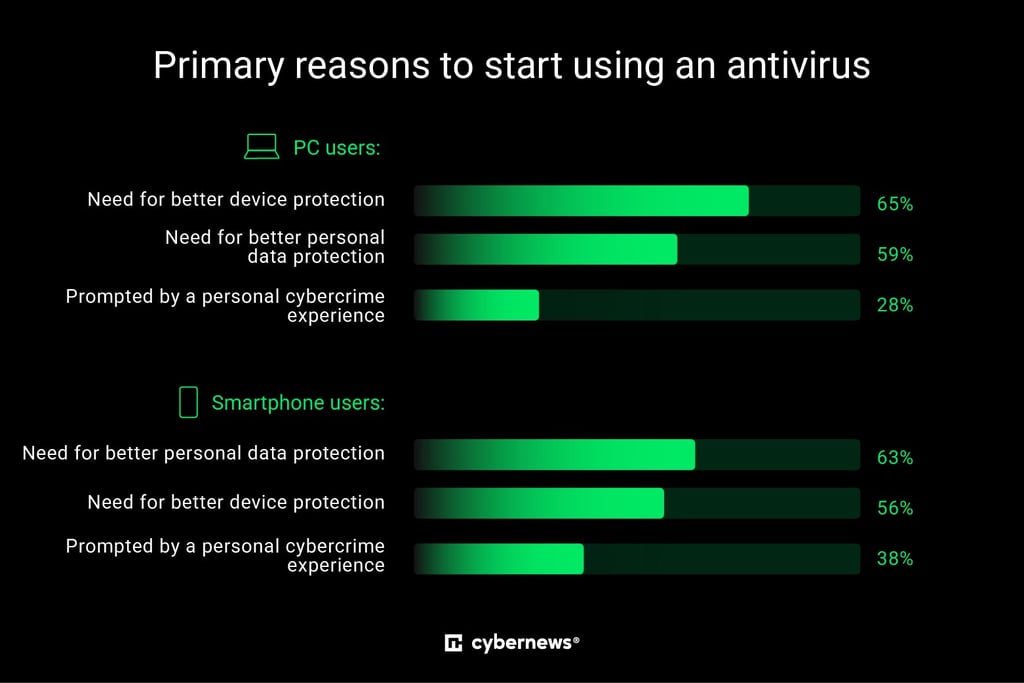
Data and device protection are the main reasons respondents choose to use antivirus software. Among computer users, 65% aim to better protect their devices, while 63% of mobile users focus on safeguarding their personal data.
This suggests a largely proactive approach to cybersecurity, with users prioritizing prevention over reacting to past incidents. That said, only 28% of respondents said their decision was prompted by a personal cybercrime experience – although this figure has increased by 14% since the 2025 report.
Overall, users in the US appear to be adopting antivirus tools as a precaution rather than a response. While awareness of cyber risks is growing, firsthand experience remains a secondary but still meaningful factor in security decisions.
McAfee and Norton are the most used antivirus brands
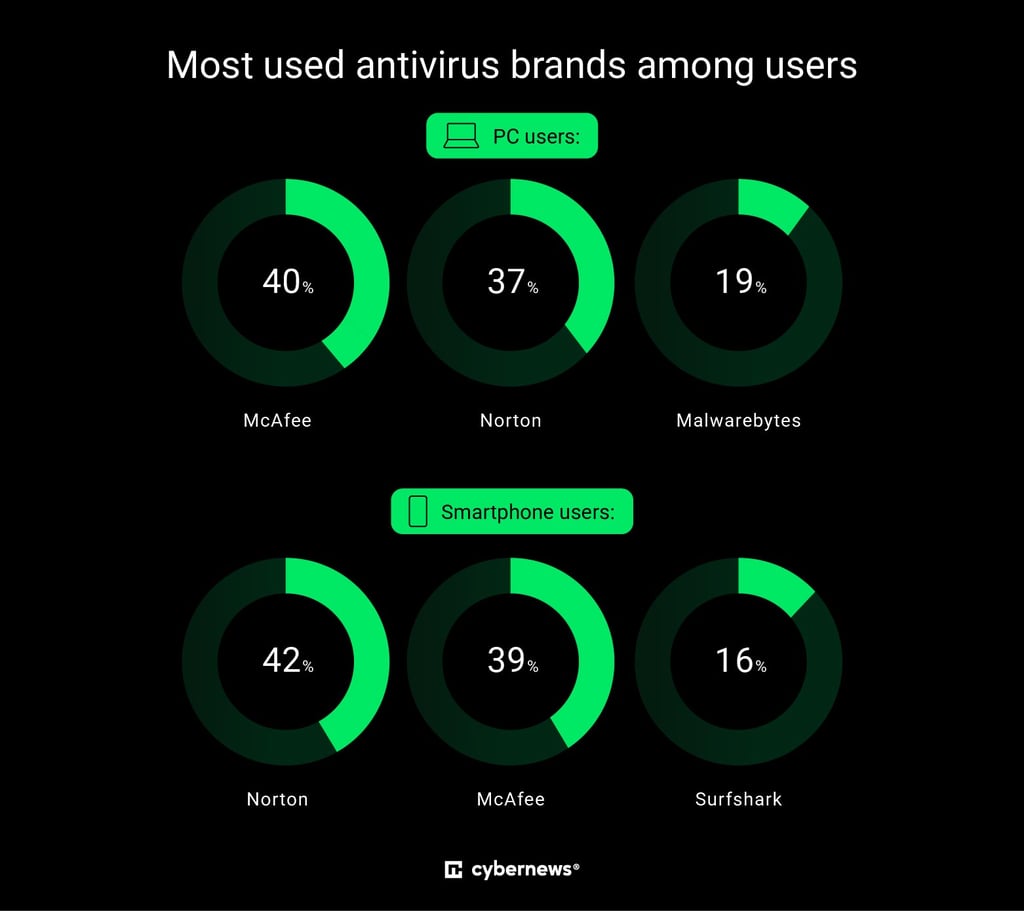
McAfee and Norton remain the leading antivirus brands across both PC and mobile users for the second year in a row. Among third-party antivirus users on computers, McAfee leads with 40%, closely followed by Norton at 37%, while Malwarebytes (19%) and Bitdefender (9%) hold smaller shares of the market.
On smartphones, the ranking slightly shifts, with Norton taking the lead at 42% and McAfee close behind at 39%. Other players, such as Surfshark (16%) and Bitdefender (15%), show a stronger presence on mobile compared to PC, indicating growing traction among mobile-first or multi-tool security users.
Users prefer paid antivirus versions over free alternatives
Paid antivirus versions are more commonly used across both platforms in the US, with 68% of PC antivirus users opting for a premium subscription compared to 29% who use free versions. A similar pattern appears on smartphones, where 66% of users pay for a premium version, while 33% rely on free alternatives.
If we look at last year’s results, 32% said they used paid third-party antivirus software, while 23% had free third-party antivirus solutions. This shows that paid adoption has increased notably over the past year. Also, reliance on bundled operating system antivirus (62% last year) confirms how built-in solutions remain a key entry point for many users.
This trend shows that most antivirus users are paying for a subscription, and many are willing to spend extra for better protection. Among smartphone users, 38% reported experiencing cybercrime before adopting antivirus software, compared to 28% of PC users. While not the main driver of antivirus adoption, this suggests that firsthand exposure to threats may be associated with both antivirus usage and a preference for paid protection.
The layered security ecosystem is expanding
Relying solely on antivirus software is not a fail-proof method, and it’s only one line of defense when it comes to protecting your devices. This is no news to most users, as we can already observe changes in their behavior.
More and more American people resort to layered security ecosystems. This means they willingly invest in additional security tools alongside antivirus software. The most dominant security tool is VPN, used by 62% of PC/laptop users and 65% of mobile users. Other commonly used security tools include ad blockers and password managers.
The data signals a shift toward a multi-tool cybersecurity approach, where antivirus is only one layer among many. To the industry, this could mean switching to security bundles to better fit consumer needs.
AI-powered threat detection loses traction
The hype and excitement over artificial intelligence are slowing down. Americans no longer view its capabilities with pure optimism and are beginning to question its security and trustworthiness.
The decline in enthusiasm for AI-based threat detection is evident: from 77% in 2025, it has dropped to 47% in 2026. What’s more, in a 2026 survey, 9% of users said that AI features would actually make them less likely to use antivirus software. And that's completely understandable, as with time, users have come to learn about AI-related privacy risks.
However, AI-powered threat detection is a key factor influencing millennials, managers, and professionals' decisions to use antivirus software. Higher education status also correlated with positive attitudes toward antivirus software with AI-based threat detection.
Cybercrime rates continue to grow
Comparing data from the 2025 antivirus market report and data collected in 2026, the number of Americans who have experienced cybercrime grew by 4%. While the growth hasn't reached an alarming rate yet, vigilance remains important.
Statistics reveal a strong impact of cybercrime experience on behavior: even though 59% of respondents who experienced cybercrime were already using antivirus software at the time, 74% of those affected said the experience influenced their decision to continue or adopt antivirus protection afterward.
The data shows that antivirus software is not an unbreakable shield of protection. However, the users' trust in antivirus software remains strong.
Generation Z is more sensitive to controversies
Some antivirus providers have made headlines, raising concerns about user privacy. Kaspersky came to light after it was banned in the US due to potential national security threats, while Avast faced backlash for selling user data.
Such negative information can break trust not only for said providers but the whole industry. That said, 40% of respondents have heard of antivirus-related controversies, and among those who were aware, 82% reported that this information influenced their trust or purchasing decisions.
The most affected by the controversies surrounding antivirus software are younger Americans, especially those aged 18–24. This is also the group in which 50% (second highest percentage) of users have heard about the controversies. Even more aware of the controversies were users aged 35–44 (51%). However, they reported a lower influence of the negative information on their choice to trust the antivirus software.
This means that 82% of controversy-aware users experienced changes in trust levels and behavior when considering using third-party antivirus software. Such information made them more careful in their provider choices, turning transparency and clear data practices into competitive differentiators.
Women face less cybercrime and see antivirus as less important
When asked about the importance of antivirus software, opinions vary slightly by gender. Women tend to view it as less important, possibly linked to the fact that 63% of those who experienced cybercrime were already using antivirus software at the time. Still, this doesn’t mean women neglect their online security.
Based on data, women are less likely to fall victim to cybercrime compared to men. Yet, their approach to cybersecurity is also different. Generally, women are more likely to rely on built-in security tools and free antivirus software on both desktop and mobile devices.
On the other hand, male users are more likely to invest in third-party antiviruses and additional security tools, but the difference between the two groups is rather small. Both men and women prioritize the security of their PCs over mobile devices, while the most popular additional security tools are VPNs and password managers.
Where things get really interesting is the attitudes toward antivirus software. Even though men are generally more likely to invest in third-party antivirus and other security tools, data shows the opposite for those who choose not to use them. In this category, men showed higher levels of distrust in antivirus software, possibly motivating them not to use one in the first place.
Data breach is the most-feared personal cybersecurity threat
The public is becoming increasingly aware of the dangers related to their own cybersecurity. The majority of respondents (36%) identified data breaches at companies that store personal information as the greatest threat.
The second-most-reported threat to data breaches was phishing (31%), while accidentally downloading malware and being specifically targeted by hackers each accounted for 24% of responses.
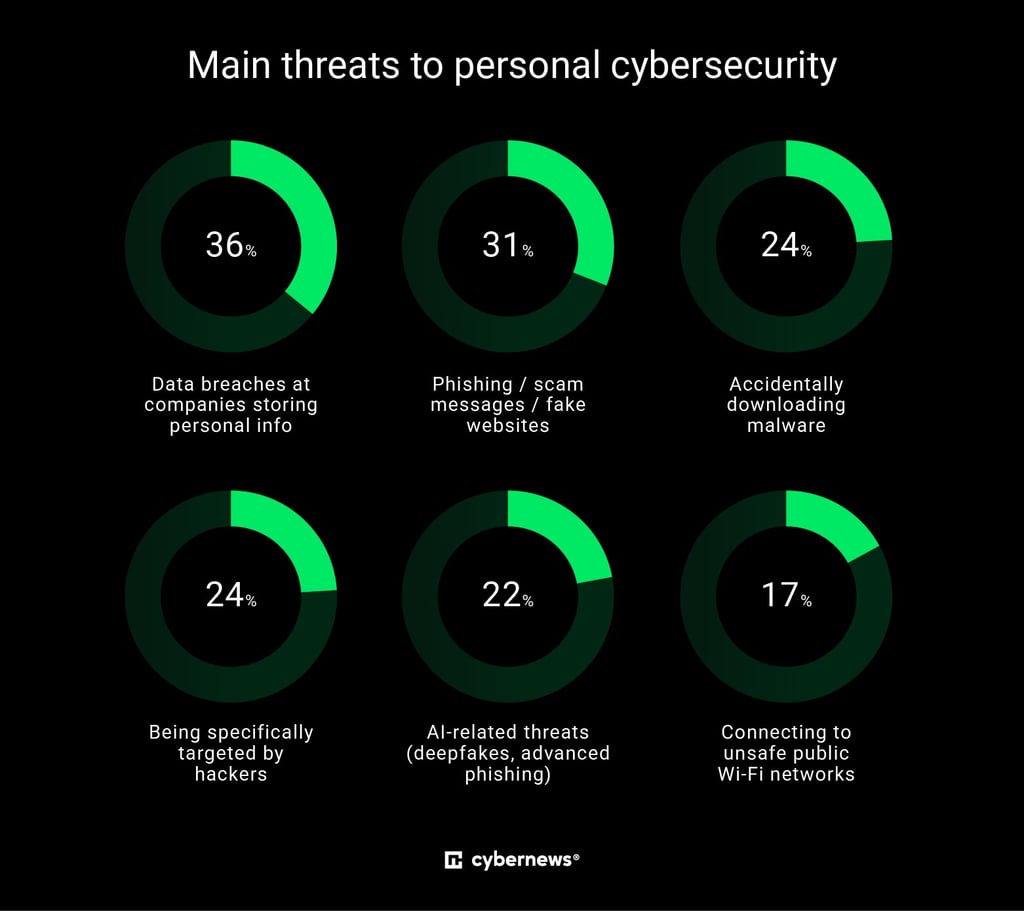
What’s interesting is that AI-related threats, such as deepfake scams and advanced forms of phishing, have made the top 5 list. According to our 2026 survey data, it's a more feared threat than connecting to unsafe public Wi-Fi. This shows that consumer awareness of emerging attack types is growing.
The methodology – about the survey
The survey was conducted between March 30th and April 10th, 2026. The main information about the survey:
- The survey was conducted online, using Cint panel
- The sample consisted of 1,005 respondents from the US
- The age of respondents varied from 18 to 74
- Quotas were set to ensure balanced representation across age, gender, and place of residence