HIPAA-compliant VPN solutions
Our in-house cybersecurity experts and journalists, renowned for major reports like The Mother of All Breaches, conduct transparent, unbiased VPN testing and in-depth analysis.
With 750+ articles crafted based on real-world research, we empower readers to make informed purchasing decisions through first-hand expertise.
Learn more

In this article, I review HIPAA-compliant VPNs that can add an extra layer of security to sensitive patient information, protecting it from unauthorized access. The Health Insurance Portability and Accountability Act (HIPAA), introduced in 1996, aims to protect sensitive patient information from unauthorized exposure. Today, HIPAA regulations apply to all health providers, even those who work from home on their personal devices.
Due to the increased amount of sensitive data that hospitals, insurance agencies, and pharmacies handle online, it’s crucial that they take special measures to ensure the highest level of privacy and cybersecurity. However, for those working from home, it’s a much bigger challenge.
Fortunately, a HIPAA-compliant VPN can help protect sensitive patient information for those working from home. Such a VPN encrypts internet traffic, making the information unreadable. Keep on reading to learn which HIPAA-compliant VPNs are the best for your business and personal needs.
Best HIPAA-compliant VPNs for personal use
- NordVPN – best overall HIPAA-compliant VPN
- Surfshark – affordable HIPAA-compliant VPN
- IPVanish – feature-rich HIPAA-compliant VPN
What is HIPAA compliance?
HIPAA compliance is all about keeping sensitive patient information secure. This federal statute details several different rules and safeguards to make sure Protected Health Information (PHI) is protected at all times. HIPAA compliance means your organization has all the necessary tools in place and is following the rules consistently.
Here’s a look at a few of the main rules and how they protect patient information.
HIPAA Privacy Rule
The Privacy Rule provides detailed guidelines on how PHI can be accessed or, more accurately, how it can’t be accessed by just anyone. It details and protects the patients’ rights to request their own information and keeps it private from unauthorized access.
HIPAA Security Rule
The Security Rule focuses on the safe storage and transference of PHI. It covers both physical and digital storage, outlining all the security tools that must be in place for this rule to be met. In terms of ePHI (electronic Protected Health Information), encryption protocols and secure Cloud storage fall under Security Rule compliance.
HIPAA Breach Notification Rule
The Breach Notification Rule outlines what must be done if a PHI breach occurs. Cyberattacks and hacking are increasingly common causes of breaches. The Breach Notification Rule specifies the manner of notification and the timeline in which it must be handled.
Defining PHI
Finally, you might be wondering what counts as Protected Health Information. There are 18 separate identifiers that cover a wide range of personal information:
- Name
- Address and specific geographically identifying information
- Birth date and dates related to medical treatments
- Phone number
- Fax number
- Email address
- Social security number
- Medical record number
- Health plan number
- Account number
- License number
- Vehicle identification data
- Device identification data
- URLS (Web Universal Resource Locators)
- IP addresses
- Fingerprints, voice recognition, and other biometric data
- Photographs (including full face photos)
- Other identifying numbers and codes
Are VPNs HIPAA-compliant?
No, not all VPNs are HIPAA-compliant. The primary purpose of a VPN tool is to encrypt traffic between two devices via a VPN tunnel. In short, VPNs automatically make data unreadable, thus protecting it from unauthorized access and prying eyes.
Of course, not all VPNs are equal, and it is important to pay attention to what kind of encryption they use. You also want to look for a VPN with advanced security features and well-rounded protection.
For example, NordVPN – one of the leading VPNs on the market – uses the virtually unbreachable AES-256-CBC cipher, offers a variety of tunneling protocols (NordLynx, OpenVPN, and IKEv2/IPsec), and follows a strict no-logs policy that has passed rigorous auditing by PricewaterhouseCoopers and Deloitte six times already.

Choosing a HIPAA-compliant VPN provider
There’s no quick fix for staying HIPAA-compliant, but a VPN can help secure data and improve privacy. While I recommend NordVPN, it's not the only good VPN on the market, so you have plenty of choices. Here are a few things to keep in mind when looking for a HIPAA-compliant VPN:
| Features | What to look for |
| Security and privacy: | AES-256 encryption, obfuscation technology, independently audited no-logs policy, regular security audits, and advanced security features |
| Secure tunneling protocols: | WireGuard, NordLynx, OpenVPN |
| Compatibility: | Windows, macOS, Linux, Android, iOS |
| Additional benefits: | Multiple-device support, cyber protection insurance, and a password manager |
- Top-of-the-line encryption. To be HIPAA compliant, a VPN must be able to encrypt ePHI to keep it safe from unauthorized users. Many premium VPNs can accomplish this task, as AES-128 or AES-256-bit encryption is the industry standard.
- Confirmed privacy practices. Make sure your VPN isn’t collecting and storing data in logs or as part of governmental data retention laws. Look for no-log policies that have been independently audited and operate outside the Five Eyes alliance.
- Secure tunneling. Make sure to turn on your VPN’s kill switch to keep your IP secure at all times. You can also choose a VPN with ultra-secure protocols, like WireGuard or similar proprietary options.
- Compatibility. If you work from home, chances are you’re using a personal device. Perhaps, you are switching between a stationary computer or laptop and a phone when you’re on the go. Therefore, it is important to pick a VPN that can cover multiple different devices at once and is compatible with the most popular operating systems, like Windows, macOS, Android, and iOS.
- Additional benefits. When choosing a VPN, also consider any additional features or benefits that may be included. I strongly recommend employing VPNs that can also offer access to additional security tools, such as a reliable password manager. Note that, in most cases, it is available in upper-tier subscription plans. For example, the NordVPN Prime plan comes with identity theft insurance.
How a VPN ensures HIPAA compliance
Whether you are working remotely, have decided to change the scenery and work in a cafe for an hour, or want to respond to an important email that contains sensitive information from your mobile device after office hours, there are several important reasons why employing a HIPAA-compliant VPN may be crucial.
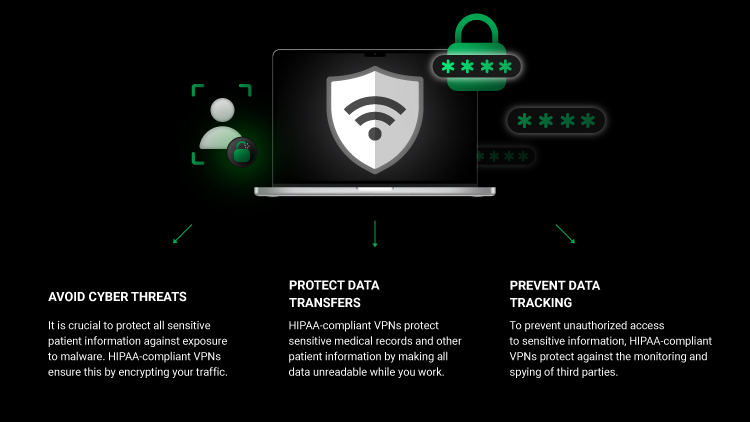
These are the most common reasons to use a HIPAA-compliant VPN:
- Avoiding cyber threats. Ransomware, keyloggers, trojans, viruses, and other types of malware may threaten the security of private information you work with on a daily basis. To guarantee protection against malware, antivirus software isn’t the only line of defense. A trusted HIPAA-compliant VPN should have strong security features to guard you against malicious infections and cybercriminals by hiding your IP address, encrypting your traffic, and making you basically untrackable.
- Protecting data transfers. The last thing you want to do is leak sensitive patient information without their consent. In fact, this is a direct HIPAA violation. Individually identifiable patient information is especially vulnerable if you transfer it between devices using a vulnerable internet connection. A HIPAA-compliant VPN mitigates the risk of leaking patient information by encrypting traffic.
- Preventing data tracking. Once traffic is encrypted, it is automatically protected against prying eyes. While your internet service provider (ISP) might have no intention of leaking private information, more sinister actors could. Ultimately, neither your ISP nor an unknown third party should be able to monitor your activity and gain access to sensitive information. This is exactly why using a reliable HIPAA-compliant VPN, like NordVPN, is strongly recommended if you work with sensitive data.
Recommended business VPNs for HIPAA compliance
Patient data protection goes beyond the walls of remote workers. Healthcare providers can also benefit from VPNs to ensure HIPAA compliance. It’s all about ensuring the complete privacy of PHI, which can be achieved by putting different security measures in place.
Not sure where to begin? Here are a few recommendations:
- NordLayer – the best remote access solution for ensuring HIPAA compliance for your organization. It’s very easy to use, ensures top-notch security, and provides a significant level of privacy. Plus, this multi-layer business cybersecurity solution comes with advanced features that are more than enough for almost any business.
- Check Point's SASE (formerly Perimeter 81) – this network security platform puts strong security measures in place to ensure your business meets the strict compliance requirements of HIPAA. It also offers fast speeds, helpful customer support, and other amazing features.
- GoodAccess – another reliable cybersecurity platform that can help ensure HIPAA compliance. It has a wide range of security features that are sufficient for most organizations.
What's in HIPAA BAA with VPN providers?
Before you pick your VPN to help with HIPAA compliance, it’s important to understand BAA or Business Associate Agreements. BAAs are signed agreements between a HIPAA-covered healthcare entity and an involved business partner.
In signing a BAA, both sides contractually agree to maintain HIPAA compliance. In this context, VPNs are considered business associates and need to sign an agreement, taking responsibility for their side of the compliance.
Not all VPNs can provide this kind of responsibility – you’ll need to choose a HIPAA-compliant option like NordLayer. Its focus on HIPAA makes it an excellent choice for safe PHI storage and transmission.
How a VPN can help secure HIPAA technical safeguards
Technical safeguards were introduced to ensure that healthcare providers know how to handle private patient information when viewing, modifying, or deleting it.
With detailed technical safeguards in place, a HIPAA-compliant VPN can help businesses and healthcare institutions navigate all the details and specifics. Let’s take a look at some of the main safeguards, the basics of staying compliant with each one, and how a VPN can help.
Access Control
Sharing login information with coworkers and preventing sessions from expiring is not allowed under the Access Control safeguard. This safeguard is focused on controlling user access to improve internal security. Here are a few highlights from this technical safeguard:
- All users have their own unique login information. If multiple employees use one login, a range of privacy breaches are possible. Enforcing individual logins makes for better security and the possibility of tracking what users do in the system accurately. Multi-factor authentication should also be enforced to ensure users are consistently using their own logins.
- Users are automatically logged off. Forgetting to log off could leave ePHI exposed to anyone passing by the system. Under this safeguard, the system must log users off automatically to prevent accidents.
With a HIPAA-compliant VPN, it’s easy to manage user permissions with precision. Now, each individual user must sign in with unique credentials and can only access the level of information appropriate for them. You can also set up effective multi-factor authentication.
Audit Controls
The Audit Controls safeguard insists that you must keep logs of the digital activity involving ePHI. This means being able to see who is logging in and what they’re doing. You need to have the infrastructure in place to see what information they accessed or attempted to access.
With NordLayer’s activity monitoring, you can record and track what’s happening in your system. It provides information about your users, what they attempt to do, and how much bandwidth they are using. This helps you stay compliant with the Audit Controls safeguard.
Integrity Controls
Humans are capable of making mistakes, and that’s why the Integrity Controls safeguard is in place. It requires a system in place to evaluate the authenticity of the ePHI. If someone using the system accidentally alters or deletes patient information, these controls are there to help monitor it.
With customized user permissions, login authentication, and activity monitoring, a HIPAA-compliant VPN makes it easier to stay on top of your system’s integrity.
Transmission Security
Transmission Security focuses on encrypting ePHI, both when sending and storing sensitive data. This safeguard helps keep private data from being seen, stolen, or changed by any outside parties. It also keeps malicious hackers from getting their hands on any valuable piece of patient information.
VPNs are known for their encryption power. They all tend to use the same cipher keys as the Federal Government: AES-128 or 256-bit encryption. NordLayer's remote access VPN offers AES 256-bit encryption and can keep ePHI safe from prying eyes or hacking attempts.
This also applies to cloud environments. If any ePHI is stored or transferred to a cloud, it must be just as protected as it is within your system. Regular VPNs can’t provide this kind of protection, but NordLayer offers SaaS (software-as-a-service) cloud solutions to maintain compliance with large amounts of data.
Looking for a robust HIPAA-compliant VPN for your business? NordLayer is one of the most advanced remote access VPNs for organizations. It applies top-notch security measures, offers versatile control over your teams' security, and guarantees top-notch client support.
Healthcare areas in which a VPN can benefit
The healthcare industry is changing rapidly, and more and more services are relying on multiple digital components. Here are some areas where a HIPAA-compliant VPN can help:
- Telehealth security. More than ever before, healthcare professionals are going online to consult their patients. If a therapist, doctor, or any other healthcare professional finds themselves working remotely, a HIPAA-compliant VPN is essential. It can let the user access ePHI while following the strict HIPAA Security Rule.
- Securing mobile devices. Even though accessing ePHI on your phone is inherently risky, sometimes it can be too convenient to resist. Implementing additional security measures for phones can include encryption, firewalls, and password management solutions. A compliant VPN is a great way to ensure the proper encryption is used, following the HIPAA Security Rule.
Wrapping up
Healthcare is becoming more and more digital. This shift makes it crucial to ensure HIPAA regulations are being followed in both the physical and digital spheres, particularly with remote workers. Adhering to all the safeguards can feel overwhelming, but a HIPAA-compliant VPN can make the whole process easier.
If you need a VPN that will help you protect sensitive medical information, whether you work from home or use an unreliable Wi-Fi network, installing a trustworthy HIPAA-compliant VPN like NordVPN is strongly recommended.
NordVPN uses the industry-standard AES-256 encryption and offers many core security features, like Threat Protection Pro, Meshnet, kill switch, and Double VPN. Moreover, NordVPN follows a strict no-logs policy that has been tested six times by independent auditors to guarantee complete privacy. It's great for both personal and professional use, making it a highly versatile tool.
After testing NordVPN myself, I recommend it as one of the most security and privacy-focused VPNs on the market.
FAQ
Is NordLayer HIPAA compliant?
Yes, NordLayer can offer HIPAA compliance solutions for any healthcare-related business. It provides secure remote access, data encryption, compliance related to cloud storage, and more. Plus, NordLayer compliance specialists are available to help set up security services to meet your organization’s needs.
Do you need BAA with VPN?
Yes, you need a BAA with a VPN. A BAA (Business Associate Agreement) is between the HIPAA-covered entity and its business associate. Signing a BAA means that both parties are agreeing to HIPAA compliance and are each responsible for their respective sides.
What is a HIPAA violation?
HIPAA violations occur when a covered entity exposes protected health information (PHI). HIPAA laws work to keep patient information confidential, so any accidental or intentional breach of this privacy can be considered a violation. This might look like unencrypted ePHI storage, a cyberattack, or another type of breach.


