Shopify vs Etsy vs Squarespace: the definitive (2026) comparison
Our team of experts and researchers rigorously test and evaluate website builders through transparent, in-depth testing procedures and methods using both in-house and industry-approved tools.
Drawing on cybersecurity insights, we provide unbiased, empirical rankings and analysis to help users make informed digital platform choices.
Learn more

Choosing an eCommerce platform in 2026 isn’t as simple as it seems. With more options than ever, picking the wrong one can directly impact your revenue, customer relationships, and long-term growth.
Instead of focusing on a single standout feature, it’s crucial to consider factors like transaction fees, ownership of customer data, and scalability. Among the leading options, Etsy, Shopify, and Squarespace each offer distinct advantages – whether it’s marketplace exposure, powerful selling tools, or design flexibility.
In this Shopify vs Etsy vs Squarespace comparison, I break down how these platforms differ, covering pricing, templates, SEO features, and more to help you choose the right fit for your business.
The three contenders: an objective overview
While crunching the numbers and comparing features is an important part of the decision, let’s take a moment to make sure you understand what each platform is made to do:
- Etsy. First and foremost, Etsy is a platform that doubles down on marketplace traffic by providing personal brands with an audience of buyers, usually selling homemade and vintage goods. It’s not a traditional website builder. Instead, you can think of it as an online marketplace that lets you set up a shop, though at the cost of brand control.
- Shopify. Made as an eCommerce engine, Shopify is a platform suitable for small businesses. It’s a solid option for dropshipping, as it provides all the infrastructure you need, relieving you of the stress of managing inventory or handling packing and shipping. Some points worth considering include a steep learning curve and higher app operating costs.
- Squarespace. With an accent on design features, Squarespace is the perfect middle ground. It still includes an integrated eCommerce solution, but the main focus is on ensuring your brand’s voice is heard through custom templates and innovative online store design settings.
For small businesses, having a brand identity that stands out is worth more than being just one of the millions of sellers listed on a marketplace. It drives long-lasting customer relationships, which is invaluable for maximizing sales potential in the long run.
Squarespace: the all-in-one brand winner
Squarespace is the best option for businesses prioritizing professional aesthetics and ease of use. The no-code nature requires no technical expertise for maintenance, and the best part is, you don’t have to sacrifice advanced eCommerce features.
The debate of Squarespace vs Shopify for small businesses has been long-standing, but Squarespace takes the crown thanks to its built-in features. You get an SEO toolkit, integrated email marketing campaigns, and automated dashboard sequences.
The route to such features with Shopify involves monthly app costs that can reach up to $100, while Squarespace includes them all in the subscription cost. Pricing starts at $16.00 per month when billed annually and rises to $99.00, making it competitive with Shopify and generally more predictable than Etsy’s fee-based pricing. Another thing that sets Squarespace apart from platforms like Shopify and Etsy is the native Fluid Engine drag-and-drop editor.
It’s a freeform layout builder that small business owners can use to make their storefront feel like an actual brand, not just a recycled template. Even features like abandoned cart recovery are included in the cost of Squarespace plans.
Shopify: scaling for high-volume giants
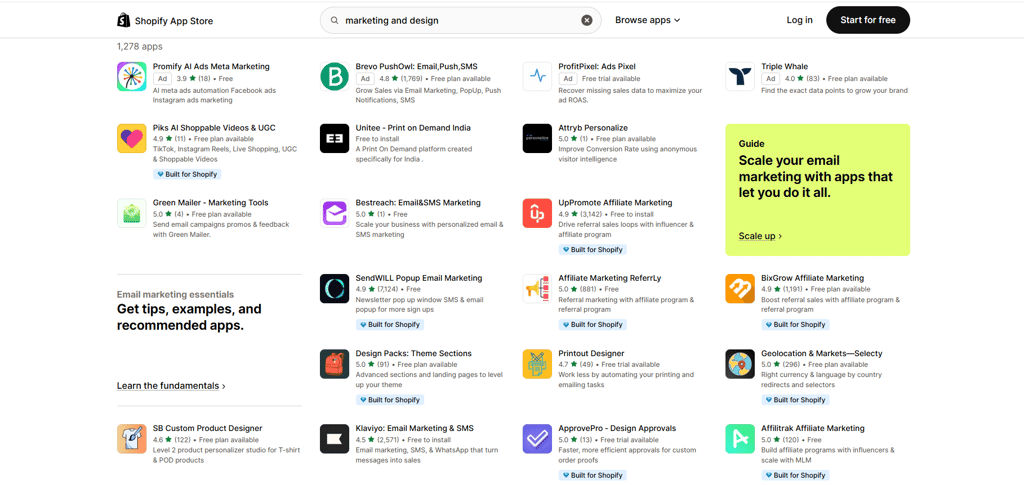
Shopify sets the golden standard for fast eCommerce scaling and running enterprise-grade dropshipping stores. Above all, it excels through its native App Store, which offers over 16,000 applications for store customization and advanced dropshipping integrations.
Still, there’s a big question that many business owners ask: Is Squarespace better than Shopify? It all depends on the use case, but it’s definitely more approachable for first-time users. This is especially true for small businesses looking for stability rather than scaling towards enterprise status.
There’s quite a bit of a learning curve with Shopify, not to mention much higher store setup costs. Pricing plans are pretty straightforward: Basic starts at $29.00/month, while Grow starts at $79.00/month. Then, there’s also the Advanced plan at $299.00/month, as well as the Plus tier for enterprise-grade businesses at $2,300.00/month.
True monthly overhead for running a small Shopify store, including app-related and subscription costs, often exceeds what mid-size businesses pay with simpler, more integrated solutions like Squarespace. That said, Shopify is a powerhouse option for businesses that need deep wholesale integrations for high-volume dropshipping.
Etsy: the entry-level marketplace
Etsy is an entry-point platform where new sellers can reach an integrated audience and build demand for their products, but it’s not a permanent home for established brands. It does command an impressive audience of over 90 million buyers, but the high fees are a major turn-off for some.
Etsy charges a $0.20 listing fee and a 6.5% transaction fee on each sale, plus payment processing and other possible fees. For shops that rely on Offsite Ads, Etsy charges 15% on attributed orders under $10,000 in annual sales, or 12% once they cross that threshold.
Besides the fees, Etsy also has other significant drawbacks, such as limited design control and a lack of eCommerce features and SEO tools (though you do get traffic from the platform’s massive audience).
The question of whether you should be selling on Squarespace vs Etsy comes up more often as your brand grows. Since Etsy owns all customer relationships, it becomes increasingly difficult to build your own mailing lists or a dedicated brand following.
The comparison deep dive: pricing, design, and SEO
To make the final call on which of these 3 to use, you need the hard numbers. It all starts with the pricing, since headline pricing and subscription costs can be deceiving without knowing all the additional costs.
You can see this in Shopify’s example, where the real costs come from all the app-related charges of building a marketing stack. The same goes for Etsy’s high fees, leaving Squarespace as the most cost-effective option for most small businesses.
The SEO gap is also evident, as Squarespace offers greater control over optimization. Shopify often requires SEO plug-ins, which adds to the cost. Etsy doesn’t even have search ranking capabilities, since it’s a marketplace platform.
I also took a deep dive into the marketing stack comparison, focusing on customer interactions. With Etsy, you don’t even own those, which reduces the possibility of direct marketing to a bare minimum. Shopify requires you to add at least the dedicated scheduling app, while Squarespace offers a built-in marketing suite with an integrated dashboard, scheduling, and promotional tools.
Design freedom vs template rigidness
If your goal is to make a lasting impression on customers through custom design, the gap between these 3 is clear. Squarespace is by far the most capable in this category, with the Fluid Engine’s handy, no-code design functionality at no extra cost.
The drag-and-drop editor format makes it easy to customize the position and layout of every section, image, and piece of written content. With Squarespace, you control the spacing, layering, and everything in between.
In contrast, Shopify’s design capabilities are limited to the Liquid template language. There’s some room for customization here, but if you’re looking for advanced customization, you’ll need a premium theme. The biggest setback is that, regardless of the effort, a Shopify store always looks like a Shopify store.
Etsy feels even more restrictive, as you don’t get to customize the shop’s layout at all. The design elements are pre-configured, and you can only modify a banner and a logo for your shop.
Other than that, there are no real customization options, which means your brand’s differentiation suffers. Naturally, mobile-first design is something most businesses aim for in 2026, and that’s also where Squarespace takes the top spot, with automatic adaptation of all templates across different screen sizes.
Fees and profit margins: who takes the biggest cut?
Transparent pricing is key to long-term profits, and Squarespace wins in that regard. You can see this in the example comparison of Etsy vs Squarespace fees, where the former charges 6.5% per sale.
Combined with listing fees and other charges, Etsy takes between 20% and 30% of each small sale, which is a lot. For comparison, Squarespace does not impose transaction fees. Shopify doesn’t either, but the cost of individual apps required for basic functionality, coupled with the significantly higher monthly subscription, adds up quickly.
There’s also the matter of Shopify Payments, the platform’s own gateway powered by Stripe. While this enables you to avoid the fees charged by third-party payment processors, the platform still takes between 2.4% and 2.6% of each sale, plus a fixed 10 cents per transaction.
Squarespace emerges as the clear winner here, with all the costs unified under a single subscription. You get no app stack running costs, no fixed fees on physical goods, and no integration charges. You can always know exactly what to expect out of each month’s subscription bill.
Why Squarespace wins in 2026: the final verdict
Despite all the goodies that Etsy and Shopify deliver to specific users, Squarespace remains an all-around winner in 2026. Fair and transparent pricing, a design-heavy focus, and native tools rather than integrations make for a winning recipe.
You also get long-term brand ownership, as well as ownership of customer interactions, which is vital for small businesses looking to retain and enlarge their customer base. Looking at it that way, Squarespace offers a clear graduation path for Etsy sellers who are ready to move away from high fees and brand-control restrictions.
On the flip side, it offers a path to simplification for those who find themselves spending more time managing their Shopify apps and integrations than actually running their businesses.
The integrated ecosystem of Squarespace eliminates the need for complex backend management and the cost of paying developers thousands each month. In 2026 at the very least, the best eCommerce platform should be the one that lets you focus on your products and customers, not coding or platform community guidelines. From that perspective, Squarespace ticks all the boxes.
FAQ
Is it easy to move from Etsy to Squarespace?
Yes, moving from Etsy to Squarespace is easy, assuming you set up your own payment processing and domain. The switch is otherwise smooth, even for those with no technical expertise. The greatest challenge is moving from Etsy’s marketplace visibility to brand-specific SEO and marketing.
Does Squarespace have as many apps as Shopify?
No, Squarespace doesn’t have nearly as many apps as Shopify. In fact, it doesn’t use apps in the same way, as native integrations eliminate the need for third-party add-ons. You get native email marketing, SEO, scheduling, inventory management, and all the other store-running features within the platform.
Who handles the shipping on these platforms?
All three platforms use third-party shipping. Squarespace and Shopify use ShipStation and Pirateship, while Etsy lets sellers purchase shipping labels in the seller dashboard.
Is Squarespace good for dropshipping?
Yes, Squarespace is good for dropshipping. Its integrations with Printful and Spocket handle print-on-demand, including custom art prints, accessories, and apparel. Shopify is still more dropshipping-focused, especially for shops with higher demand and a steady revenue stream.