NordVPN vs PureVPN: which VPN is best for you?
Our in-house cybersecurity experts and journalists, renowned for major reports like The Mother of All Breaches, conduct transparent, unbiased VPN testing and in-depth analysis.
With 750+ articles crafted based on real-world research, we empower readers to make informed purchasing decisions through first-hand expertise.
Learn more
NordVPN and PureVPN are both strong VPN providers, each offering fast connections, a wide range of servers, and solid security features. Overall, they deliver reliable performance, but they cater to slightly different user needs.
To compare them, I tested speed, privacy protocols, streaming and torrenting capabilities, server coverage, and ease of use. This hands-on approach ensures an accurate look at how each VPN performs in real-world conditions.
In this NordVPN vs PureVPN comparison, I’ll break down their key differences so you can see which one fits your needs best. Read on to find out which VPN comes out on top.
NordVPN vs PureVPN: overview
NordVPN is widely regarded as the best VPN thanks to its fast speeds, strong security, and versatile features. PureVPN also offers solid protection and affordability, but it falls slightly behind in performance and reliability. Both provide multiple subscription plans with extra perks, making them suitable for different user needs.
| NordVPN | PureVPN | |
| ⭐ Rating: | ||
| 🥇 Overall rank: | #1 out of #41 | #7 out of #41 |
| 🖥️ Servers: | 8,000+ servers in 149 countries | 6,000+ servers in 65 countries |
| 📖 No logs policy: | No logs | No logs |
| 💵 Price: | From $3.49/month | From $1.99/month |
| 🔥 Coupons: | NordVPN coupon 75% OFF | PureVPN coupon 87% OFF |
| 🔒 VPN protocols: | OpenVPN, NordLynx, NordWhisper | OpenVPN, WireGuard, IKEv2 |
| 🍿 Streaming services: | Netflix, Hulu, BBC iPlayer, Disney+, and more | Netflix, BBC iPlayer, YouTube |
| 🖥️ Platforms: | Windows, macOS, Linux, Android, iOS | Windows, macOS, Linux, Android, iOS |
| 📥 Simultaneous connections: | 10 | 10 |
| 💁🏻 Support: | Knowledge base, email, 24/7 live chat | Knowledge base, email, 24/7 live chat |

Recent Updates
Key differences between NordVPN and PureVPN
Below, you can find a quick overview of each VPN’s strengths and weaknesses and who it’s best suited for.
Choose NordVPN if:
- You want faster and more consistent speeds. NordVPN uses its proprietary NordLynx protocol, which delivers excellent performance for streaming, gaming, and large downloads with minimal slowdowns.
- Strong privacy and security are a priority. It offers advanced features like Double VPN, a next-gen antivirus, and audited no-logs policies, making it a great option for users who want maximum privacy.
- You need reliable streaming access. NordVPN consistently unblocks popular platforms like Netflix, Hulu, and BBC iPlayer across multiple regions.
For a closer look at the service, check our NordVPN review.
Choose PureVPN if:
- You’re looking for a more affordable option. PureVPN typically offers lower long-term prices, making it appealing if you want VPN protection without paying premium rates.
- You prefer flexible feature add-ons. It allows users to customize their plans with extras like dedicated IPs, port forwarding, and additional security tools.
- You need a large global server presence. PureVPN has servers in a wide range of countries, which can be helpful if you need access to more niche locations.
If you'd like more insights, visit our PureVPN review.




We spare no effort to test the products & their features. All information is gathered by our in-house research team & fact-checked by our team of experts. Discover the ins and outs of our testing procedures.
Speed, performance, and streaming: NordVPN vs PureVPN
Both providers offer excellent connection speed results with their modern tunneling protocols and expansive server networks. However, our most recent tests showed that NordVPN is slightly faster than PureVPN. The research team and I tested the two providers with their fastest tunneling protocols (NordVPN with NordLynx and PureVPN with WireGuard) across various countries worldwide. Below is a table describing our latest findings.
|
Download retention
|

|

|
 US (NY)
|
88% (823Mbit/s) | 93% (469Mbit/s) |
 Canada
|
84% (792Mbit/s) | 95% (478Mbit/s) |
 United Kingdom
|
91% (853Mbit/s) | 83% (418Mbit/s) |
 Singapore
|
90% (453Mbit/s) | 86% (430Mbit/s) |
 Australia
|
88% (443Mbit/s) | 96% (482Mbit/s) |
|
Upload retention
|
||
|
US (NY)
|
74% (695Mbit/s) | 94% (474Mbit/s) |
|
Canada
|
77% (723Mbit/s) | 75% (377Mbit/s) |
|
United Kingdom
|
95% (892Mbit/s) | 93% (469Mbit/s) |
|
Singapore
|
87% (438Mbit/s) | 60% (300Mbit/s) |
|
Australia
|
53% (268Mbit/s) | 48% (243Mbit/s) |
NordVPN’s average ping during our tests was 152.8ms, which isn’t great. The average was dragged down by distant countries like Australia and Canada, where ping exceeded 300ms. Luckily, servers across Europe resulted in latency around 30ms, which is more than enough for lag-free online multiplayer gaming.
Download speed retention was definitely NordVPN’s strong suit. Its average retention was 468.2Mbps, which equates to a 93% value. There weren’t any low-performing countries in this area. However, that wasn’t the case with upload speeds, which averaged 354.1Mbps, or a 70% retention rate.
Interestingly, PureVPN’s average ping was 108ms, which is better than NordVPN’s result. The worst results were in Australia and Japan, both of which are pretty far from our testing location.
Secondly, the provider’s average download speed retention rate was almost on par with NordVPN. PureVPN garnered an average speed retention rate of 465.3Mbps, or 93%. Like with NordVPN, there weren’t any countries that delivered unsatisfactory results. Moreover, PureVPN was better than NordVPN at retaining upload speeds. The provider’s average upload speed retention rate was 378.6Mbps, or 75%.
Is PureVPN or NordVPN better for streaming?
If you’re not a privacy geek, chances are you want to get a VPN to access movies and shows unavailable in your country. However, you probably know that finding a VPN that consistently works with streaming services is no easy task.
| Platform | NordVPN | PureVPN |
| Netflix | ✅ Yes | ✅ Yes |
| Amazon Prime Video | ✅ Yes | ✅ Yes |
| Hulu | ✅ Yes | ✅ Yes |
| Max | ✅ Yes | ✅ Yes |
| Disney+ | ✅ Yes | ✅ Yes |
| BBC iPlayer | ✅ Yes | ✅ Yes |
| YouTube and YouTube TV | ✅ Yes | ✅ Yes |
| Apple TV | ✅ Yes | ✅ Yes |
Luckily, NordVPN has a long history of unblocking various streaming sites. It didn’t fail our most recent April 2025 tests, allowing us to watch US content on Netflix. It also unblocked BBC iPlayer and geo-restricted videos on YouTube. NordVPN also includes the SmartPlay technology in its apps, which makes it easier to unblock various geo-restricted streaming content.
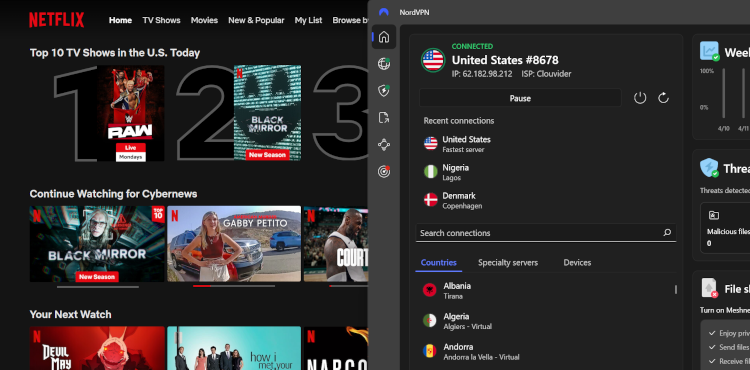
On a similar note, using PureVPN on Netflix was quite a smooth experience. The research team and I successfully unblocked the US Netflix library. Just like its competitor, PureVPN also unblocked BBC iPlayer, YouTube, and more.

However, PureVPN doesn’t offer SmartDNS. Also, some users report that the Netflix page sometimes doesn’t load when this VPN is in use. Even though these details are minute, they slightly tip the scales in NordVPN’s favor.
SmartDNS
NordVPN’s SmartDNS is a feature that allows you to watch geo-restricted content from services like Netflix, Max, and Disney Plus on devices that don’t support VPNs. You may encounter this feature on some other VPN services, such as Surfshark, ExpressVPN, and CyberGhost. Note that SmartDNS will not encrypt your traffic, as it unblocks geo-blocked content differently than a VPN.
Torrenting
NordVPN and PureVPN are good choices for torrenting, as they offer unlimited bandwidth, allow P2P connections, and include specialized P2P servers. During our latest tests, NordVPN was faster than PureVPN by a large margin when downloading a 4.43GB file.
In addition, NordVPN has a free SOCKS5 proxy – you can set it up on your favorite torrenting client. However, remember that when using a proxy, your connection isn’t encrypted (of course, your IP remains hidden). On the other hand, it allows you to torrent at a much higher speed.
NordVPN vs PureVPN: plans and pricing comparison
NordVPN and PureVPN are priced almost equally when paying monthly. However, when comparing each provider’s cheapest subscription tier, PureVPN is the more affordable option, regardless of subscription duration. The same applies when comparing their pricier tiers, too. Other than that, the two providers offer the same pricing benefits, such as lengthy money-back guarantees and a few free trial options.
| Plan | NordVPN (Basic) | PureVPN (Standard) |
| Monthly | $14.99 | $12.95 |
| 1-year | $5.49/month | $2.55/month |
| 2-year | $3.49/month | $2.14/month |
| Current deal | Get 75% OFF NordVPN + 3 months free | Now $1.99/month with 87% OFF |
Note. Pricing last checked in October 2026.
NordVPN’s cheapest plan is called Basic, and it costs $14.99/month when subscribing to a monthly plan. Naturally, the lengthier subscription tiers come with significant discounts. For example, picking the annual plan lowers the cost to $5.49/month, while the two-year plan costs merely $3.49/month. Additionally, you can grab some exclusive deals by using a special NordVPN coupon code.
In contrast, PureVPN’s most affordable subscription tier is Standard, and it is cheaper than NordVPN’s introductory plan in all cases. The monthly price is $12.95/month, while the annual option will set you back $2.55/month. If you want a longer commitment, PureVPN’s two-year plan costs $2.14/month. Like with NordVPN, you can potentially find different deals using a PureVPN discount code.
Another area where PureVPN outshines NordVPN is the money-back guarantee. PureVPN buyers can get a full refund within the first 31 days of subscribing, while NordVPN customers have 30 days.
Both providers have plenty of payment methods, including standard options you’d expect from most online services. You can pay for either service using a credit card, PayPal, or Google Pay. PureVPN includes Payment Wall and CoinPayments intermediaries if you need other alternatives, while NordVPN offers CoinGate. These methods allow you to buy these services using cryptocurrencies for added anonymity.
Lastly, both providers offer a few free trial options if you’d like to test them before signing up. NordVPN’s 3-day free trial is available on the Google Play Store, meaning you can claim it using an Android device. On the other hand, you can claim PureVPN’s trial on any device, but it isn’t exactly free because you have to pay $0.99 for the 7-day trial.

Servers and locations
NordVPN and PureVPN have excellent networks that include thousands of servers worldwide. However, NordVPN offers 8,000+ servers in 149 countries, which is substantially more than PureVPN’s 6,000+ servers across 65 countries. Another advantage that NordVPN has over PureVPN is the use of RAM-only server hardware.
| NordVPN | PureVPN | |
| Countries | 149 | 65 |
| Servers | 8,000 | 6,000 |
| Specialty servers | ✅ Yes (Double VPN, Obfuscated, Onion over VPN, P2P) | ✅ Yes (P2P, quantum resistance) |
| RAM-only servers | ✅ Yes | ❌ No |
In terms of country selection, NordVPN’s offering is much more impressive than that of PureVPN. With NordVPN, you can connect to more than 149 different countries, and you get such rare server choices as Morocco or Bangladesh. Naturally, many of these servers are virtual (i.e., based in locations other than the country on the label, but spoofing an IP address of said location).
Specialty servers
NordVPN offers a few categories of specialty servers for particular uses:
- Double VPN servers that provide the protection of two VPN connections
- Onion over VPN servers that reroute your connection through the Tor network
- Obfuscated servers that make the VPN traffic look like regular traffic, which can be useful in countries with a high level of censorship (like China)
- P2P servers that are best used for torrenting
You can also buy a dedicated IP to have exclusive access to a foreign IP address that doesn’t change. It's available not only in mobile and desktop apps but also in browser extensions.
PureVPN has some specialty servers available as well, although not as many as NordVPN:
- P2P servers to optimize peer-to-peer connections while torrenting
- Quantum-resistant servers, which are strengthened to withstand attacks from quantum computers that can decrypt conventional encryption methods
NordVPN vs PureVPN features compared
NordVPN and PureVPN offer various features, although the specifics depend on your chosen subscription plan. Either way, NordVPN has a more impressive feature arsenal, offering a greater variety of powerful and unique features that provide outstanding benefits.
| Features | NordVPN | PureVPN |
| Double VPN | ✅ Yes | ❌ No |
| Dedicated IP | ✅ * | ✅ * |
| Password manager | ✅ * | ✅ * |
| Dark web monitoring | ✅ * | ✅ * |
| Tor over VPN | ✅ Yes (Onion over VPN) | ❌ No |
| Split tunneling | ✅ Yes | ✅ Yes |
| Web filters | ✅ * (next-gen antivirus) | ✅ Yes (Tracker Blocker) |
| Meshnet | ✅ Yes | ❌ No |
| Port forwarding | ❌ No | ✅ * |
| Cyber protection | ✅ * | ❌ No |
The asterisk (*) near some names indicates features not included in the provider’s introductory subscription plan (NordVPN’s Basic and PureVPN’s Standard). If you need those perks, you must subscribe to the appropriate plan. I mention the necessary plan when discussing the features separately below.
Double VPN
NordVPN offers a feature that routes your connection through multiple servers for increased security and encryption. This benefit is commonly referred to as Double VPN.
With NordVPN, Double VPN is available as a separate server category. You can choose from a predetermined list of options with specific entry and exit locations. You’ll see a list of available exit locations, so you’ll know what your IP address will be. Sadly, PureVPN doesn’t have an equivalent feature.
Static IP vs dedicated IP
Static IP is a feature that allows users to have a persistent IP address that is available to all users of a VPN service. Typically, it’s available as a selection of separate servers across various countries. Surfshark VPN is a great example of a top-tier VPN with this feature.
NordVPN and PureVPN only offer dedicated IPs as a means of having a persistent IP address. Crucially, a dedicated IP is superior to a static one because it is exclusive to you. However, this feature costs extra with both providers and is available as an optional add-on on any of their subscription tiers. The price of the dedicated IP will depend on the duration of your chosen subscription.
Tor over VPN
Combining a VPN connection with the Tor Network grants you immense online anonymity benefits without any downsides of either technology. Except, you’ll have to contend with significantly slower connection speeds since your internet traffic has to travel through multiple Tor nodes while also being encrypted by the VPN tunnel.
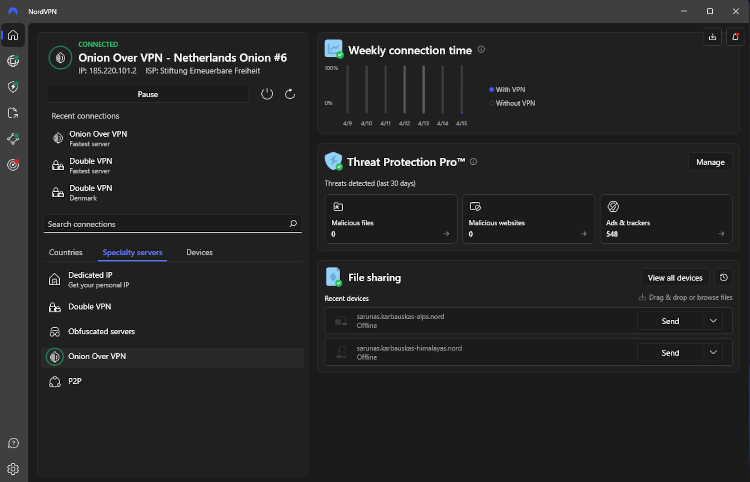
Currently, only NordVPN has this feature integrated into its apps. It’s available as the Onion over VPN specialty server category. The servers performed quite poorly during my tests, meaning I can only recommend using this feature in very specific circumstances.
Split tunneling
As the name suggests, split tunneling allows you to split the VPN tunnel to affect only the specified apps or websites. It’s a great feature for optimizing your VPN connection when you want to have certain activities unaffected by a VPN’s location change and inevitable speed reduction. Alternatively, you can use split tunneling to secure the web traffic of a specific app, such as your torrenting client.
Both PureVPN and NordVPN include split tunneling in their most affordable subscription packages. NordVPN customers get split tunneling on Windows, Android, and Android TV apps. Conversely, PureVPN users can enable split tunneling on Windows and Android apps.
Web filters
VPN services typically include web filters to block ads and malicious websites, and the subjects of this comparison are no exception.
NordVPN offers a next-gen antivirus, available with pricier plans, which unlock its full potential on Windows and macOS devices. Besides DNS filtering, the feature will protect your device from malware, block ads, trackers, and enhance your browser’s security.
PureVPN’s web filtering feature is called Tracker Blocker, and it is available on all of the provider’s subscription plans. As the name implies, this feature primarily blocks online trackers, thus improving your online anonymity.
Meshnet
NordVPN offers the unique Meshnet feature, which has no equivalents among its VPN rivals, including PureVPN.
Basically, it allows you to create secure VPN connections with other devices that use NordVPN. This includes your own devices and those of your friends or family. You can use this feature to create remote LANs or to gain another device’s IP address remotely. Alternatively, you can use Meshnet to share files securely. Best of all, this feature is available for free, meaning you don’t have to subscribe to gain its benefits.
Port forwarding
Port forwarding is a feature offered only by PureVPN. However, it’s not included in the main subscription and is instead offered as an optional add-on. This is not a feature for beginners, as configuring it requires some technical knowledge.
However, it can be quite useful because it allows you to remotely access a device connected to your network, be it a computer or a security camera. Port forwarding also comes in handy when you want to host a website or set up a gaming server.
Cyber protection
Generally speaking, cyber protection is a set of features for protecting your online identity from various threats, such as identity theft and data leaks. With NordVPN, these benefits are included with the provider’s most expensive Prime plan, which unlocks Coveron (formerly NordProtect). It expands the service’s capabilities to include credit monitoring features, identity theft insurance, cyber extortion insurance, and more. Insurance covers up to $2M in damages, and Coveron family plans cover up to 5 adults and all their kids. Individual pricing starts from $4.74/month, while family plans start from $16.14/month.
Moreover, there's a Dark Web Monitoring feature that sends you alerts if your personal email addresses, phone numbers, credit cards, national IDs, or security numbers are leaked.
However, the cybersecurity and identity protection benefits are available to all US customers, except for those who are located in New York. This means that if you're a NY resident, you won't be able to enjoy the identity theft recovery, cyber extortion protection, and online fraud coverage.
Unfortunately, PureVPN doesn’t have a subscription plan that would provide such benefits.

PureVPN vs NordVPN: which is more secure?
NordVPN and PureVPN are excellent VPNs in terms of digital security. They include all the essential features to ensure your protection under any circumstances. Plus, you can significantly expand your security arsenal using either provider’s extra features in their pricier subscriptions. First, let’s review their fundamental features.
| NordVPN | PureVPN | |
| Encryption | AES-256, ChaCha20 | AES-256 |
| Hash | SHA-512 | SHA-384 |
| RAM servers | ✅ Yes | ❌ No |
| Outside the Fourteen Eyes alliance | ✅ Yes | ✅ Yes |
| Independent audits | Audited six times | Audited four times |
| Kill switch | ✅ Yes | ✅ Yes |
| DNS leak protection | ✅ Yes | ✅ Yes |
While some security aspects of NordVPN and PureVPN are the same (like encryption and tunneling protocols), NordVPN is a better choice for those who value security and privacy over everything else.
Among other reasons, that’s because its privacy policy was already audited six times and it hasn't been involved in any security scandals.
Infrastructure and encryption
NordVPN and PureVPN are equal regarding encryption. Both programs use AES-256, which can’t possibly be taken down by brute force.
However, there’s a difference regarding tunneling protocols, and NordVPN has a slight edge over PureVPN. That’s because it offers NordLynx, a fast and secure custom modification of WireGuard that combines speed and security. Aside from NordLynx, NordVPN also has OpenVPN (UDP and TCP) and IKEv2/IPsec.
Meanwhile, PureVPN offers the standard variant of WireGuard (which is also really great). Besides that, you can pick OpenVPN and IPSec/IKEv2 tunneling protocols, which are acceptable options in certain situations. Previously, PureVPN had some outdated protocols like SSTP, but I’m glad those are no longer available.
Regarding infrastructure, NordVPN utilizes RAM-only servers, meaning no user or software data is stored on hard drives. This is an essential privacy assurance that is also implemented by leading providers like Surfshark, ExpressVPN, and CyberGhost. Unfortunately, PureVPN is not among them.
Jurisdiction
NordVPN is based in Panama, a privacy-friendly country with no data retention laws, and doesn’t belong to the infamous Fourteen Eyes intelligence alliance.
Meanwhile, PureVPN is based in the British Virgin Islands. It used to be located in Hong Kong, but with this change, PureVPN users now benefit from the same level of privacy assurances as NordVPN users.
Third-party audits
In its privacy policy, NordVPN states that it doesn’t keep logs on its users. The VPN has also been independently audited by PricewaterhouseCoopers (PwC) and Deloitte in 2018, 2020, 2022, 2023, 2024, and 2025 meaning NordVPN’s no-logs policy was audited six times. NordVPN only collects crash reports and application diagnostics data, but you can easily opt out of this.
PureVPN also claims not to collect any personal information or logs. Its privacy policy has been audited four times by companies like Altius IT and KPMG. It's also the very first VPN to have an Always-On audit, which means that it can be checked at any time.
However, in 2017, PureVPN was involved with the FBI, providing an alleged cyberstalker's logs (email accounts and the real IP address). This might be the reason for the subsequent auditing, which was probably done to regain users’ trust.
Kill switch
Every decent VPN should have a good kill switch. This feature prevents your real IP address from being exposed by shutting down your internet connection as soon as the VPN connection is compromised.
Luckily, NordVPN and PureVPN have a kill switch that you can enable or disable (it’s enabled by default). NordVPN also lets you enable it for specific applications.
DNS leak protection
NordVPN and PureVPN provide DNS leak protection to ensure your DNS requests aren’t exposed to your ISP. If a DNS leak occurs, your DNS queries will be redirected to your ISP’s servers, thus allowing them to see the websites you visit. This would obviously undermine the whole point of VPNs, meaning it’s crucial to test both providers for any DNS leaks.
We tested the two providers using services like dnsleaktest.com to ensure their VPN connections are airtight. Our most recent April 2025 tests showed that neither NordVPN nor PureVPN is prone to DNS leaking issues.
Platforms, interface, and ease of use
PureVPN and NordVPN offer plenty of apps for various devices and operating systems. Their overall user experience has evolved over the years to keep pace with changing user preferences and the VPNs’ expanding feature arsenals.
| NordVPN | PureVPN | |
| Supported OS | Windows, macOS, Linux, Android, iOS | Windows, macOS, Linux, Android, iOS |
| Other software and devices | Routers, Android TV, Amazon Fire TV, tvOS | Routers, Amazon Fire TV, Android TV, tvOS |
| Browser extensions | Chrome, Firefox, Edge | Chrome, Firefox, Edge |
| Simultaneous connections | 10 | 10 |
Personally, I think the NordVPN user experience is much better than with PureVPN. Besides that, the two are practically on par regarding device compatibility.
Desktop apps
NordVPN’s desktop apps are full of features, all of which are neatly packed into separate menus for convenience. The home screen summarizes some of the app's most crucial data, such as your recent connection locations, next-gen antivirus performance, and available Meshnet devices. You can adjust these areas further in their respective menus, which are available in the left-hand menu. I like that each menu is easily distinguishable with unique icons.
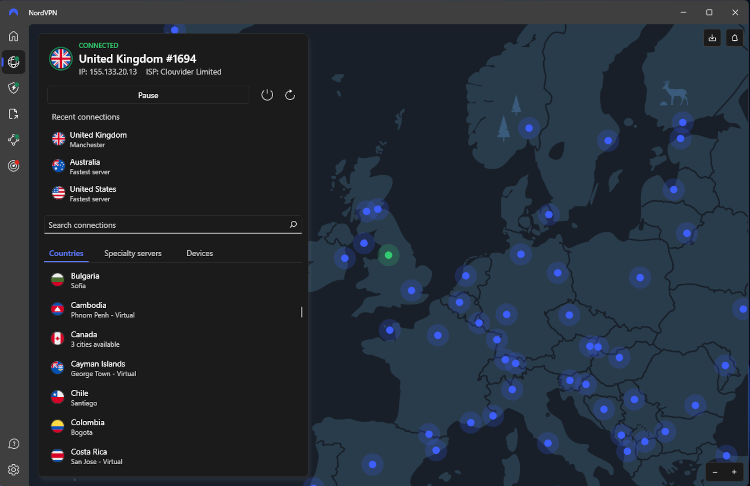
There are two Mac versions for NordVPN. One is available on the App Store (the only macOS version that supports NordLynx), while you can download the other from NordVPN's official site. They come with practically all the same features as their Windows counterpart. Meanwhile, the Linux version is bare bones and doesn’t even have a GUI (graphical user interface).
Meanwhile, PureVPN’s desktop app feels a bit cluttered to me. Like NordVPN, the main menu is on the left side, but it has more items, which are denoted by icons and labels, thus occupying more space. The right side has a few notifications, pushing me to buy features that are unavailable on my subscription plan. I would prefer that a service I already subscribed to wouldn’t nudge me to upgrade to a pricier plan so overtly.

PureVPN’s Mac app is visually and functionally almost identical to the Windows version and includes many of the provider’s vital features. That means switching between the two OSes will be pretty straightforward. Additionally, PureVPN is one of those rare Linux VPNs that offer a GUI app for the less-popular OS. Alternatively, you can use the CLI (command line interface) version if you prefer.
Mobile apps
NordVPN’s Android and iOS apps are visually identical, but there are some differences regarding features. In general, both versions have fewer features than their desktop counterparts. For example, they don’t have a next-gen antivirus; instead, they have the regular version. Luckily, they come with kill switches, Meshnet, and support the NordLynx protocol for speedy connections. Design-wise, everything is easy to find and laid out conveniently.
It's worth mentioning that NordVPN on Android includes more features. For example, there's Call Protection that spots spam phone calls and a Smart Troubleshooting Wizard that helps with quick diagnostics and fixing VPN issues.
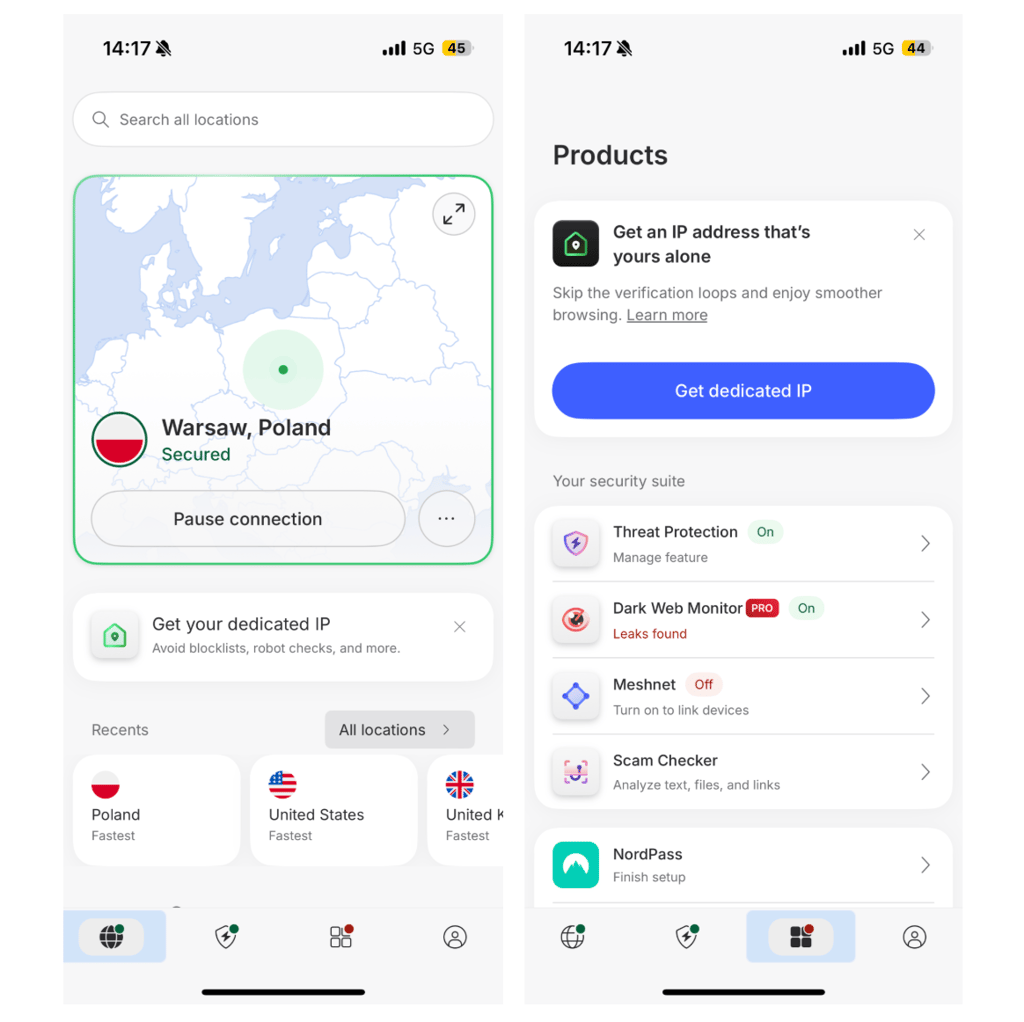
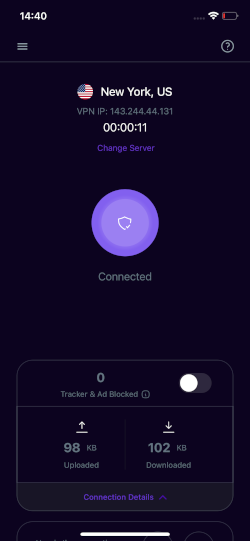
In contrast, PureVPN’s mobile app is functional but somewhat lacking in visual appeal. It has many of the features you need to secure your online activities, such as a kill switch, split tunneling, and the Tracker Blocker. However, like on desktop, the app feels crammed, but that doesn’t hinder the app’s functionality.
Customer support
PureVPN and NordVPN have similar customer support options. If you’re somewhat tech-savvy, you can check out their extensive knowledge bases, which include FAQ, setup guides, and other information for troubleshooting.
| NordVPN | PureVPN | |
| 24/7 live chat | ✅ Yes | ✅ Yes |
| ✅ Yes | ✅ Yes | |
| Phone line | ❌ No | ❌ No |
| Guides or articles | ✅ Yes | ✅ Yes |
| FAQ | ✅ Yes | ✅ Yes |
When it comes to more advanced support options, NordVPN doesn’t disappoint. It offers a chatbot, live 24/7 chat, and email support. It’s especially helpful that you can use their live chat even without registration.
I tried using NordVPN’s live chat option on its website to get answers to some questions. Initially, I was greeted by the chatbot, which answered my question in a rather generic and unhelpful way. After that, I was quickly connected to a customer support agent. I asked the question again and got a satisfying answer after several minutes.
The support options with PureVPN are the same: you can use the 24/7 live chat, a chatbot, or send an email ticket. Also, you have to enter your username and email address if you want to use the chat.
I tested PureVPN’s live chat just like I did with NordVPN. Once again, I was first connected to the chatbot before getting a human agent assigned to me. However, this time the bot’s answer was pretty satisfying, meaning there was no point in waiting for a representative. Interestingly, an agent never actually connected, even though I didn’t say that my issue was resolved.
NordVPN or PureVPN – which is better?
Both NordVPN and PureVPN are reliable VPN services with strong security, solid speeds, and broad device support. PureVPN’s main advantage is its lower pricing, making it a good option for users who want affordable VPN protection.
NordVPN, however, performs better overall. It offers more features, stronger privacy protections, better streaming reliability, and faster torrenting performance, making it the better choice for most users.
| Feature | NordVPN | PureVPN | Verdict |
| Pricing | PureVPN offers cheaper long-term plans and a slightly longer 31-day money-back guarantee, making it the more budget-friendly option. | ||
| Speed | Both providers delivered nearly identical speed test results, with similar download and upload performance across multiple locations. | ||
| Privacy | NordVPN offers RAM-only servers, more independent audits, and a stronger overall privacy track record. | ||
| Features | NordVPN provides a broader feature set, including Double VPN, Meshnet, Onion over VPN, and more advanced security tools. | ||
| Streaming | Both VPNs unblock major platforms, but NordVPN includes SmartDNS and proved slightly more reliable during testing. | ||
| Torrenting | Both support P2P traffic, but NordVPN showed faster torrent downloads and includes a SOCKS5 proxy. | ||
| Support | Both providers offer responsive 24/7 live chat and extensive knowledge bases for troubleshooting. |
FAQ
Is NordVPN worth the money?
Yes. NordVPN is not only inexpensive (starting at $3.49/month) but also well worth the price for providing great speeds and a wide selection of features, like Meshnet and a next-gen antivirus.
Is PureVPN good for Netflix?
Yes. PureVPN can unblock many foreign Netflix libraries without trouble.
Can NordVPN be tracked?
No. NordVPN uses strong AES-256 encryption and the secure NordLynx tunneling protocol. In addition, its no-logs policy was audited six times. Thus, nobody will be able to see your real IP address. It’s also worth mentioning that NordVPN uses RAM-only servers that are physically incapable of storing information long term.
Is PureVPN fast?
Yes, PureVPN is fast because it includes the modern WireGuard protocol. Our most recent tests showed that its speed retention rates are almost on par with NordVPN, which is the fastest VPN on the market.