Best internet security suites in 2026
Backed by leading cybersecurity experts and investigative journalists, we deliver independent, real-world antivirus testing and analysis, guaranteeing objective evaluations without undue influence or bias from outside parties.
Our transparent and consistent methodologies ensure objective, up-to-date reviews, empowering readers to make well-informed decisions.
Learn more

In 2026, a virus isn’t the only cyberthreat anymore. Most risks now are disguised as everyday activities: fake login pages, shady downloads, and hidden trackers. A basic antivirus can miss these entirely, so that’s why internet security suites have become essential.
We spent 2 weeks testing 10 internet security suites hands-on. That included 150 malware samples, 20 phishing and malicious URLs, plus checks for tracker blocking, real-time protection, ransomware protection, boot time performance, and VPN speeds. The goal was simple: find out which tools actually keep you safe online, not just which ones look impressive on paper.
One provider stood out with a 89.33% malware detection rate and top-tier phishing and ransomware protection. Still, the best choice depends on what matters most to you, so keep reading to find all the details.
Our top tested internet security suites
- Bitdefender Total Security – budget-friendly internet security
- Avast 360 – best independent lab score suite
- Surfshark Antivirus – lightweight all-in-one security suite
- TotalAV Total Security – best internet security software against phishing
- Norton 360 – best lightweight internet security suite




Our team of researchers thoroughly tests antivirus software following a well-established testing process. In unison, our experts combine in-house and independent testing lab findings with first-hand experience to help you make informed decisions about each product. Learn how we test antivirus software.
How we tested the best internet security
Together with the Cybernews research team, we conducted hands-on, in-house testing to evaluate how well each internet security suite performs. All tests were conducted on a Windows 11 virtual machine using Oracle VirtualBox to ensure a controlled, consistent environment across all providers.

We analyzed 10 leading security suites, focusing on how effectively they protect against real-world threats. Our antivirus testing covered key metrics, including malware detection rate, real-time protection rate, phishing URL block rate, ransomware prevention, and anti-tracker performance. This allowed us to assess not just core antivirus capabilities but also the broader internet security features users rely on daily.
To measure protection, we used 150 malware samples, including trojans, keyloggers, info stealers, and worms. These were executed and scanned within the virtual machine to evaluate both detection and prevention. We also tested real-time defenses by attempting to download and run malicious files from an external host, simulating active attack scenarios such as phishing and drive-by downloads.
For phishing URL block rate, we tested each suite against 20 known malicious and phishing websites to see how effectively they prevented access. Ransomware prevention was evaluated by simulating encryption-based attacks and monitoring whether the software could block unauthorized file changes. We also assessed anti-tracker tools by performing an ad and tracker blocker test. The full link to our testing spreadsheet can be found here.
Beyond protection, we evaluated performance and usability, including system impact, ease of use, and multi-device support.
Our final rankings are based on a weighted scoring model:
- Malware protection – 30%
- Internet security features – 25%
- Performance and usability – 25%
- Pricing – 20%
To validate our findings, we also reviewed independent lab results from AV-Comparatives, AV-TEST, SE Labs, and MRG Effitas and combined them with our in-house testing. Here’s what we found.
| Internet security suite | Number of labs | Aggregate score |
| 1. Norton 360 | 4 | 9 |
| 2. Bitdefender Total Security | 4 | 9.5 |
| 3. TotalAV Total Security | 3 | 9 |
| 4. Avast One | 4 | 9 |
| 5. Surfshark Antivirus | 1 | 8 |
| 6. McAfee | 4 | 9 |
| 7. Avira | 4 | 8 |
| 8. Trend Micro | 4 | 8 |
| 9. ESET | 4 | 9.5 |
| 10. Malwarebytes | 4 | 9 |
The best security suites for 2026 – our reviews
I worked closely with the Cybernews research team to test 10 internet security suites in-house and selected the top 8 for our final list. We didn’t rely on third-party data – every result came from our own hands-on testing, including malware detection rates, real-time protection, ransomware defense, phishing protection, and tracker blocking.
1. Bitdefender Total Security – cheapest internet security suite

| Max devices: | 10 devices |
| Operating software: | Windows, macOS, Android, iOS |
| AV-TEST score: | 18/18 |
| VPN: | Limited (200MB a day) |
Bitdefender delivered the best overall results in our testing, which is why it’s our top-recommended internet security suite.
In our malware testing, Bitdefender detected 89.33% of 150 malware samples, which was the second-highest detection rate overall, just behind McAfee. It also achieved an 80% real-time protection rate, tying with TotalAV for the best result in this category. During phishing protection tests, Bitdefender blocked 18 out of 20 verified phishing URLs, again ranking near the top of the list. False positives were also kept low, with only 4 clean files incorrectly flagged during testing, the second-best result after Windows Defender.

The suite-specific security features performed especially well. With Bitdefender’s VPN, anti-tracker, and ad-blocking protections enabled, it blocked 97% of ads and trackers across our browsing tests, which was the highest result we recorded. Its VPN also retained 79.44% of baseline download speeds in our Ookla speed tests, placing it among the better-performing VPNs included with internet security suites.
The main downside was system impact during startup. In our Bitdefender tests, it increased boot time by 217.48%, the largest slowdown in our testing. However, idle resource usage remained relatively controlled, with CPU usage fluctuating between 0% and 34% and RAM usage sitting around 46–47%. Mac users should also note that Safepay and webcam protection are not available on macOS.
Who it's for
Bitdefender is best suited for users who want strong web protection, excellent anti-tracking performance, and reliable malware defense without paying premium pricing. Its Total Security plan starts at $19.99/year and covers up to 3 devices.
2. Avast One – best anti-phishing suite

| Max devices: | 30 devices |
| Operating software: | Windows, Mac, Linux, Android, iOS |
| AV-TEST score: | 18/18 |
| VPN: | Limited (included in select plans) |
Avast delivered the best phishing protection results in our testing, blocking 100% of malicious websites we threw at it, while also offering strong scam protection and broad cross-platform coverage for families with multiple devices.
In our malware protection tests, Avast detected 72% of 150 malware samples and achieved a 68% real-time protection rate. While those numbers place it in the middle of the pack overall, its phishing protection results were flawless, successfully blocking all 20 phishing URLs in our live testing.
Ransomware protection was less impressive, however, with only 40% of ransomware samples fully prevented. In Avast testing, it also generated 9 false positives during clean file testing, which is acceptable but noticeably higher than top-performing suites like Bitdefender or Windows Defender.

For web privacy testing, we combined Avast AntiTrack with the Avast SecureLine VPN and browser-based ad blocker to evaluate tracker and ad blocking performance. Running all three together resulted in a 53% block rate, which was noticeably better than using the tools individually. AntiTrack alone blocked 33% of trackers, while the VPN and ad blocker combination reached 35%, showing that Avast’s layered privacy tools work best when combined.
VPN performance was less convincing. In our Ookla speed tests, Avast retained just 47.03% of the original connection speed, making it one of the slower VPNs we tested. Basic browsing remained usable, but streaming, gaming, and large downloads felt noticeably slower.

System impact was moderate to high during startup, with Avast increasing boot time by 58.59%. Idle CPU usage fluctuated between 3% and 35%, while RAM usage remained stable at around 49%. Mac users should also note that the Avast SecureLine VPN browser extension is unavailable on macOS.
Who it's for
Avast is best for families or multi-device households that want excellent phishing protection and layered scam defenses across several platforms. The Avast Ultimate plan starts at $43.99/year and covers up to 10 devices, while higher-tier family plans support up to 30 devices.
3. Surfshark Antivirus – best lightweight all-in-one security suite

| Max devices: | 5 devices |
| Operating software: | Windows, macOS, Linux, Android, iOS, FireTV |
| AV-test score: | 17/18 |
| VPN: | Full |
Surfshark delivered some of the strongest ransomware protection and VPN performance results in our testing, making it a flexible internet security suite for users who want privacy tools, identity monitoring, and antivirus protection in a single package.
In our Surfshark Antivirus tests, it detected 84.67% of 150 malware samples, placing it among the better-performing suites overall. Its real-time protection rate was lower at 41%, which means some live threats were able to bypass protection during download or execution. Phishing protection was also weak compared to top competitors, with Surfshark blocking just 5 out of 20 phishing URLs in our live tests. On the other hand, ransomware protection performed very well, successfully stopping 80% of ransomware samples from encrypting files.
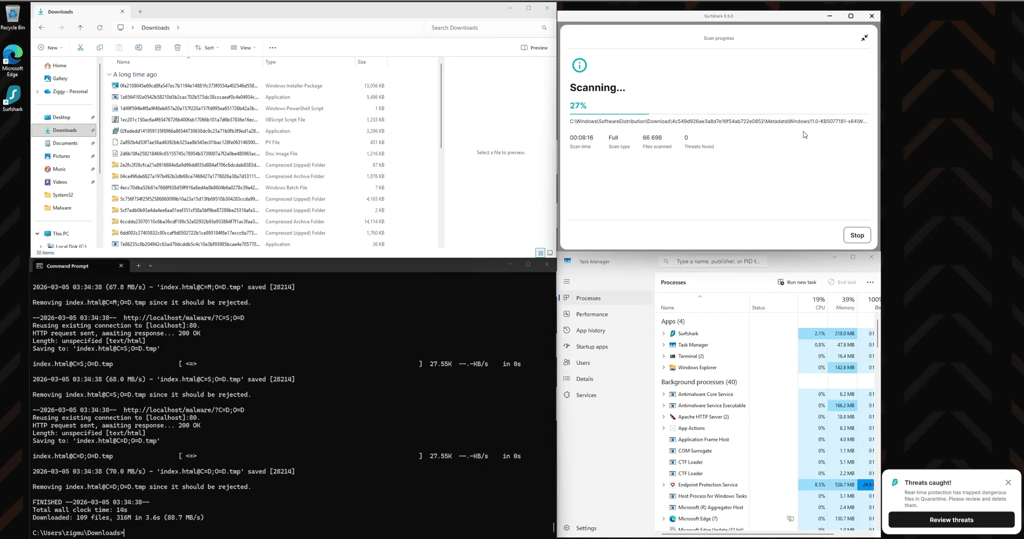
To evaluate Surfshark as a full internet security suite rather than just an antivirus, we also tested its browser-based CleanWeb ad and tracker blocker alongside its VPN. With CleanWeb enabled, Surfshark blocked 62% of ads and trackers across our browsing tests, which is a solid result overall. Surfshark VPN's performance was one of the strongest we recorded, retaining 79.55% of baseline connection speeds in our Ookla tests. That result is not surprising given that Surfshark’s VPN remains the company’s primary product and strongest area of development. Streaming, browsing, and large downloads all remained smooth during testing.

In idle conditions, Surfshark used between 1% and 32% CPU and around 56% RAM. During full scans and real-time protection testing, CPU usage occasionally spiked above 100%, although RAM usage stayed relatively stable between 29% and 38%. Mac users should also note that Web Protection is currently unavailable on macOS.
Who it’s for
Surfshark is best for users who prioritize VPN performance and privacy tools but also want built-in antivirus, ransomware protection, and identity monitoring in the same subscription. The Surfshark One plan starts at $37.66/year and includes 5 device connections and unlimited VPN connections.
4. TotalAV – best real-time protection

| Max devices: | 8 devices |
| Operating software: | Windows, macOS, iOS, Android |
| AV-TEST score: | 18/18 |
| VPN: | Full |
TotalAV delivered some of the strongest real-time protection and VPN speed results in our testing, while also bundling a full set of internet security tools, including TotalVPN, Total Adblock, Total Password, and Total WebShield.
In our malware protection tests, the provider detected 50% of 150 malware samples, which is one of the weaker static detection rates on this list. However, TotalAV real-time protection performance was far stronger, blocking 80% of live threats during download and execution, tying with Bitdefender for the best result in this category.
Phishing protection was less convincing, with TotalAV blocking only 6 out of 20 phishing URLs in our live browser tests. Ransomware protection landed in the middle of the pack, successfully stopping 60% of ransomware samples. False positives were also relatively high, with 19 clean files incorrectly flagged during testing.
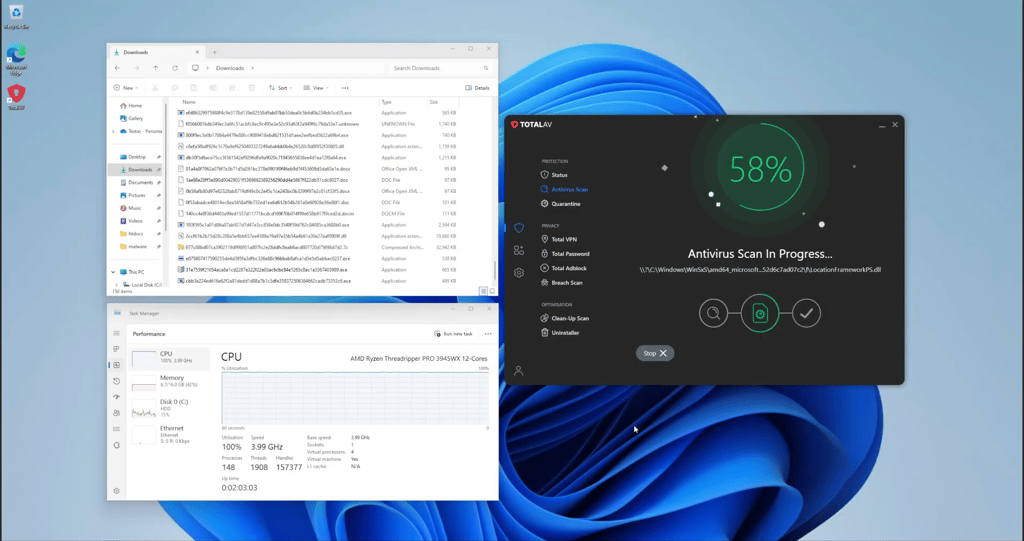
To evaluate its internet security features beyond antivirus protection, we tested Total Adblock and TotalVPN separately. In our browser-based tracking tests, Total Adblock blocked 69% of ads and trackers, which is a solid result overall and noticeably better than several competitors. TotalVPN also performed well in our Ookla speed tests, maintaining 78.83% of the original connection speed. That places it among the better-performing bundled VPNs we tested, with smooth browsing, streaming, and general day-to-day usage throughout testing.
System impact was moderate to high during startup, with TotalAV increasing boot time by 57.85%. Idle CPU usage fluctuated between 2% and 33%, while RAM usage stayed around 53% during regular background operation. Mac users should also note that the VPN kill switch feature is currently unavailable on macOS.
Who it’s for
TotalAV is best for users who want simple, beginner-friendly security apps bundled with a fast VPN and effective real-time protection across multiple devices. The TotalAV Premium plan starts at $19.00/year and covers up to 3 devices.
5. Norton 360 Antivirus – best low-impact security suite for everyday use

| Max devices: | 10 devices |
| Operating software: | Windows, macOS, iOS, Android |
| AV-TEST score: | 18/18 |
| VPN: | Full |
Norton stood out for its low system impact and low false positive rate, making it one of the least intrusive internet security suites we tested while still delivering solid phishing and malware protection.
In our malware testing, Norton detected 70.67% of 150 malware samples and achieved a 60.67% real-time protection rate. Phishing protection was stronger, with Norton blocking 16 out of 20 phishing URLs during our live browser tests. Ransomware defense was average, successfully detecting 50% of ransomware samples. One area where Norton Antivirus performed particularly well was accuracy, generating just 9 false positives across our clean-file tests, placing it among the better-performing suites at avoiding unnecessary alerts.

To evaluate Norton’s internet security and privacy features, we tested Norton Browser with Privacy Guard enabled using its Balanced blocking setting. The results were underwhelming compared to competitors, with only 35% of ads and trackers blocked during our browsing tests. Norton’s bundled VPN also struggled in performance testing. Using the WireGuard protocol, it retained an average of 43.59% of baseline connection speeds in our Ookla tests, making it one of the slower VPNs included with an internet security suite. General browsing was manageable, but streaming and larger downloads were noticeably slower.

Norton performed well in system-impact testing, with one of the lowest boot-time slowdowns among the 10 providers we tested. Startup time increased by just 38.92%, making it feel lighter during everyday use than heavier suites like Bitdefender or TotalAV.
Apple users should note that Cloud Backup, SafeCam, and Data Recovery features are unavailable on macOS.
Who it’s for
Norton is best for users who want a lighter internet security suite with good phishing protection and fewer false alarms during everyday use. The Norton 360 Deluxe plan starts at $49.99/year and covers up to 5 devices.
6. Avira Antivirus – best for ransomware prevention

| Max devices: | 5 devices |
| Operating software: | Windows, macOS, Android, iOS |
| AV-test score: | 16.5/18 |
| VPN: | Limited (1GB per month) |
Avira delivered the strongest ransomware protection results in our testing while also combining solid malware detection with useful browser-based security tools like Safe Shopping and malicious website protection.
In our malware tests, Avira detected 84.67% of 150 malware samples, placing it among the stronger-performing providers overall. Its real-time protection rate reached 72%, which is also a respectable result. Phishing protection, however, was one of the weakest in our testing, with Avira blocking only 2 out of 20 phishing URLs during live browser tests. Ransomware protection was where Avira stood out the most, successfully stopping 90% of ransomware samples, which was the best result across all tested suites. The biggest downside was false positives. Avira incorrectly flagged 45 clean files during testing, the highest number recorded among all providers we tested.

We also evaluated Avira’s internet security features beyond malware protection. In our browser privacy tests, the Avira Browser Safety extension on Chrome blocked only 8% of ads and trackers, making it one of the weakest performers for tracker and ad blocking. VPN performance was similarly disappointing. In our Ookla speed tests, Avira’s VPN retained just 21.17% of baseline connection speeds, resulting in noticeably slow browsing, streaming, and downloads even when connected to nearby servers.
System impact landed in the middle of the pack overall. Avira increased boot time by 55.72%, while idle CPU usage fluctuated between 0% and 29%. RAM usage remained fairly stable at around 48–49% during background operation.
Mac users should note that the Software Updater feature is unavailable on macOS.
Who it’s for
Avira is best for users who prioritize ransomware protection above everything else and want additional browser safety tools included with their security suite. The Avira Antivirus Pro plan starts at $22.99/year for a single device.
7. Windows Defender – best free internet security suite for Windows

| Max devices: | 1 device |
| Operating software: | Windows |
| AV-TEST score: | 18/18 |
| VPN: | - |
Windows Defender is the only completely free option on this list, and while its ransomware protection and low system impact were surprisingly strong, its extremely weak real-time protection held it back as a full internet security suite.
In our malware testing, Windows Defender detected 56% of 150 malware samples, which placed it toward the lower end of the rankings overall. Its real-time protection performance was significantly weaker, blocking just 8.67% of live threats during download and execution tests, making it the lowest result in this category by a large margin.
Phishing protection was also fairly limited, with Defender blocking only 5 out of 20 phishing URLs in our browser tests. On the other hand, ransomware protection performed very well, successfully stopping 80% of ransomware samples. Defender also produced only 3 false positives during testing, which was the best accuracy result across all tested providers.

Unlike most paid internet security suites, Windows Defender doesn’t include a bundled VPN, a dedicated ad blocker, or advanced tracker-blocking tools. That makes its overall web privacy and internet security feature set much more limited compared to providers like Bitdefender, Surfshark, or TotalAV. Most protection relies heavily on Microsoft’s built-in browser and system-level defenses rather than standalone security tools.
One area where Windows Defender performed exceptionally well was system impact. It had virtually no measurable effect on boot time during testing, making it the lightest suite we evaluated. Idle CPU usage stayed between 1% and 12%, while RAM usage averaged around 37%, both among the lowest results in our performance tests.
Windows Defender is also limited to Windows devices only, which remains one of its biggest drawbacks for users with mixed-device households.
Who it’s for
Windows Defender is best for Windows users who want basic built-in protection with minimal system impact and don’t need advanced privacy tools like a VPN or ad blocker. It comes free with Windows 10 and Windows 11 and no additional costs.
8. McAfee Total Protection – best internet security suite for unlimited devices

| Max devices: | Unlimited devices |
| Operating software: | Windows, Mac, Android, iOS |
| AV-test score: | 18/18 |
| VPN: | Full |
McAfee achieved the highest malware detection rate in our testing while also offering solid phishing protection and unlimited device coverage, making it a strong fit for large households with many devices to protect.
In our McAfee malware tests, it detected 92.67% of 150 malware samples, the best result across all tested internet security suites. Surprisingly, its real-time protection performance was extremely poor, blocking 0% of live threats during our download and execution tests. That disconnect between static malware detection and live protection was one of the more unusual results in our testing.
Phishing protection was much stronger, with McAfee blocking 17 out of 20 phishing URLs during browser-based tests. Ransomware protection also performed well, successfully preventing 80% of ransomware samples. McAfee generated 14 false positives during clean file testing, which is acceptable overall, though higher than the top-performing suites in this category.

To test McAfee’s internet security and web privacy features, we enabled the Web Protection browser extension alongside its bundled VPN. Ad and tracker blocking performance was disappointing, with only 8% of trackers and ads blocked during our browsing tests. VPN performance was also below average. In our Ookla speed tests, McAfee retained 39.75% of baseline download speeds, resulting in noticeably slower browsing and streaming performance compared to faster VPNs from Surfshark, Bitdefender, or TotalAV.
System impact was relatively moderate. McAfee increased boot time by 40.10%, placing it among the lighter-performing suites in startup testing. Idle resource usage also remained fairly controlled, with CPU usage fluctuating between 0% and 25% and RAM usage averaging between 37% and 45%.
Mac users should note that parental controls, file shredder tools, and tracker remover features are unavailable on macOS.
Who it’s for
McAfee is best for families or users with many devices who want strong malware detection and unlimited device coverage under a single subscription. The McAfee Advanced plan starts at $89.99/year and supports unlimited devices.
Internet security software compared
The table below shows our top antivirus programs and what they offer. Compare their features to see which one suits you best and find the best internet security suite for your needs.
| Suite | Phishing block rate | Price | Max devices | VPN | Firewall | Anti-tracker | Identity theft protection |
| Bitdefender Total Security | 90% | From $19.99/year | 10 | Limited | ✅ Yes | ✅ Yes | ✅ Yes |
| Avast 360 | 100% | From $43.99/year | 30 | Limited | ✅ Yes | ✅ Yes | ✅ Yes |
| Surfshark Antivirus | 25% | From $37.66/year | 5 | Full | ❌ No | ✅ Yes | ✅ Yes |
| TotalAV Total Security | 30% | From $19.00/year | 8 | Full | ❌ No | ✅ Yes | ✅ Yes |
| Norton 360 | 80% | From $49.99/year | 10 | Full | ✅ Yes | ✅ Yes | ✅ Yes |
| Avira Antivirus | 10% | From $22.99/year | 5 | Limited | ✅ Yes | ✅ Yes | ✅ Yes |
| Windows Defender | 25% | Free | 1 | ❌ No | ✅ Yes | ❌ No | ❌ No |
| McAfee Total Protection | 85% | From $89.99/year | Unlimited | Full | ✅ Yes | ✅ Yes | ✅ Yes |
| Trend Micro | 5% | From $29.95/year | 10 | Limited | ✅ Yes | ✅ Yes | ✅ Yes |
| ESET Home Security | 0% | From $34.99/year | 10 | Limited | ✅ Yes | ✅ Yes | ✅ Yes |
| Malwarebytes | 50% | From $26.99/year | 20 | Limited | ✅ Yes | ✅ Yes | ✅ Yes |

Do I need an internet security suite?
Yes, an internet security suite is a must-have. In 2026, even connecting to public Wi-Fi at a café can put your data at risk, since it only takes one unsecured network for someone to intercept it or push malware onto your device.
A solid internet security suite can also protect you from phishing attacks, block threats, stop hidden downloads, and warn you before any damage is done. It’s also useful if kids use your devices, helping filter unsafe content and preventing accidental clicks.
Should I use antivirus or internet security?
In most cases, an internet security suite is the better choice, but it really depends on your needs. Security suites usually cost more, but they offer much broader protection for everyday online activity. Many include extra tools like VPNs, password managers, and identity theft protection, giving you a more complete security package.
To clarify the difference, antivirus software focuses mainly on detecting and removing malware. An internet security suite goes further by adding layers of protection for your online life. These can include anti-phishing tools, parental controls, identity protection, ad and tracker blocking, and even webcam protection.
What about VPNs in security suites?
Having a VPN included in an internet security suite is convenient. You don’t need a separate app or subscription, and everything is bundled in one place, which makes setup and daily use easier. However, these built-in VPNs are usually fairly basic, with fewer server locations, limited performance options, and fewer advanced features like specialty servers or protocols.
For casual use like streaming, light torrenting, or gaming, they are typically enough. But if you need advanced features such as port forwarding, niche locations, or a double VPN, a standalone service is often better. That said, some providers cover both needs well. For example, Surfshark combines a strong VPN with antivirus protection, plus extras like identity protection and a tracker blocker, making it a solid all-in-one option.
Conclusion
An internet security suite does more than protect your device from malware. It also helps keep you safe when banking, shopping, or simply browsing online.
Based on our in-depth testing and comparison, Bitdefender performed particularly well with tracker blocking, Avast Antivirus showed excellent phishing detection, and Surfshark Antivirus demonstrated solid ransomware and malware protection.
FAQ
Is paying for internet security worth it?
Yes, getting a paid cybersecurity suite is worth it, especially if you spend a lot of time online. Internet security suites come with a variety of practical tools like dark web monitoring, identity theft insurance, and cloud backup.
Do I need both antivirus and internet security?
Yes, having both an antivirus and an internet security suite is worthwhile. Antivirus will detect and remove viruses and other malicious software. In the meantime, the cybersecurity suite contains various tools to safeguard users against internet threats.
Do security suites slow down your PC?
Yes, security suites can add some system load, but on modern devices, the impact is usually minimal. For example, Bitdefender uses 0–34% of CPU on idle.