Best privacy compliance tools in 2026


Data privacy is a major factor for businesses. Just a decade ago, pivotal data privacy laws weren’t established and consumer awareness was limited. Since then, billions of sensitive records have been exposed, and data misuse scandals have surfaced – resulting in multi-billion dollar fines and public outrage. According to the European Data Protection Board (EDPB), data protection is a must not just because it's protected by law, but it can also build trust among your customers. Thus, using privacy compliance tools is essential.
These tools automate tricky tasks like cookie consent and data requests, while maintaining audit trails and managing vendor compliance – aligning business practices with shifting privacy rules, and protecting data. As a Cybernews expert, I worked with the research team to pinpoint the strongest privacy compliance tools. I’ll explain how my five top picks work, compare the best options, and help you choose the right one.
Best privacy compliance tools – shortlist
- Termly – best for small businesses needing quick cookie and policy compliance
- iubenda – best lawyer-backed compliance across global privacy laws
- TermsFeed – best for affordable, customizable website legal documents
- Enzuzo – best for scaling privacy compliance with multi-language support
- CookieYes – best for advanced consent and cookie banner management
5 best privacy compliance tools – our detailed list
This detailed list introduces my top privacy compliance tools in 2026. I’ll briefly mention the platforms’ backgrounds, key features, and pricing structures. Plus, I’ll talk about how these tools tackle common business challenges, and which types of businesses benefit most from each.
1. Termly – top low-cost compliance starter

| Best for: | Small sites, blogs, and startups |
| Free trial: | Yes (free plan) |
| Starting price: | $0.47/website/day, billed monthly |
| Top features: | Google CMP Gold, IAB TCF 2.2, global law coverage, auto-updated legal policies |
My first-place pick – Termly – started out as a policy generator, while it now serves over two million businesses globally. It combines a consent management platform (CMP) with policy generators and DSAR forms. Multiple privacy requirements are covered in one dashboard.
Termly handles privacy laws like GDPR, CCPA/CPRA, and PIPEDA. It also supports ePrivacy and newer frameworks like Quebec’s Law 25, as well as South Africa’s POPIA, Brazil's LGPD, France's CNIL, and Thailand's PDPA, which is a big advantage for global sites.
Termly’s standout feature is simplicity, shown through its customizable cookie banners, auto-updated privacy policies, and EU-based data storage. It’s also Google-certified and supports Consent Mode V2 and IAB TCF 2.2 for ad and analytics compliance. Policy coverage extends beyond privacy and cookies to disclaimers, returns, and shipping terms.
Pricing-wise, there’s a free plan, Starter with 10 policy edits ($0.47/website/day, billed monthly) and Pro+ plan ($0.67/website/day, billed monthly) that expands to unlimited edits, unlocking Google Consent Mode V2, and branding control. Growing SMBs and online businesses, like niche blogs and ecommerce shops, will appreciate Termly’s low cost and broad compliance abilities.
2. iubenda – best global, lawyer-backed compliance
| Best for: | Enterprises and businesses with multinational operations |
| Free trial: | Yes (free plan) |
| Starting price: | $6.99/month |
| Top features: | Auto-updating legal documents, geolocation consent, multi-language support, lawyer-approved templates |
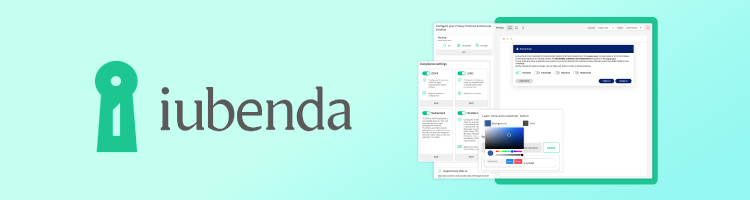
iubenda serves over 150,000 clients worldwide. It has very broad legal coverage with a lot of customization, and it’s backed by an international team of lawyers, which is crucial for businesses operating across regions.
Policies-wise, it supports GDPR, ePrivacy, CCPA/CPRA, LGPD, Switzerland’s FADP, and many more. It has geolocation-based consent adapting banners to user location, an auto-configuration wizard, automated site scanner, and rejection recovery prompts. All of these features simplify compliance while improving consent rates.
Agencies and larger teams benefit from extras like analytics, role-based access, and integrations with WordPress, Magento, and Zapier to keep compliance projects in sync. For bigger clients, there are also options like white-label branding, built-in accessibility, and ISO-certified hosting to meet stricter requirements.
The basics are quite affordable, with a free plan, and a $6.99 Essentials plan. The Advanced plan ($27.99) raises page view and language limits, while Ultimate ($119.99) unlocks DSAR handling, advanced analytics, and full white-label branding.
3. TermsFeed – zero-hassle compliance generator

| Best for: | Small businesses, ecommerce stores, app developers |
| Free trial: | Yes (free policies available) |
| Starting price: | $10 (one-time, policies), $10/month (Privacy Consent) |
| Top features: | Generous free tier, modular add-ons, one-time policy purchases |
TermsFeed works with legal experts to provide policy generators and free tools. Its core policies and clauses are convenient one-time purchases, unlike my other picks. It combines free starter policies with à la carte premium clauses, suiting small companies, ecommerce shops, and app developers needing quick coverage.
TermsFeed’s generators produce Privacy Policies, Terms & Conditions, Cookies Policies, Disclaimers, EULAs, and Refund Policies. Laws supported include GDPR, CCPA/CPRA, CalOPPA, PIPEDA, and more, meaning it's suitable even for international businesses. Additionally, TermsFeed has free perks like cookie pop-ups, “I Agree” checkboxes, and consent notices for embedded material. For those requiring more than just static policies, the Privacy Consent subscription manages cookies, scripts, and third-party embeds.
Free basics are available, while premium clauses range from $10 to $82, and stacking add-ons raises costs. TermsFeed’s Privacy Consent is available for $10/month, and beefs up compliance with advanced cookie and script management tools.
4. Enzuzo – best at scalable consent management

| Best for: | Agencies, growing businesses, multilingual websites |
| Free trial: | Yes (free plan) |
| Starting price: | $9/month |
| Top features: | Google CMP Gold, support for Microsoft Consent Mode, geo-fenced banners |
Some rivals keep premium features within Enterprise plans, but Enzuzo says it's a “one-stop shop for all things data privacy and compliance.” That's because it combines cookie consent management, auto-updating legal policies, and DSAR handling in one dashboard. The company says that, unlike simpler generators, its platform keeps policies current as laws change.
Enzuzo supports GDPR, CCPA/CPRA, PIPEDA, LGPD, and others, with cookie banners in over 24 languages. Highlight features include granular consent analytics to help improve opt-in rates, geofenced banners for region-specific compliance, and lightweight scripts for better site performance. Its multi-domain support and white-labeling benefit agencies, while its A/B testing, API access, and dedicated support benefit enterprises.
Regarding pricing, the free plan has basic policy, banner, and 3 DSARs/month. Paid plans start at Starter ($9/month), up to Growth ($29/month), Pro ($79/month), and Enterprise custom plans which unlock DSAR automation, advanced analytics, and dedicated support.
5. CookieYes – cookie compliance made simple

| Best for: | Blogs and personal sites, SMBs, high-traffic agencies |
| Free trial: | Yes (free plan) |
| Starting price: | $10/month |
| Top features: | Google-certified CMP, auto cookie blocking, 170+ languages with 40 auto-translations |
CookieYes is a Google-certified CMP used by over 1.5 million global businesses, checking against over 100,000 cookies, with customizable banners and automated scanning tools that update cookie lists.
It supports cookie/consent compliance under GDPR, CCPA/CPRA, PIPEDA, VCDPA, and other global laws, and blocks scripts like Google Analytics or Facebook Pixel until consent is given, with scans scheduled weekly or monthly. Its banners are impressive, as they come with branding, CSS, and are available in 170+ languages, with 40 built-in auto-translations.
It integrates with Google Tag Manager, Consent Mode V2, Microsoft UET, and IAB TCF v2.2 so that ad and analytics setups stay compliant. It also respects Global Privacy Control (GPC) and Do Not Track signals. Thus, it's ideal for US state law compliance.
Plans start at free, covering small sites (5,000 pageviews/month), Basic ($10/month) which adds pageviews and customization, Pro ($25/month), and Ultimate ($55/month) with unlimited pageviews, weekly scans, and branding removal.
How did we select the best privacy compliance tools?
To create as honest and realistic a review as possible on the best privacy compliance tools in 2026, the Cybernews research team and I spent weeks on market research, scanning official documentation, and digging through real-world customer feedback. Then, using the Cybernews in-house privacy testing process, I weighted the most critical factors to reflect how these platforms perform in real business scenarios:
- Pricing (30%). I searched for platforms with transparent pricing, meaningful free tiers or trials, and those providing scalability for businesses. I gave top points to platforms that manage to be both affordable and have broad coverage. Conversely, I avoided platforms with hidden fees or extremely restrictive entry plans.
- Features (30%). I made sure all of my chosen tools handle core global laws like GDPR, CCPA/CPRA, LGPD, and others. I also looked for advanced features like DSAR workflows, automated cookie scanning, consent analytics, and integrations with CMS or analytics.
- Scalability (25%). I considered how well platforms adapt – from freelancers running personal sites to agencies handling dozens of domains. Those supporting multi-domains, white-labeling, APIs, and enterprise traffic capacity scored highest.
- Customer satisfaction (15%). Verified customer reviews, onboarding ease, and vendor reputation were my focus here. Plus, if the platform also had dependable support, good uptime, and usable dashboards – it got max points.
What are privacy compliance tools?
Privacy compliance tools are software for organizations to satisfy global data protection laws like GDPR, CCPA/CPRA, LGPD, and PIPEDA. Manually, this process would take a large team of people, including lawyers – costing time and money. Instead, these tools automate that complex workflow, such as how personal data is handled day-to-day, and scaling compliance to businesses of any size. When regulators come knocking, these tools give organizations a structured way to respect user rights and prove accountability.
Privacy compliance tools have several features:
- Consent management: places banners to secure user approval before loading cookies or tracking scripts.
- Policy generators: produce Privacy Policies, Terms and Conditions, and Cookie Policies that adjust to evolving regulations.
- DSAR tools: streamline visitor requests to access or delete data.
- Data mapping: traces data flows across systems.
Plus, other common features include audit logs for keeping records and vendor risk management – ensuring third-party partners align with the same standards.
These tools can be confused with related solutions, so it’s important to distinguish them. Consent management platforms (CMPs) focus on banners and ad-tech integrations. Privacy management platforms (PMPs) provide enterprise-grade dashboards for risk and cross-border data. Vendor risk tools focus on third-party oversight. The difference is that privacy compliance tools can combine all of these functions into one.
Here’s an example: a personal blog only requires a consent banner, but a retailer might need DSAR workflows. A multinational company may use data mapping to track personal data globally. Ultimately, the goal is the same: to stay lawful, keep records, and stay transparent with visitors.
Main benefits of privacy compliance tools
Privacy compliance software has real-world benefits, like taking the manual labor out of compliance, and minimizing fines. Here’s a quick breakdown:
- Compliance and legal risk reduction: Software automates compliance and satisfies global privacy laws. This minimizes human error that opens the door to large fines or lawsuits. For example, a retail site avoids the EU’s steep GDPR penalties with consent banners on the site to block trackers until users accept cookies.
- Scalability and consistency: Compliance software applies modifications to privacy tasks across websites, apps, and global offices. For example, an international company can deploy consistent cookie policies across regions automatically.
- Audit readiness and evidence trails: Built-in logs and reports provide clear proof of compliance – simplifying audits. For example, a US-based dental clinic can instantly export HIPAA compliance records during a surprise regulatory inspection.
- Efficiency and cost savings: This software minimizes expensive legal help. For example, instead of paying an attorney, an EU-based e-commerce shop saves tens of thousands each year thanks to automated cookie consent updates for shifting GDPR regulations.
- Competitive and customer trust advantage: Transparent practices – like customizable consent banners – show commitment to user privacy. For example, a UK-based fintech app displays precisely how it uses transaction data and provides customers with a one-click opt-out of marketing – besting competitors who bury data sharing in fine print.
What to look for when choosing a privacy compliance tool
When it’s time to add a privacy compliance tool to your business inventory, the most important consideration is that it actually works for your business scenario. Here’s what you should consider:
- Regulation coverage. Your chosen compliance platform should support major privacy regulations like GDPR, HIPAA, CCPA/CPRA, LGPD, and others. It should also quickly update for new laws. Ask yourself if it covers the regulations relevant to your industry, and if it can handle region-specific nuances.
- DSAR flows. Handling requests shouldn’t be stressful – so look for automated intake, secure ID checks, a clear dashboard, and if it keeps up with volumes. Also check if it connects well with your CRM.
- Consent and cookie management. Go for a tool which can customize your cookie banners. Check if it’s easy to update consent settings, and if logs are regulator-ready.
- Data discovery and mapping. Look for tools that automatically scan for personal data and give you easy-to-understand maps of that data moving through your systems. Also check if it detects unstructured data and supports cloud/on-premise systems.
- Vendor risk management. Choose tools with pre-built questionnaires, automated risk scoring, and real-time vendor monitoring. Check if a tool consistently tracks vendor compliance, lets you tailor risk assessments, and smoothly onboards new partners.
- Reporting and audit dashboards. Pick regulator-friendly reports, real-time dashboards, and exportable audit logs. Also see if reports can easily adapt to your needs.
Best practices for using privacy compliance tools
It’s crucial that you know what the best practices are when using privacy compliance tools to extract the most value out of them – and remember, privacy is an ongoing process. Here’s what to consider:
- Start with internal readiness: get executive buy-in, assign roles, map current privacy maturity. Secure leadership support, assign responsibilities, and benchmark where your privacy program stands today.
- Pilot / phased rollout rather than “go-live everywhere”: Test the tool in one team or region, refine workflows, then scale once processes stabilize.
- Data inventory first, then module selection: Map all personal data across CRMs, cloud apps, and data stores. Use this inventory to prioritize modules like DSAR or consent management.
- Integration planning: Ensure smooth connections between privacy tools and your apps, CRMs, marketing, data stores to avoid silos or duplicate work.
- Train staff, set processes & SLAs: Provide training, establish clear workflows, and enforce SLAs so requests are handled on time – for example, like meeting DSAR deadlines under GDPR or CCPA.
- Monitor, audit, and iterate: Track performance metrics such as consent rates or DSAR turnaround, audit regularly, and adjust as laws or business needs evolve.
Conclusion
Privacy compliance tools are essential in today’s industry – protecting customer trust and minimizing regulatory risk for businesses. Privacy laws are holding strong and expanding worldwide – with fines into the billions now. As such, organizations of every size need a fast, economical, and error-free way to handle consent, policies, DSARs, and audits.
The smart move is to map your requirements – the laws that apply to your industry, the number of domains you manage, and if you need advanced features like DSAR automation or vendor risk checks.
I highly recommend you don’t commit blindly without testing out two or three platforms – such as Termly, iubenda, and TermsFeed – side by side first. Ultimately, the world of data privacy tends to shift and get more complex, so use this guide to help you find the right tool so your business aligns with the law, is efficient, and trusted by customers.
FAQ
Do all businesses need a privacy compliance tool?
Not all, but any organization handling significant personal data should consider a privacy compliance tool. Well-regarded privacy compliance tools like Termly reduce manual work and cut exposure to risk.
Are privacy compliance tools only for GDPR?
No, most support multiple laws like CCPA, LGPD, and HIPAA – which is crucial if the business operates outside of the EU.
Can a privacy compliance tool guarantee full compliance?
No, tools help, but policies and human oversight are still required to adapt to unique business practices and regulatory expectations.
Can these tools integrate with existing systems?
Yes, leading tools usually integrate with CRMs, HR, and cloud platforms – so it’s easier to centralize workflows and avoid silos.
Do small businesses benefit from these tools?
Yes, especially if they serve customers in regulated regions – since they save costs compared to hiring attorneys or data privacy consultants.