Your LinkedIn data will be fed to AI, but you can still stop it


LinkedIn will soon start feeding your profile, posts, and job applications into Microsoft’s AI training pipelines. But there’s a way to stop it.
Microsoft's LinkedIn has announced that, starting November 3rd, 2025, data from users in the European Union, European Economic Area, Switzerland, Canada, and Hong Kong will be shared with Microsoft and its affiliates to train AI models.
“Our GenAI features can help hirers find and reach you more easily, and assist members in creating content such as profile updates, messages, and posts,” the LinkedIn team explained in a privacy update notice.
Users will be opted in by default, although they can opt out. However, users who want to opt out should hurry up and do it before the deadline. While opt-out is still possible after November 3rd, any information shared on the platform up to that date will be used.
Microsoft is feeding user data to AI
Premium customers sued LinkedIn earlier this year, claiming the business-focused social media platform disclosed their private messages to third parties without permission to train generative artificial intelligence models.
According to a proposed class action filed on behalf of millions of LinkedIn Premium customers, LinkedIn quietly introduced a privacy setting last August that let users enable or disable sharing their personal data.Last year, the company denied having enabled user data sharing for AI purposes in the UK, the European Economic Area, and Switzerland.


LinkedIn has over one billion users worldwide, nearly a quarter of whom are based in the United States. In 2024, the platform generated $16.37 billion in revenue.
The current push aligns with Microsoft’s broader strategy of expanding its AI capabilities. Microsoft, which owns LinkedIn, has announced plans to invest about $80 billion in fiscal 2025 to build new data centers and increase computing capacity for training and deploying AI systems.
Have thoughts about this topic? Others do, too. Join them in the discussion.
The company confirmed that Word documents will now save to OneDrive by default, with Excel and PowerPoint soon to follow. In practice, it pushes vast amounts of personal and professional content into Microsoft’s cloud.
What exactly is LinkedIn scooping up to feed Microsoft’s generative AI?
If you wonder which data will be affected by the current privacy update, it’s pretty much everything you’ve ever put on your profile and all the interactions you’ve had. The data that is going to be used in training generative AI includes:
- Your name
- Photo
- Job history
- Education
- Skills
- Publications
- Patents
- Endorsements from colleagues
- Resumes
- Job applications
- Responses to recruiter screening questions
- Application details
- Posts
- Articles
- Poll responses
- Contributions
- Comments
- Group activity and messages
- Feedback and ratings
According to LinkedIn, private messages will not be used to train AI models.
How to block LinkedIn from training AI on your data?
1. Go to your LinkedIn profile, press under the photo, and in the dropdown select “Settings & Privacy”
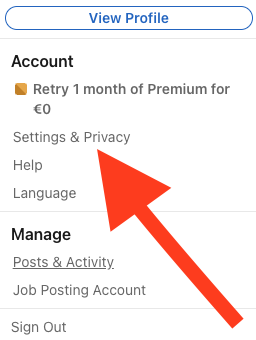
2. Pick “Data privacy” and then “Data for Generative AI improvement”
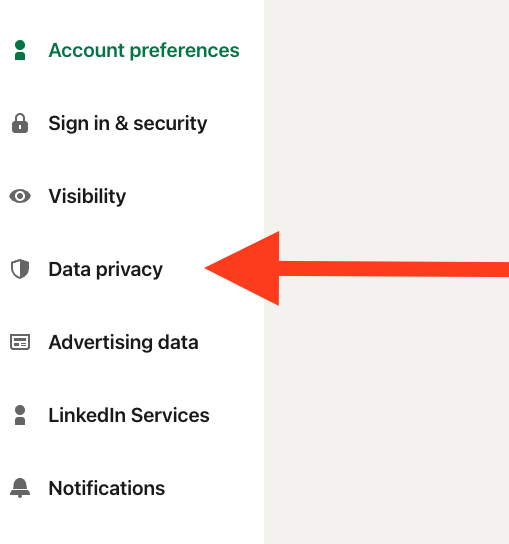
3. Toggle off “Use my data for training content creation AI models”

4. Then move to Data Processing Objection Form

5. In the dropdown, pick “Object to processing for training content-generating AI models,” tick a box saying “I object to LinkedIn using my personal data for the training of generative AI models that create content,” and press submit

Unlock more exclusive Cybernews content on YouTube.