The em dash dilemma – AI tell or human flourish?
Once a stylistic flourish, the em dash is now an AI tell, sparking debates on LinkedIn about authenticity and writing style.
Image by Cybernews

 Follow us
Once a stylistic flourish, the em dash is now an AI tell, sparking debates on LinkedIn about authenticity and writing style.
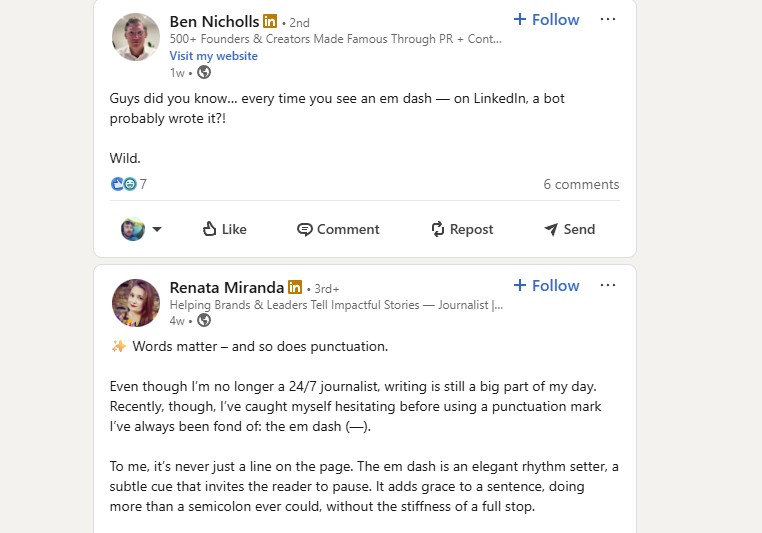
When scrolling my LinkedIn feed recently, a big chunk of the content was about punctuation – the em dash, to be exact.
Now, as someone who taught English for over 10 years, this topic is enticing. With the em dash (—) so ubiquitous in AI output and many writers claiming they’ve used the em dash for decades, it has opened the lid on a rousing debate.
Many are calling each other out on two fronts – one for the necessity of the en dash itself, and the other for the phony, or lazy use of generating AI slop for content.
Suddenly, a punctuation mark has become a test of authenticity online.



Writers are pausing before they type, not because of style guides, but because they don’t want to look like bots.
What started as a light-hearted matter now feels like a cultural panic across LinkedIn, Reddit, and X.
For the record, as you can see, Cybernews has long used the en dash. (–) We are humans, after all.
Why writers love the em dash
The em dash has been around since Shakespeare and is named as a mark that’s as wide as an “m.”
“To be, or not to be—to sleep, perchance to dream"Shakespeare's Hamlet
The function is to interrupt, emphasize, add an aside, or act as a breather – much as we might pause or deviate when someone asks our opinion on the coffee at Starbucks.
“Not the best coffee beans in my opinion — did I tell you I had a crush on the barrister there?
It echoes how we actually think in terms of bursts, pauses, and sudden detours.
The em dash can barge in mid-sentence, as opposed to the glue of a hyphen (brother-in-law) or to show a relationship between words like the traditional use of the en-dash (London–Paris).




When I read modern American novels, some writers have a penchant for sensory overload, and they pack em dashes in like sardines.
So, what’s supposed to be an organic device ends up suffocating the text with as many deviations as an episode of Family Guy.
A bigger irony, though, is that the em dash is not breathing and is being stripped of its credibility. Even if there are vehement defenders of its use, the attention of this elongated line has split us right down the middle.
If AI were taken out of the equation, it feels like a legitimate stylistic choice, though of course overuse can be annoying, especially since the onset of ChatGPT.
From flourish to “AI tell”
So, what was once a stylistic flourish is now being flagged as machine-like from all corners.
Readers spot an em dash in a text and flag it as fake news or AI immediately, without pausing to consider the writer's intention, such is our impatient attention spans in this age.
While some don’t hold back from copying and pasting away, they show more trepidation when using one of punctuation's most prized assets.
Digital transformation leader Ben White even wrote an “elegy” for the em dash, describing the hesitation he now feels before typing one.
“We find ourselves in a bizarre paradox. To prove we are human, we are being quietly encouraged to write less like a thoughtful, stylistically-aware human and more like someone who has flattened their language to avoid suspicion."
The sandpaper effect
Sanding down your voice to avoid suspicion is just as much a pity as littering LinkedIn with AI slop.
If your communication style is to use em dashes, as a flourish – then it’s a shame to be lambasted by snobbery – the AI debate is a different thing.
However, the list of suspect signs has grown from just the em dash. Semicolons, transitional words, and long clauses are rife in AI-generated content.
Punctuation on its own is a terrible way to spot AI – it’s like judging a dish from the side salad.
The real giveaways are clunky vocabulary, odd references, and writing that feels oddly flat – which LinkedIn is full of. Hello, listicles.
The em dash isn’t only a machine quirk – it’s just popular right now, as the debate rages on.
I personally gloss over bland and saturated content, not because of the em dash itself, but because it feels hollow.