Too easy: naturally biased AI chatbots change people’s politics with just a few messages
As modern large language models (LLMs) become integral to everyday tasks, concerns about their inherent biases and their impact on human decision-making have emerged. While biases in models are well-documented, less is known about how they influence human decisions. A new study says they definitely do – and quite easily, too.
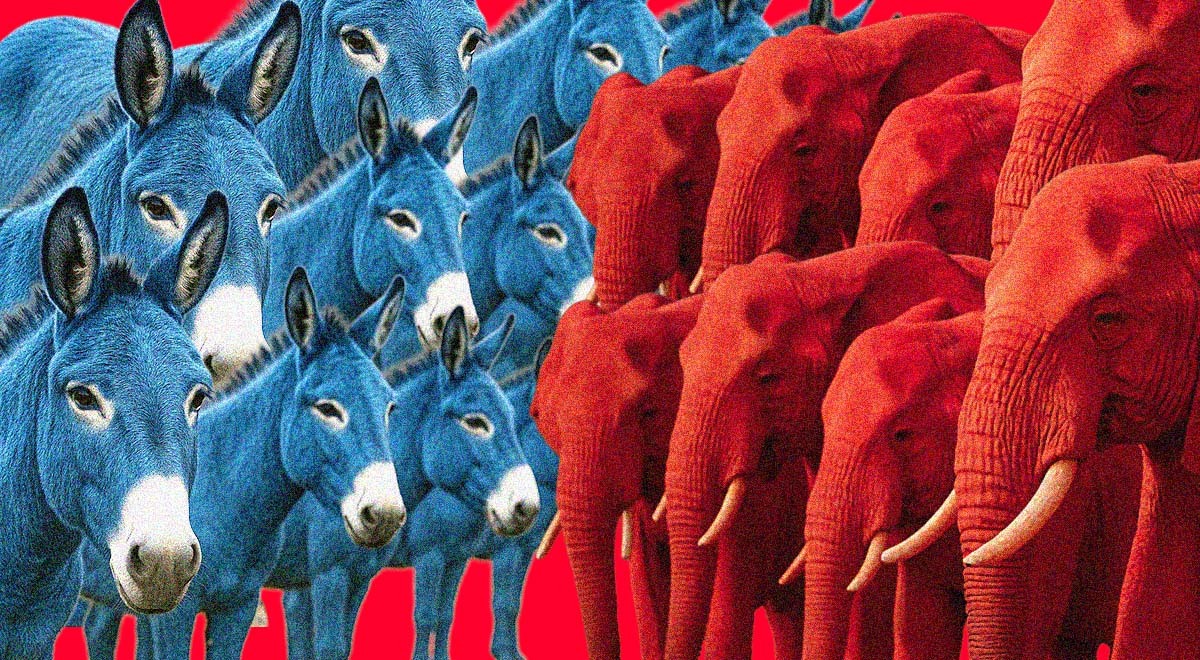
Image by Cybernews.

 Follow us
As modern large language models (LLMs) become integral to everyday tasks, concerns about their inherent biases and their impact on human decision-making have emerged. While biases in models are well-documented, less is known about how they influence human decisions. A new study says they definitely do – and quite easily, too.
By now, it’s pretty obvious that AI systems such as ChatGPT mirror human biases. Sure, they’re trained on gigantic sets of unruly data, but they’re refined through human instructions and testing – and every human is naturally biased.
Of course, AI biases can probably be reduced by carefully selecting the data used to train these systems. But the big hungry tech giants want big money, so they just gobble up everything they can.
Still, it’s less clear how a system’s biases can affect users and their beliefs. So, a University of Washington study tested this by unleashing biased chatbots on a group of Americans active in politics.





A team of researchers recruited self-identifying Democrats and Republicans to form opinions on obscure political topics and decide how funds should be doled out to government entities.




For help, participants were randomly assigned three versions of ChatGPT, which was chosen because of its ubiquity. They included a base model, one with liberal bias, and one with conservative bias.
Perhaps unsurprisingly, Democrats and Republicans were both more likely to lean in the direction of the biased chatbot they talked with than those who interacted with the base model. As an example, the lefties leaned further left after chatting with a liberal-biased bot.
“Even more surprising, this influence was seen when the model bias and personal political partisanship of the participant were opposite,” the study said.
“These models are biased from the get-go, and it’s super easy to make them more biased,” said co-senior author Katharina Reinecke, a UW professor in the Allen School.
“That gives any creator so much power. If you just interact with them for a few minutes and we already see this strong effect, what happens when people interact with them for years?”
However, the team also found that prior knowledge of AI was weakly correlated with a reduction of the impact of the bias, highlighting the possible importance of AI education for robust mitigation of bias effects.
In other words, knowing more about AI biases will make you less susceptible to generated manipulations.
Meredith Broussard’s book “More than a Glitch: Confronting Race, Gender, and Ability Bias in Tech” is a perfect intro to this topic, by the way.
Knowing more about AI biases will make you less susceptible to generated manipulations.
Broussard thinks we should be aware of grandiose and overblown statements about any rosy tech-enabled future or God-like chatbots. In the book, she cites a simple three-step method of bullshit detection, taught at the University of Washington.
The method involves three questions. Who is telling me this? How do they know it? What are they trying to sell me?