The silent watchers: how surveillance balloons are redefining intelligence in the sky
Surveillance balloons are making a comeback as a cost-effective, high-altitude solution for real-time intelligence and defense. From military spy missions to disaster monitoring, these silent sentinels offer unique advantages over satellites and drones, while also posing new security risks. Which countries will lead this emerging race?

By Cybernews.

 Follow us
Surveillance balloons are making a comeback as a cost-effective, high-altitude solution for real-time intelligence and defense. From military spy missions to disaster monitoring, these silent sentinels offer unique advantages over satellites and drones, while also posing new security risks. Which countries will lead this emerging race?
Surveillance balloons have gained more popularity in recent years as countries seek to optimize their spending on national security without compromising on the quality of reconnaissance.
Just last week, the United Kingdom announced that it had completed a series of trials on uncrewed, high-altitude surveillance balloons. The Ministry of Defence called these tests a significant advancement in long-duration, cost-effective intelligence, surveillance, and reconnaissance capabilities.
This June, reports showed that the Israel Defense Forces had previously started a top-secret spy balloon programme over Gaza. Its purpose was to fly over underground tunnel networks, map them, and collect information about Hamas command centers, weapons storage, and movement during attacks or before they begin.
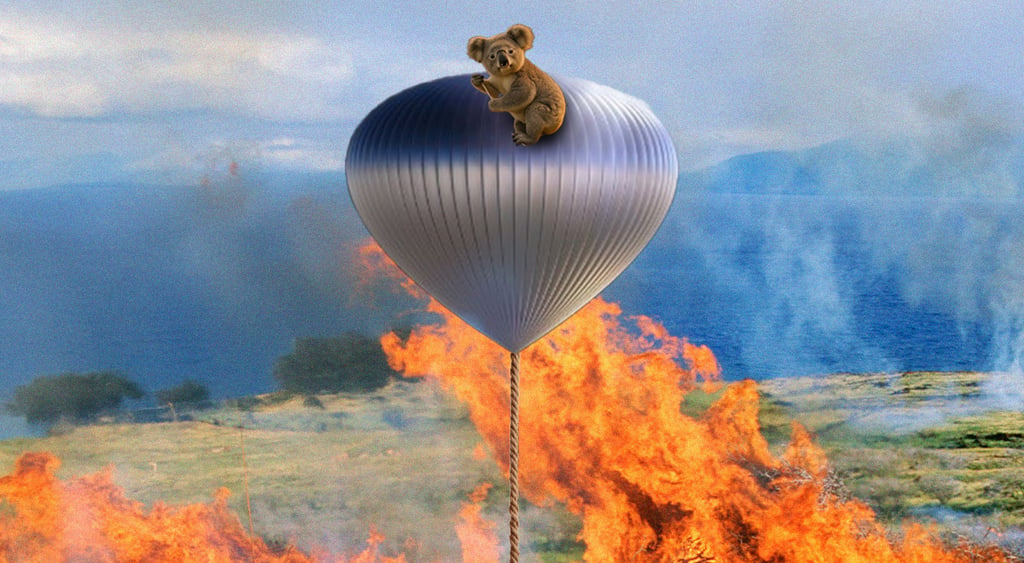
France, Italy, and Australia have also previously partnered with tech companies to use balloons, but in their case, it was to detect wildfires and monitor the climate, especially during extremely hot summers.






Cybernews spoke to Dr. David Stuckenberg, a former US Air Force combat pilot who has held several roles as a Pentagon security advisor. According to him, using balloons for surveillance and defence is now a trend and is “prototypical.”
“Their earliest use was during the US Civil War as observer posts. The new trend is expanding the use of balloons to deliver strategic effects such as a high-altitude electromagnetic pulse, directed energy, or chemical, biological, radiological, or nuclear agents of terror,” he said.
Surveillance balloons (or their load) can be world-ending. So far, the important thing to know is that using balloons a) makes a lot of tech and financial sense, and b) they can carry deadly weapons.
Below, you’ll find out the gruesome capabilities of this tech and an answer to the following question: why not use satellites or planes instead? Cybernews investigates.
Three reasons why countries turn to balloons and not other tech
Valentin Canales, Co-founder and Co-Chief Executive Officer at B2Space, a UK-based aerospace company, says that balloons' variety of uses and affordability make them an increasingly attractive choice for both military and civil stakeholders.
1. Balloons are cost-effective
The affordability of surveillance balloons is a critical advantage, especially for countries that seek quality intel without having to invest in satellites.
Compared to drones or planes with human pilots, which can cost millions, balloons tend to be more cost-effective.
“These balloons would cost in the tens of thousands of pounds,” said Canales.
“That means that you can launch hundreds or even thousands of them at a very competitive cost, reducing the operational cost dramatically.”
2. Balloons provide real-time surveillance with a focus on a specific region
Canales calls surveillance balloons “a perfect complement to both satellites and drones,” because they offer advantages over both.
For instance, satellites are ideal for global coverage, but they can only capture images when passing over a specific area. Because they were initially built to orbit around Earth, it limits their ability to be consistent with the footage they take. Unless, of course, a country has launched a few.
Drones, on the other hand, take high-resolution pictures and videos, but they heavily rely on battery life and the distance they have to fly.
“Balloons, however, float at 20 kilometers of altitude; they can cover very wide areas and provide very high-definition images or videos in real time,” said Canales.
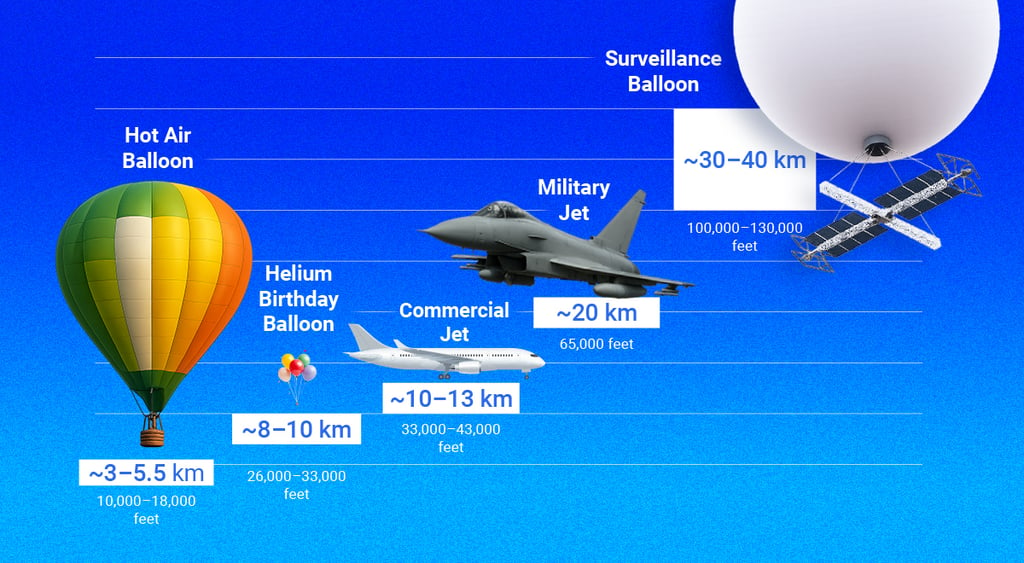
A good example is the US Army’s balloons, which were deployed over Tucson and Sierra Vista in Arizona just this June. One balloon remained in the same position for over a week, staying between 60,000 and 100,000 feet (18.3 -30.5 kilometers) in the air. During all that time, the balloon was taking pictures.
According to Canales, balloons can stay up in the air for weeks or even months.
Because balloons can function somewhere in between a satellite and a plane, they can also guarantee an important middle layer for collecting intel.
“So, we have an aerial layer – drones, helicopters, and small aircraft. Then we have the stratospheric layer with high-altitude balloons. And then the space layer with satellites,” said Canales.
“Using these three layers provides a richer set of information and data for both civil and military applications.”
3. Balloons guarantee better emergency response and civilian communications
Balloons are highly valuable in disaster-struck areas, either after a natural disaster caused by, let's say, hurricanes or after heavy shelling in cities during a war. That’s because balloons can operate regardless of what’s on the ground and can reestablish communications because they are not as high as a satellite and are more responsive to voice control signals. A balloon can also be launched much faster.
“In case of floods, for example, where the infrastructure is destroyed, these small balloons can be very quickly, very effectively deployed to provide communications,” said Canales.

“We’ve flown balloons in pilot projects to prevent disasters, such as detecting wildfires early using infrared sensors to spot heat anomalies.”
An example is the tragic West Mountain Complex fires in Idaho last August. At the time, the US Forest Service launched a high-altitude balloon with visual and infrared cameras and a special transmitter that could steer coverage toward moving fire, crews, and command posts.
As promised before, let's move on to the gruesome capabilities of what harm surveillance balloons can cause. Stay with us.
What can surveillance balloons carry, and what’s their potential harm?
While surveillance balloons may look physically harmless at first glance, their load should raise the most concerns. Defense balloons can carry around 150 kilograms, and that’s not for colorful confetti to be released into the air.
“Balloons can serve as innocuous delivery platforms for nearly any kind of weapon imaginable,” said Dr. David Stuckenberg.
“During WWII, Japan floated balloons over the United States and caused civilian casualties. Today, the tech is better.”

In the Second World War, Japan released around nine thousand Fu-Go balloon bombs that were intended to start forest fires but failed. However, they did manage to take six civilian lives. At the time, those balloons did not have onboard navigation tech or propulsion.
Fast forward to the present – modern surveillance balloons are autonomous, can be powered by solar energy, be steerable, and thus enable themselves to “station keep” over targets or hover precisely above desired targets to damage or spy on facilities.
Just last year, Chinese spy balloons – not in the thousands, but in the hundreds – were released to head over Taiwan, right before the country’s presidential election. Those balloons, equipped with surveillance equipment, were reportedly used to gather intelligence on military installations and disrupt communication networks.
According to Dr. Stuckenberg, surveillance balloons today can support far more than just traditional optical or communications equipment.

“Lofting a nuclear weapon in a balloon is not a stretch by any means,” Stuckenberg warns.
“In 2015, I wrote a peer-reviewed security paper… warning that obtuse actors can use balloons to deliver weapons of mass destruction easily and without attribution.”
That research was later cited by the US Congress in 2023 following the China balloon incident mentioned earlier. It explained how balloons could deliver high-altitude electromagnetic pulse attacks that could potentially bring down electrical infrastructure over wide areas.
One of the big problems here is that an attack like this is minimally traceable. Balloons can be launched from ships or remote terrain, thus hiding their origin. This blurs out the lines of accountability. At the same time, during a war, this “feature” is what makes high-altitude balloons a perfect means of “gray zone” warfare.

Gray zone warfare is military actions that do not qualify as an open conflict (no direct shooting or actions like that have been done), but it still inflicts damage or instability.
“Without the ability to attribute an attack, retaliation becomes difficult,” said Stuckenberg.
“If retaliation becomes difficult, deterrence breaks… As a result, balloons are considered a tool of gray zone warfare.”
Kind of like with damaging underwater cables.

Balloons that fool armies
Balloons can also act as decoys. Once they enter a country’s airspace, they trigger warning systems or distract air defense networks. In the meantime, more covert tools operate elsewhere.
Another delicate way in which balloons can harm air forces is through swarms. A large concentration of them could pose collision risks for aircraft and spacecraft. They can also be used to deny access to strategic facilities like airports or launchpads.
“Imagine balloons station-keeping or hovering over airports and Star Bases (launch facilities),” Stuckenberg noted.




“In aerospace terms, the risk of losing crew and vehicle is real. Deploying balloons can be very effective for area denial operations.”
What makes this possible is the fact that some balloons can be built to evade detection altogether. While balloons are generally easier to spot than stealth aircraft, new materials and coatings are being developed to reduce the chance of them being spotted by radars or to exploit gaps in the already existing radar coverage.
“A balloon’s size often relates to payload capacity. If a bigger payload can pose a bigger security threat, making a big balloon look small might make sense operationally,” concluded Stuckenberg.