Can Europe build a rival to SpaceX?
The continent’s aerospace giants, Airbus, Leonardo, and Thales, are partnering to create a “leading European player in space.” This aligns with Europe’s ambition of strategic autonomy and could challenge the dominance of US companies like SpaceX.
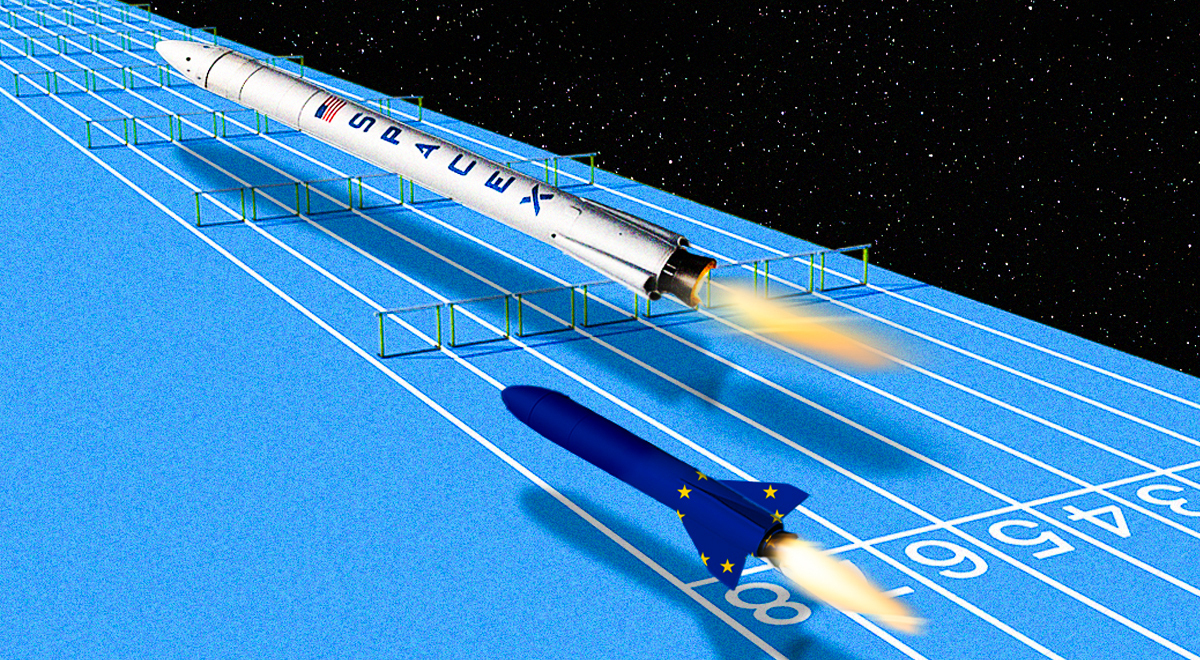
Image by Cybernews

 Follow us
The continent’s aerospace giants, Airbus, Leonardo, and Thales, are partnering to create a “leading European player in space.” This aligns with Europe’s ambition of strategic autonomy and could challenge the dominance of US companies like SpaceX.
- Airbus, Leonardo, and Thales will create a major European space company by 2027 to strengthen the EU’s independence from US firms like SpaceX.
- Geopolitical tensions and reliance on Starlink satellites have pushed European efforts to build homegrown space capabilities.
- Europe’s success depends on overcoming internal divisions and matching SpaceX’s scale and innovation, experts say.
Key Takeaways by nexos.ai, reviewed by Cybernews staff.
The three companies have announced plans to pool their resources and decades worth of know-how to build what could become Europe’s champion in space, ranging from satellites to systems manufacturing.
They said they expect to open the new company in 2027, subject to regulatory approvals. It would employ 25,000 people across the continent and have an annual turnover of about €6.5 billion ($7.55 billion), the companies said.
By comparison, SpaceX, currently the world’s leading private space company, employs some 13,000 people and is expected to record revenue of about $15.5 billion in 2025, according to its billionaire owner Elon Musk.












SpaceX also operates Starlink, the world’s largest satellite network, but experts say a European rival has the potential to quickly catch up, benefiting from the continent’s already strong aerospace industry.
“Europe’s strength lies in mobilizing a world-class ecosystem. There’s clear space in the market for a European competitor,” said John Schmidt, global aerospace and defence lead at Accenture, a consulting firm.
According to Schmidt, roughly 10% of the EU’s economic output depends on space-based navigation systems, which makes them a "strategic priority” for Europe’s wider space economy.
Europe “can lead at the frontier and be a serious competitor in the global market” through partnerships like this, which could help accelerate innovation and address remaining challenges such as high costs, talent shortages, and limited infrastructure, he said.
Can Europe overcome its own divisions?
With each European country promoting its own industrial “champions,” national rivalries limit cross-border funding and prevent mergers and acquisitions of some companies that national governments see as strategic, despite the EU technically being a single market.
“This is where the US has a real scale advantage,” said Guy Rozentsveig, managing director at Solomon Partners, the investment banking arm of Natixis, a subsidiary of Groupe BPCE, a major French banking group.
Rozentsveig, who advises companies in aerospace, said that Europe “has found it difficult to compete with the US space industry partially because of the protectionist nature of government budgets.”
However, joint initiatives like the proposed new space venture mitigate these protectionist instincts and may help it compete with SpaceX, whose largest contractor is the US government.
All three partners – the Netherlands-based multinational aircraft manufacturer Airbus, Italy’s aerospace and defence group Leonardo, and France’s Thales – have significant government ownership.
“There is no doubt that whatever European contracts SpaceX will be pursuing in the future, where governments have any say, SpaceX will find it increasingly difficult to compete with the new partnerships,” Rozentsveig said.
“Pivotal moment”
The goal of the new venture is not to necessarily take on SpaceX directly, but is rather part of Europe’s concerted efforts to reduce its dependence on foreign-owned companies in strategic markets in a world where it feels increasingly exposed.
“This partnership aligns with the ambitions of European governments to strengthen their industrial and technological assets, ensuring Europe’s autonomy across the strategic space domain and its many applications,” chief executives of Airbus, Leonardo, and Thales said in a joint statement.
The proposed new company marks “a pivotal milestone” for Europe’s space industry, they said. Europe’s relations with the US, one its closest allies, have entered a volatile territory following Donald Trump’s re-election as president, but its concerns about relying on American systems, particularly SpaceX’s Starlink, go back much further.
Both Trump and Joe Biden before him imposed restrictions on how American weapons can be used in the Ukraine war, leaving Europe painfully aware of just how vulnerable and dependent on the whims of foreign leaders it is.

Not much of a choice
The sense of urgency grew following reports that Elon Musk had interfered in Ukraine’s war efforts against Russia. The billionaire allegedly ordered Starlink to be disconnected for Ukrainian forces as they were pushing to regain territory in September 2022, disrupting their counteroffensive, according to Reuters.
This was despite the fact that Poland largely paid for the service on which Ukraine relied for critical communications. Separately, Musk reportedly ordered Starlink to be turned off over Crimea later that year to prevent Ukraine from attacking the Russian naval fleet.
This left Europe with no choice but to change gears, including an ambitious €10 billion ($11.6 billion) space program to build an alternative to Starlink.
“The growing political decoupling between European NATO members and the US, along with rapidly rising European defense budgets bring about a reality where European nations will inevitably want to spend more of their defense and space budgets at home in lieu of buying American,” Rozentsveig said.
Unlock more exclusive Cybernews content on YouTube.